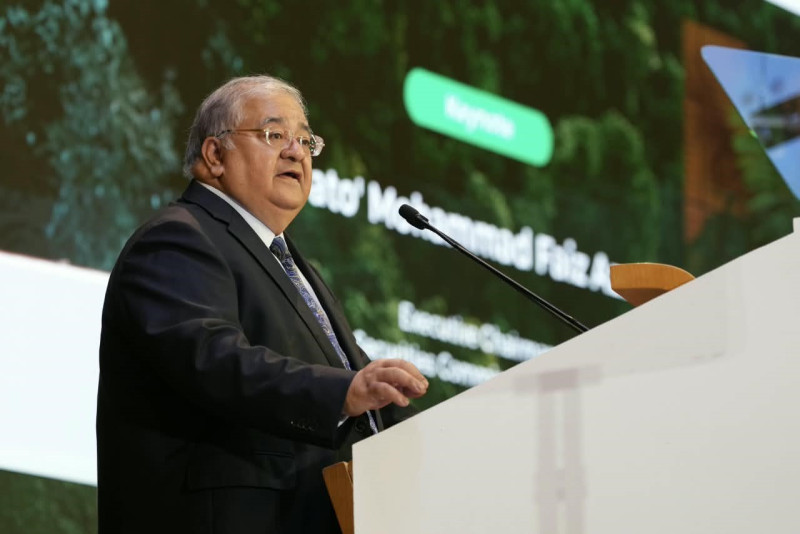
MALAYSIA could need between US$852 billion and US$1.1 trillion to adapt to climate change by 2050, Securities Commission Malaysia (SC) chairman Dato’ Mohammad Faiz Azmi said today.
He said the projected requirement was roughly equivalent to the size of Malaysia’s entire capital market, which currently stands at just over US$1 trillion.
“Estimates put Malaysia’s climate adaptation needs by 2050 at between US$852 billion and US$1.1 trillion. To put it in context, the entire Malaysian capital market size is just over US$1 trillion,” he said.
Faiz said the scale of the requirement was particularly challenging because adaptation projects often had limited commercial viability and marginal bankability, making it difficult to attract private capital.
“All this reinforces the message, that climate risk is not just an environmental issue but also a national and economic one. For government, regulators and market participants, it will need a considered response to the material threat this poses to our economic and financial stability,” he said.
He said the SC was therefore exploring new financing mechanisms to connect foreign and private capital with Malaysia’s climate adaptation and resilience priorities.
Among the initiatives is Sukuk Prisma, which is intended to provide another avenue for financing projects related to climate adaptation and resilience.
Faiz said tokenisation could also help reduce costs, improve efficiency and widen access to capital, noting that Malaysia’s first tokenised sukuk was launched by Khazanah Nasional Berhad in collaboration with the SC in April.
Under the Capital Market Masterplan 2026–2030, the SC’s sustainability pillar aims to mobilise RM90 billion to RM100 billion in financing over five years.
Faiz said stronger climate-related data would also be important in reassuring investors and supporting Malaysia’s attractiveness as a destination for foreign direct investment.
“We need to identify data that asset owners want to see to reassure them that investing in Malaysia is safe. The good news is that in international rankings, we are generally perceived as being quite resilient, ranking second after Singapore in ASEAN5. However, we need more data to prove it,” he said.
He said climate risks should increasingly be viewed as a factor affecting economic and financial stability rather than solely an environmental concern.
“The point to leave you with is that if financial statements are considered the ‘quarterly check-ups’ on the health of a company, then the sustainability disclosures are the stress tests that shows the company’s resilience and robustness in the future,” he said.
Faiz also called for economic growth to take account of environmental, social and governance considerations.
“My takeaway is that we all need to grow as all economies needs to grow. However, growth has to be measured. You cannot have growth for growth’s sake or at all costs, as you all have an obligation to the next generation, your children. Also, you must take into account the ESG factors as well to grow responsibly.” - September 28, 2026


.jpeg)