Business

Costa Rica president calls off IMF talks after protests

He invited political, business, trade union and academic sectors for talks on a potential economic solution

Updated 5 years ago · Published on 05 Oct 2020 11:54AM

Costa Rica president calls off IMF talks after protests
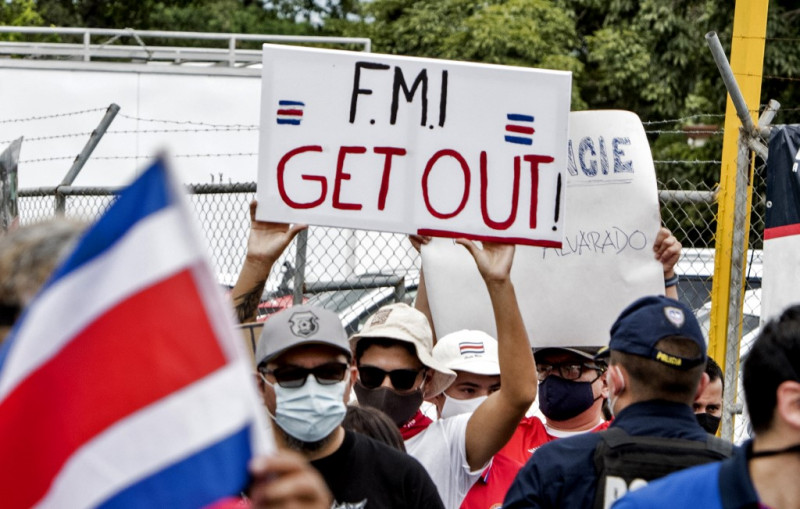
A man holds up a sign during a protest against the government's proposal to increase taxes to reach a credit agreement with the International Monetary Fund (IMF), outside the house of Costa Rican President Carlos Alvarado in San Jose, on September 20, 2020. – AFP pic, October 5, 2020

SAN JOSÉ – Costa Rican President Carlos Alvarado yesterday withdrew a negotiation proposal with the International Monetary Fund and called for a national dialogue after a wave of protests in the country.

He invited political, business, trade union and academic sectors for talks on a potential economic solution as the country struggles under a fiscal deficit that is projected to hit 9.7% of gross domestic product this year owing to the impact of the coronavirus.

"Today I call on the sectors that support the industrial channels to open a national dialogue to solve the economic emergency that the country is facing," Alvarado said in a speech broadcast on radio and television.

He added that, given public sentiment and "the need to take viable actions, the government will not go ahead with its proposal" of negotiation with IMF, which had been criticised by the opposition – the majority in Congress – for emphasising temporary taxes instead of cuts in public spending.

Alvarado's message came after the country was rocked by road blocks in several regions in protest at the IMF negotiations.

The protests, which began on Wednesday, turned violent in the past few days, and several police officers were injured while trying to lift the blockades.

Alvarado said he was withdrawing the negotiation proposal "for the purpose of dialogue and to balance the responses that the country needs to resolve the situation."

But he warned that the time for such a negotiation is "not unlimited."

"The worst thing is to do nothing, and only wait for a more severe crisis to hit us," Alvarado added. – AFP, October 5, 2020
Related News

Opinion / 3d

Massive attacks in the Thai Deep South aimed at destroying the economy

Malaysia / 6d

Malaysia records 6% GDP growth in Q2 despite global headwinds, says Sim

Malaysia / 1w

Six per cent growth proves Malaysia's economy remains resilient - PM

Opinion / 2w

LHDN’s uneven hand: Tough on MSMEs, soft on the shadows

Opinion / 3w

Lessons From Negeri Sembilan - Charles Santiago

Opinion / 3w

The last dredge

Spotlight

Malaysia

Elderly man admits to hitting neighbour with iron rod

Malaysia

Body found at KLIA2 in tyre storage compartment of aircraft from Japan

Malaysia

Factory operator faces rape, unnatural sex charges involving polytechnic student

Malaysia

Ismail Sabri granted RM300k bail after pleading not guilty to asset declaration charge

By Alfian Z.M. Tahir

Malaysia

Sunway Lagoon ride halted as safety probe seeks to protect public - DOSH

Malaysia

Malaysia ready to deploy military expertise for Nepal flood relief, says Defence Minister

Malaysia

Violence in Thailand: Visitors drop by almost 50 per cent

By Ian McIntyre

You may be interested

Business

Moves in major US stock indices could spill into currency and gold markets

By Alfian Z.M. Tahir

Business

Oil falls for fourth day as Hormuz supply fears ease

Business

Robo.ai Inc announces appointment of new independent director

By Alfian Z.M. Tahir

Business

K8 Cargo: Company still in limbo, claims CEO

Business

Asia-Pacific growth set to slow as tariffs, geopolitical risks raise economic pressure

Business

Oil slides as Iran-Oman Hormuz talks raise hopes of easing tensions