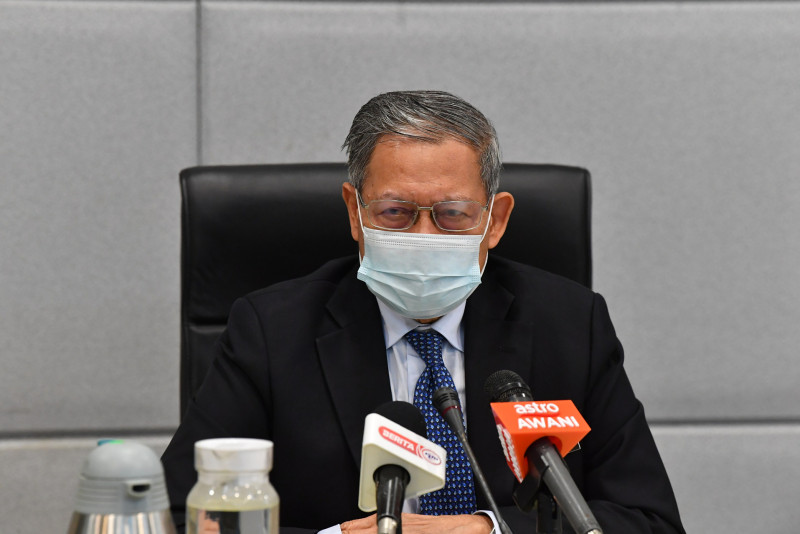
KUALA LUMPUR – The factor-driven growth that has served Malaysia well in the past, bringing it to the cusp of attaining high-income status, is not enough to carry the nation over the threshold, said Minister in the Prime Minister’s Department (Economy) Datuk Seri Mustapa Mohamed.
In his speech at the launch of the World Bank Flagship Report: Aiming High – Navigating the Next Stage of Malaysia’s Development today, he said factor-driven growth is becoming more costly to sustain, with every unit of input injected into the economy yielding lower gross domestic product growth.
“New sources of growth are needed to ensure that it is driven by multi-factor productivity. We need to build a workforce for the future, drive digitalisation, and spur productivity at the sector and enterprise levels.
“With this mind, Malaysia has strengthened its resolve to intensify the digitalisation journey that first began with the Multimedia Super Corridor, and (now), the Malaysia Digital Economy Blueprint launched by the prime minister on February 19.”
The country has a strong trajectory, he said, experiencing solid growth in recent decades that resulted in a transformation of the national economy and sustained improvements in living standards.
The Covid-19 pandemic, however, has interrupted this progress, but the goal to become a high-income and developed economy, and one that embraces shared prosperity, remains, he said.
“Despite the economy recording a significant contraction of 5.6% in 2020, this year, it is expected to improve in line with the vaccine roll-out and reopening of most economic sectors.
“Malaysia’s economy recorded a steady growth of 6.1% in the period from 1971 to 2019, despite facing five economic downturns since 1970. The country has been able to rebound quickly after each crisis due to its economic resilience and competitiveness.”
Mustapa noted that the current economic crisis is unprecedented as it started off as a health disaster, adding that it is the worst downturn since the Great Depression.
The government is focusing on efforts to overcome the pandemic and revive the economy, he said, and it also needs to make long-term development plans.
He said moving forward, addressing poverty and income inequality is among Malaysia’s key development agendas.
Based on the Household Income and Basic Amenities Survey Report 2019, the Gini coefficient increased from 0.39 in 2016 to 0.41 in 2019.
In addition, the income gap between regions and states has widened, as is the case between and within races, said Mustapa.
“While we have done well in the past, there is certainly a lot more that needs to be done.
“To accelerate balanced and inclusive development, regional economic potential will be optimised and rural areas will be transformed to bridge the development gap.
“Strategic collaboration and coordination between the federal and state governments will be strengthened to support effective regional development planning and implementation.”
He said the challenge now is to find ways to do things differently, creatively and innovatively, emphasising the need to learn from experience and overcome shortcomings, as well as take into account other countries’ best practices. – Bernama, March 16, 2021