Business

Myanmar junta takes responsibility for economic crisis

Local currency kyat has lost over 60% its value since beginning of the month, driving up food, fuel prices

Updated 5 years ago · Published on 30 Sep 2021 11:30PM

Myanmar junta takes responsibility for economic crisis
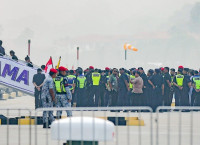
The World Bank predicts that the Myanmar economy will slump 18% this year, and the country will see Southeast Asia’s biggest contraction in employment. – Reuters pic, September 30, 2021

YANGON – Myanmar’s ongoing economic problems were caused by “outside factors” and two waves of Covid-19 infections, but the military government takes full responsibility and is working hard to address them, said a spokesman today.

Speaking after the kyat hit new lows this week, the ruling military council’s spokesman Zaw Min Tun said the central bank has been unable to meet local demand for dollars.

Myanmar’s currency has lost more than 60% of its value since the beginning of the month, driving up food and fuel prices in an economy that has tanked since a February 1 coup by the junta.

“The government is working its best to solve this situation as best as possible,” Zaw Min Tun told a regular news conference.

“As it happened under this government, the current government will have to take responsibility.”

Many gold shops and money exchanges have closed in the country due to the turmoil, while the slumping kyat has been a hot topic on social media networks, where users today posted images of panic-buying of fuel, or gas stations closing due to shortages.

The rising prices of goods including fuel have posed major challenges to previous military governments in Myanmar, with the cost of cooking gas among the triggers of the monk-led “Saffron Revolution” in 2007.

Zaw Min Tun said the economy has worsened due to outside factors, as well as the coronavirus, but did not specify the said factors.

“We have the responsibility to build it back,” he said of the economy.

The World Bank on Monday predicted that the Myanmar economy will slump 18% this year, and the country will see Southeast Asia’s biggest contraction in employment.

Last month, the Central Bank of Myanmar tried tethering the kyat 0.8% either side of its reference rate against the dollar, but abandoned the effort earlier this month as pressure on the exchange rate mounted. –Reuters, September 30, 2021


Related News

Business / 3d

Pengerang needs to create wider economic value, not just store more oil, says expert

Malaysia / 6d

Santiago demands answers over Malaysia’s bid to bring Myanmar back into Asean

Business / 3w

Energy disruptions - a timely reminder that energy, economic security are interconnected - Minister

Malaysia / 1mth

Malaysia’s K-shaped economy: Growth without shared prosperity?

World / 1mth

Bangkok floods: The real pain starts when waters recede

Malaysia / 1mth

Mixed reactions as 1,476 Myanmar nationals sent home

Spotlight

Malaysia

Disputed Sungei Ujong Undang to face sedition charge tomorrow

Malaysia

Cabinet to weigh US tariff threat as Malaysia defends 19% trade ceiling

Malaysia

Announcement on Negeri MB will come from Istana – Ahmad Zahid

Malaysia

Inspector Sheila challenges police dismissal over alleged denial of fair hearing

Malaysia

Drug syndicate moved 3 tonnes of syabu worth RM156m through RMAF bases in Sabah

Malaysia

Fire destroys 90 per cent of Putrajaya apartment unit

Malaysia

Govt studying age restrictions, verification measures for online gaming platforms

Malaysia

40,214 cyberbullying-related posts removed as MCMC steps up child safety enforcement

You may be interested

Business

South Korean robotic parking company explores opportunities in Malaysia

By Ian McIntyre

Business

Matrix Concepts founder honoured as FIABCI Malaysia Property Man of the Year 2026

Business

SMEs face higher costs as LHDN stamp duty interpretation covers purchase orders, quotations

Business

MAG to add 10 Boeing Dreamliners in long-term fleet expansion drive

Business

Ringgit slides as oil rebounds against renewed Middle East supply threats

Business

Oil prices rebound on Middle East supply fears