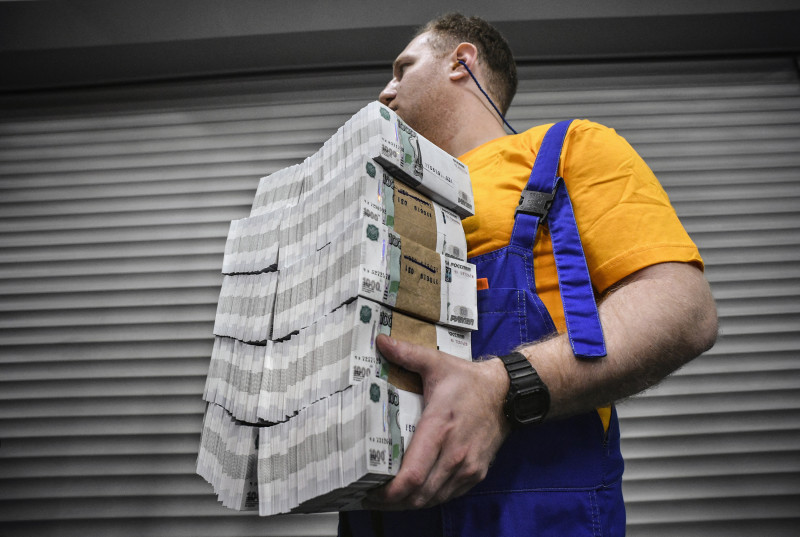
MOSCOW – After a historic collapse in the wake of Russia’s military offensive in Ukraine, the ruble has staged a spectacular bounceback, supported by strict capital controls and energy exports.
But analysts say that success is in many ways artificial and does not bode well for the health of the Russian economy.
The February 24 military operation triggered unprecedented Western sanctions on Moscow, sending the ruble into free-fall and accelerating already high inflation.
Four days after President Vladimir Putin sent troops into the pro-Western country, the central bank more than doubled its key interest rate to 20% to prop up the financial system.
In a surprise move yesterday, the central bank lowered the rate to 17%, saying risks to financial stability had “ceased to increase” for now.
“It’s clear that the Central Bank of Russia assesses that Russia’s economy is now emerging from the most acute phase of its crisis and that such restrictive monetary conditions are no longer warranted,” said Liam Peach, emerging Europe economist at Capital Economics.
The ruble’s return to levels last seen before the start of Moscow’s military campaign is a sign that the economy may be adjusting to the sanctions, economists say.
Sofya Donets, chief economist at Renaissance Capital, said the ruble recovery has been aided by an unprecedented trade surplus amid high energy prices.
“There has been a decline in imports, partly because of sanctions, partly because of uncertainty and logistical disruptions,” she said.
“But exports are solid, and with commodity prices high we expect a historically high account surplus of US$20 billion (RM84.4 billion) to US$25 billion in March.”
Oil and gas, Russia’s main exports, keep flowing abroad, filling Russia’s coffers.
The United States has banned Russian oil imports and the EU adopted a ban on Russian steel imports but those penalties have largely spared key Russian exports.
“It only affects 5% of Russian exports, so it’s not that much,” said Donets.
Robust exports have been supplemented by harsh capital controls introduced by the central bank.
The West froze some US$300 billion of Russia’s foreign currency reserves abroad, a move that Foreign Minister Sergei Lavrov has described as “theft”.
To counter the sanctions, exporting companies were forced to sell 80% of their export earnings to buy rubles.
Russians have also been barred from withdrawing more than US$10,000 in foreign currency or taking more than that amount out of the country, and foreign investors have been banned from selling Russian assets.
Late Friday the central bank relaxed some curbs, saying that from April 18 it was scrapping the ban on buying dollars and euros introduced in early March. – AFP, April 9, 2022