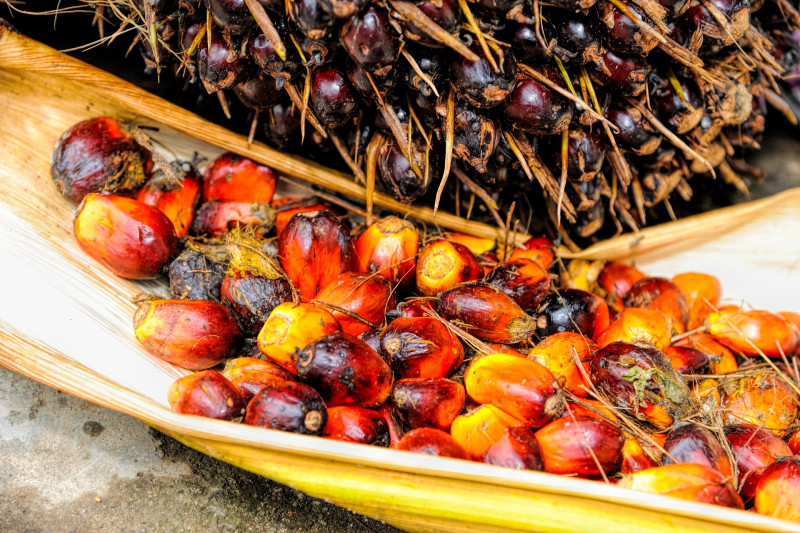
KUALA LUMPUR – The Malaysian oil palm industry saw a brighter performance this year, which may continue into 2023, supported by stronger demand for the commodity, the Malaysian Palm Oil Board (MPOB) said.
Director-general Datuk Ahmad Parveez Ghulam Kadir said the ongoing Russia-Ukraine conflict has disrupted the sunflower oil supply chain globally, causing a surge in the demand for palm oil as a replacement for sunflower oil.
The rising prices of soybean oil and Brent crude oil in the world market are also contributing factors that may impact the performance of palm oil, he said.
“As such, we expect the price of crude palm oil (CPO) to average at RM5,100 a tonne for this year, 15.7% higher than RM4,407.00 a tonne in 2021,” he said in a statement today.
The average CPO price for January-November 2022 was RM5,167 a tonne, an increase of 18.4% from RM4,363 a tonne in the same period in 2021.
CPO prices saw a decline at the beginning of the third quarter of this year due to high production season, rising palm oil stocks, and declining soybean oil prices.
Hence, MPOB said, it foresees the CPO price will stabilise and average at RM3,800 a tonne in 2023.
This is in anticipation of higher palm oil production, improvement in weather conditions especially in the second half of next year, and expectation of higher availability of supply of other major vegetable oils.
Meanwhile, soybean oil prices, expected to be low due to high production in Brazil and the United States, may also impact the CPO price.
“Additionally, the strengthening of the ringgit against the US dollar may also affect the price of the CPO,” Parveez said.
He said Malaysia’s ratification of the Comprehensive and Progressive Agreement for Trans-Pacific Partnership (CPTPP) will encourage demand for palm oil products, as it broadens the country’s access to new markets such as Canada, Mexico, and Peru, which are not covered by any existing free trade agreements.
Based on the cost-benefit analysis of the potential impacts of the CPTPP, upon its ratification and implementation, tariffs for palm oil products are now reduced from a maximum of 6% for Canada, 5% for Mexico, and 9% for Peru to lower tariffs based on the tariff elimination schedule.
Apart from higher palm oil exports to the markets, the elimination of tariffs improves the competitiveness of Malaysian palm oil in the CPTPP member countries.
Exports of palm oil rose slightly by 0.8% to 14.25 million tonnes in January-November 2022, compared with 14.14 million tonnes in the previous corresponding period.
As such, palm oil export revenue surged 31% to RM80.22 billion from RM61.26 billion in the same period in 2021.
Parveez also said that CPO production is expected to increase slightly by 2.1% to 18.50 million tonnes this year from 18.12 million tonnes in 2021.
“We expect a slow recovery in palm oil production due to the labour shortage issue in oil palm plantations, especially for fresh fruit bunch (FFB) harvesting and unloading activities.
“CPO production is projected to further increase to 19 million tonnes in 2023 due to the expected increase in productive areas, especially in Peninsular Malaysia and Sarawak,” he said.
Additionally, the workforce situation may stabilise next year as migrant worker applications are being approved in stages.
CPO production for January-November 2022 stood at 16.83 million tonnes compared with 16.67 million tonnes achieved in the same period in 2021, attributed to an increase in processed FFB to 86.51 million tonnes in January-November 2022 compared with 84.17 million tonnes in the same period last year.
“In anticipation of higher production, we expect the closing stocks of palm oil in 2022 at 1.85 million tonnes, up 0.24 million tonnes or 14.9% from 1.61 million tonnes in December 2021,” he said.
According to Parveez, palm oil closing stocks are projected at two million tonnes in 2023, higher than that in 2022, due to the expected higher supplies of other major vegetable oils including palm oil. – Bernama, December 30, 2022