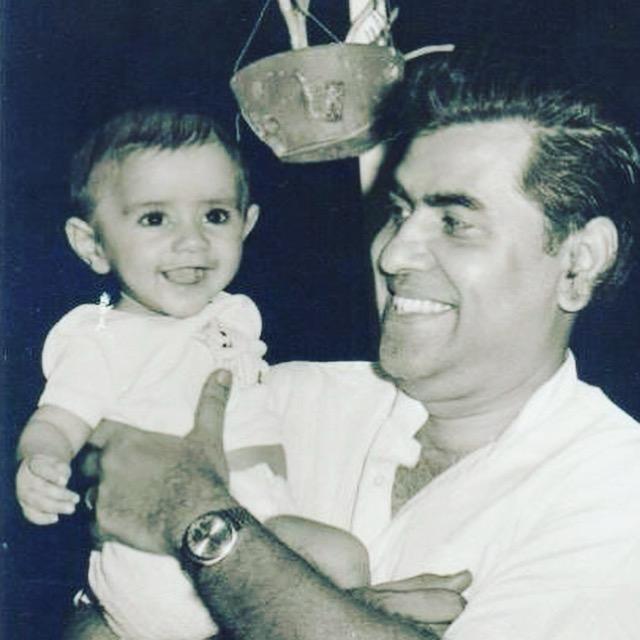
SEPTEMBER, 19 years ago I lost the most influential and inspirational person in my life. He was not only my father, but a best friend. Losing him changed my life and a day doesn't go by that he isn't on my mind or in my heart.
With all that has happened in our country recently and continues to happen, it's now critical we remember people like my dad who were nation builders.
And there were many like him, who we as a nation have chosen to forget - to our detriment. We need to remember them if we are to overcome the obstacles and spectacles in our way.
We need to be inspired to stand and push ahead. It was Malaysians of all races that ensured its success and survival.
This is not a country for or of just a single race or religion. She is a nation of Malaysians, for all Malaysians.
The choices we make every day, are critical as to the identity of our nation. As I see it, we have two choices - fear and hate, or hope and acceptance. We must choose well or risk losing our nation's soul.
What is the point of having a mobile phone if you don’t use it!
As I have done yearly, allow me to share again with you what I wrote right after my father’s death.
I received a call from my dad. Well actually – it was the second call, as I had missed his first. He left me the usual message he normally does when I don’t pick up – “Idiot! This is your father. What is the point of having a mobile phone if you don’t use it! Call me.”
We all knew that ‘Idiot’ was only reserved for those he loved. Of course, when I tried to reach him in Chennai – he had already left for Mumbai.
When we finally spoke – he was excited about some breakthroughs he felt he was making with a few of his innovations.
He had misplaced some numbers of friends in Mumbai, and he wanted me to get them for him. I promptly did – and according to mum – he met up with them over the weekend and had some very positive and successful discussions.
Little did I know that 15 minute chat earlier on Friday would be the last time I would ever speak to my daddy again.
I remember talking to him about the Forbes Global CEO Conference being held in Singapore, that I was participating in the following week.
We briefly talked about Malaysian politics, and about St Vincent and the Grenadines (SVG), and then Cuba. He had become very fond of the Prime Minister of SVG, Dr Ralph Gonsalves and thought he was a good man.
And he wanted to meet Fidel Catro. “Maybe I’ll take Mummy before our anniversary”, he told me. “With my grandchildren.”
His grandchildren were the bright stars in his universe. They loved him, and he loved them. He had just spent three weeks with the five elder portion of his eight grandkids, which included my daughter Petra.
They had travelled all over the southwest of India. In cars, in trains – visiting the villages of his ancestors, and all his relatives. Petra and Dad had become very close in recent months, and she had come to view him as her buddy, not just Papa.
He taught her how to play gin rummy, he encouraged her in using her imagination when she draws, and he inspired her to be as creative as she could be in everything she did.
On Wednesday, September 6 – while I was having breakfast in Singapore, I got a phone call that started the worse day of my life.
He’s gone
It was a simple statement to me from my eldest brother. “He’s gone.” My mother came on the line right after in tears, “They’ve made a mistake. Vinod, you go and fix this. You can fix this. Go there and bring him home. They must have made a mistake……”.
On the morning of September 6, 2006, Tan Sri Dr. B.C. Sekhar died of a massive, silent, cardiac arrest.
We were told it was over in less than 40 minutes. My youngest daughter, Tara, still asks occasionally, “When is Papa coming back, I want to go see him?”
As a five-year-old she did not understand death. After all, if Papa has gone to see God, he must come back at some stage.
At the funeral, she wanted to be allowed to kiss him. In the past, every time her Papa slept, all she had to do was kiss him to wake him up.
My little five-year-old was convinced she could wake him up. It was remarkable to see how much of an impact he had on all his grandchildren, and how much they loved him.
I am writing this, because a very dear friend told me that writing about my father may help me with this constant pain within.
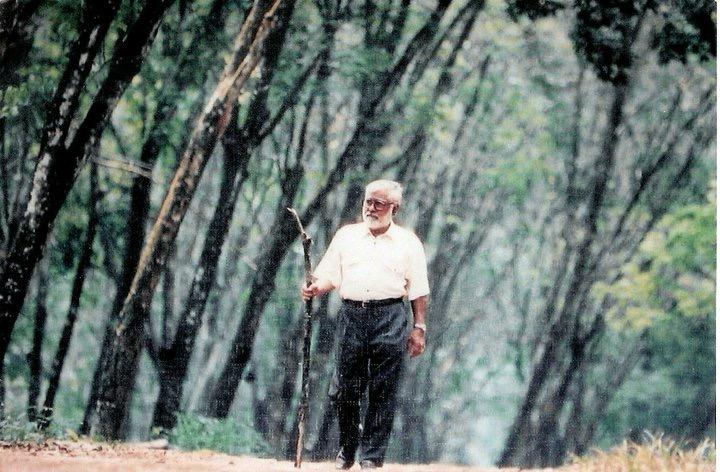
So let me tell you a little more about him. Balachandra Chakkingal Sekhar or Unni as he was affectionately called, was born on November 17, 1929, in the Ulu Bulu Estate, about four miles from the 3,400 acre RRI Experimental Station.
He joined the Rubber Research Institute as a chemist by chance. He went looking for a job, although they said there was none on offer.
So impressed was the English man who spoke to him, that B.C.Sekhar was offered a job. In 1964 he became the Head of the Chemistry division, and then in 1966, he created history by becoming the first Asian Director of Research. It was front page news when it was announced. And of course, as everyone knows, he rose to become the first Asian Chairman and Controller of Research.
At his peak, he led an industry that accounted for about 70% of the GDP of Malaysia. He had also developed a research organisation that was held as the most respected Rubber Research Institute in the world.
Along the way he founded PORIM (Palm Oil Research Institute of Malaysia), now known as MPOB, the Malaysian Palm Oil Board (starting with two employees, and now several thousand – he led this organisation for a decade creating a world class research institute in the process), RISDA (the Rubber Industry Small Holders Development Authority), MARDEC (the Malaysian Rubber Development Corporation), Malaysian Carbon and played a role in the creation of Petronas (the national oil company) and the Malaysian International Shipping Corporation (MISC) of which he was a founding director.
The list goes on and on. When he was made a Tan Sri, he was one of the youngest recipients. Soon after he would decline offers of a Knighthood from the British government. His reasoning was simple and straightforward, “How can I as a Malaysian Lord (Tan Sri), be beholden to a foreign Queen”. His principles just wouldn’t allow it.
Take a train
His integrity was legendary. I remember once asking if his official car in the UK (he was Chairman of the Tun Abdul Razak Research Centre in Hertford), could fetch me from school to take me to the airport at the end of term.
He said “No!” without hesitation. The car is an official car and only for official business. “Unless I am in the car with you, it cannot be used. Take a train.”
And if he was in the country at the time, he would be waiting for me at the train station in a cab.
Again, he didn’t approve of the government car and driver being used to ferry his son – even with him in it.
Growing up, my father was always there for me. It didn’t matter what I did, or how badly I screwed up – I always knew that he would protect me, that he would forgive me.
I grew up with more love than any individual ought to be blessed with. We were very similar in temperament and ideas, and that probably explains why we were so close and why we fought many times about all sorts of silly things. But it was always short lived and over before you knew it.
He loved golf, he loved gadgets, he loved cooking, and he loved life. When he smiled, he would light up an entire room.
His presence commanded attention, and everyone always gravitated, quite naturally, to him.
He was as comfortable with Kings and Prime Ministers, as he was with plantation workers and clerks.
A former union leader recounted a conversation with him during the wage negotiations.
He recalls my father saying, “I’ll take care of the tree, you take care of the man under the tree. But always remember, if there is no tree, there will be no man under it.”
The union leader then added, “In the end, as was his style, he took care of both.”
A truly Malaysian funeral
You never really know what people think of you or your contributions until you’re no more. From the thousand odd people that came on the day of the funeral, the day after he died, I know what people thought of my father.
My family was overwhelmed by the grief and love that was shared with us, by so many people.
It was truly Malaysian. All races, all religions. At one point, an old friend of my father who had become a Hare Krishna devotee asked my mum if he could pray for my Dad by his coffin, as he did, another old friend who had arrived came and recited verses from the Quran, and speaking to my mother at that same moment was a lady who had become an evangelical Christian.
I remember just staring at this moment, this picture. None of them had any issues with what the other was doing.
They were united in grief, and in the belief that there is a far greater power in this universe that dictates everything, and loves everything.
It reminded me of the prayer alter in the house I grew up in. On it, my dad had placed among our Hindu deities, a verse from the Holy Quran, a Crucifix and a Buddha.
“There is only one Supreme Being,” he would tell me, “Call him what you like”.
Even in death my father was sending everyone a message.
“Good guys always win,” he constantly advised, “It may hurt a bit, and take longer, but in the end, good guys always win.”
With his death I have realised that everything I have tried to achieve has been to make him proud.
I was only interested in scaling whatever heights I needed to, just so that I could go to him and talk about it.
It all seems unimportant to me now. I’ve lost my compass in life, and when I find it again, I imagine it will be broken.
But I will try to find it and fix it, as my Dad would expect nothing less. From leading an organisation that held sway over tens of billions of dollars of income for Malaysia, he retired as a normal pensioner.
No big directorships, no big cash hoard in banks, no private businesses. But he had what he felt were more important than anything, the love of his family, the respect of his peers and his integrity.
The government of the time has a lot to answer for in relation to how they treat Malaysia’s great sons.
Tun Daim Zainuddin has a lot to answer for. But in the end, my father held a grudge against no one.
He was from a generation that believed that service to the nation was an honour, and to serve was reward enough.
A towering Malaysia
His was the era of Tunku Abdul Rahman, Tun Dr Ismail Abdul Rahman and Tun Abdul Razak Hussein.
He was a proud Malaysian who was a patriot and a nationalist. Malaysia had in him, a global scientific icon who was a ‘Towering Malaysian’ before they started using that term.
A man, who right to the last day of his life was creating, inventing and developing technologies and ideas to make life better, not just for the poorest among us, but for all of us.
And incredibly, never expecting or needing to be rewarded nor remembered for it.
A friend mentioned to me that he had overheard someone at the funeral saying, “Vinod Sekhar is half the man his father was.” I suppose it was meant as a slight.
All I can say is that, if at the end of my life I truly do achieve half what my father has – then I will die a very happy, and incredibly successful man.
I am nowhere near half now, but I suppose it is something I can aspire for. I realise I am blessed. I am blessed for being born his son, and for having the mother I have.
I am only now appreciating the dignity and incredible strength she possesses. I only now, truly realise what a partner, in every sense of the word, she was to my father.
My last words to my father were, “I love you daddy”, and his to me were, “I love you too.” I can ask for no better last words.
I hope that I eventually grow to become the kind of man and son my father would have been proud of.
I hope I have the strength of character to maintain the kind of integrity he had. I hope that one day, my daughters can be as proud of their father as I am of mine.
But talk is cheap. “It is what you do that counts, and your most important audience should be your mirror”.
My dad took the road less traveled, and looking at the state our world is in now, maybe we all should follow. - May 8, 2025
Datuk Dr Vinod Sekhar is the publisher of the Vibes and Chairman of the Petra Group