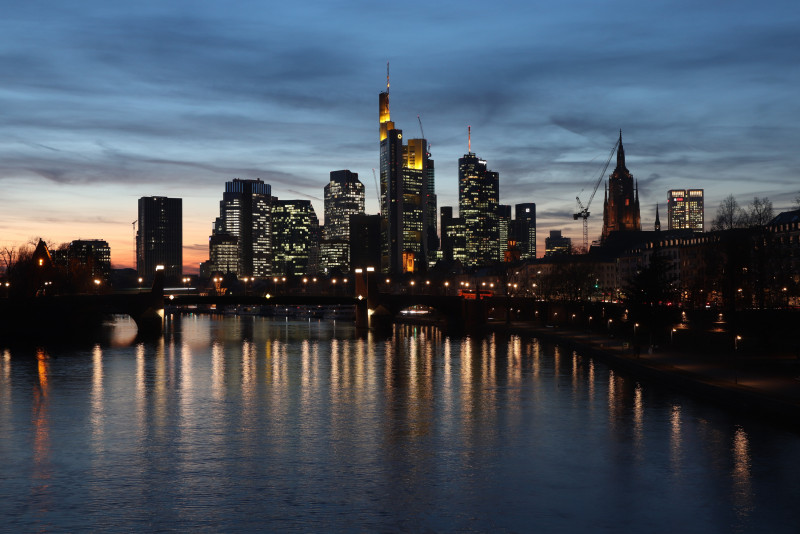
FRANKFURT AM MAIN – Hubertus Vaeth was considered crazy when he launched a Frankfurt initiative to lure banks there after Brexit.
“Are you nuts? What did you smoke?” his critics asked, according to the managing director of Frankurt Main Finance (FMF) in an interview with AFP.
No one is laughing now.
More than four years after the vote that took Britain out of the European Union, Frankfurt is emerging the winner among EU financial capitals in attracting London’s much-coveted banking business, ahead of Paris, Milan and Amsterdam.
The Bundesbank estimates that non-German banks could move €675 billion (RM3.3 billion) to Europe’s largest economy.
That is just over half the total amount of assets – €1.3 trillion – that the European Central Bank (ECB) had estimated would be transferred to the eurozone from Britain ahead of Brexit.
Since the vote, banking giants Morgan Stanley, JP Morgan and Goldman Sachs have said they will shift more than €350 billion in combined assets from London to Germany.
Over 60 international banks have also signed up with German financial regulator BaFin.
Brexit, as Vaeth said, marks an “opportunity to turn the tide” of “30 years of continuously losing business to London”.
‘New London Bridge’
Vaeth’s campaign for Londoners went live the day after the vote.
“At seven in the morning after the referendum, we pressed the button and the campaign ran,” he said, promoting themselves as a “new London Bridge”.
FMF’s estimates of up to 10,000 finance jobs being created here have so far proved overconfident, however, with local bank Helaba now predicting 3,500.
But, bankers who have already moved here believe others will join them because come January 1, UK-based financial firms will lose their “passporting rights” to do business with clients in the EU.
Martin Campbell, a risk manager at a major Japanese bank who moved from London last year, said the slow influx so far is only because customers have not yet migrated across to using EU subsidiaries rather than London operations.
“Under EU rules, it’s possible for staff in London to execute transactions in the European subsidiary from their desk in London. That ceases to be possible on January 1.”
Banks are also wary of announcing their movements because “the discourse around Brexit is so horrifically toxic that there’s nothing to be gained by a commercial organisation making things public”.
“Privately, all these banks are telling their customers, ‘We are in Frankfurt, and we are ready for you’.”
Carsten Loll, a partner at the Linklaters consultancy, believes that if no trade deal is reached, international firms will rent more office space here.
He estimates that an influx of post-Brexit bankers will drive up prices “crazily” for residential properties.
‘You cry twice’
Already, the switch has been visible in the type of business being done in the city, which is also home to ECB.
Before Brexit, Frankfurt’s large financial community – around 65,000 bankers – was focused on commercial, not investment, banking, said Campbell.
“The idea of a big international investment bank in Frankfurt didn’t exist.
“So, Brexit created an investment banking industry in Frankfurt from as good as nothing.”
Vaeth believes that once they have made the move, bankers will not look back.
While some dismiss Frankfurt as boring compared to vibrant London, others enjoy the city of 700,000 people for its manageable size, easy-going vibe, and close access to nature.
“I used to commute over an hour into London. That’s how far I had to live out in order to get a place to live that I could afford, that was the size I wanted,” said Campbell.
“Here in Frankfurt, I live in a flat that’s 20 minutes either by bike or public transport to my office,” he said, adding that his wife can pop by for lunch.
“When you are posted to Frankfurt, you cry twice,” said Vaeth, chuckling.
“Once you’re posted there, and once you’re posted out.” – AFP, December 13, 2020