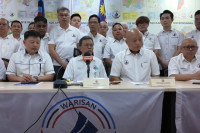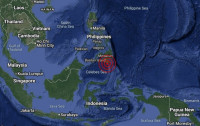
KOTA KINABALU – Sabah opposition party Warisan took a swipe at the state government’s continuous reliance on the export of raw commodities such as crude petroleum, natural gas and crude palm oil, stressing that most of the industries lack the involvement of locals.
Its Sri Tanjong assemblyman Justin Wong said the Gabungan Rakyat Sabah-led (GRS) Sabah government should have built the state’s manufacturing and downstream activities to cut down reliance on such commodities.
He said the creation of a downstream and more manufacturing sector would allow the state to generate new jobs and economic spillovers, benefitting local Sabahans.
Wong was referring to the Statistics Department’s report on Sabah’s external trade for the year 2022, which states that Sabah’s total export revenue for 2022 was worth RM77.2 billion with a trade surplus at RM36.2 billion.
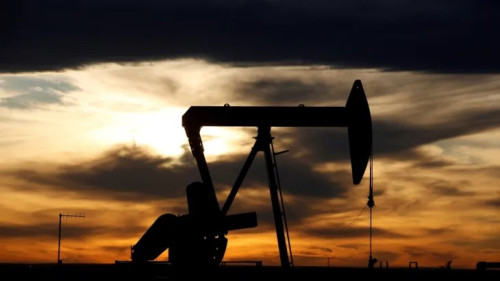
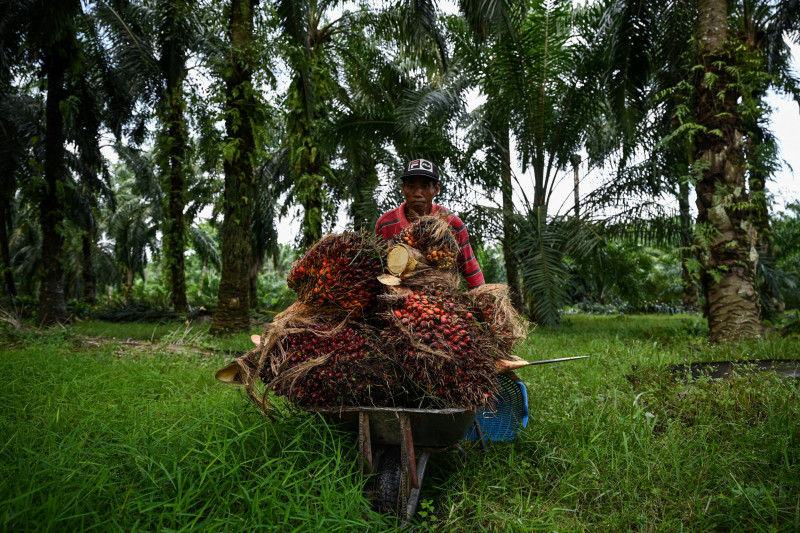
Of this amount, 39.3% was contributed by the export of crude petroleum (RM30.3 billion), 27.4% crude palm oil (RM21.1 billion) and 6.7% natural gas (RM5.2 billion), the report said.
“This gives an impression that as much as RM56.6 billion (73.4%) of Sabah’s total export value is only enjoyed by a small group, especially owners who may not even reside in Sabah, involved in either one of the above three sectors,” said Wong.
“If GRS had emulated the passion shown by Warisan to develop Sabah’s own export-oriented local manufacturing and downstream industries, then more job opportunities would have been created for our Sabahan graduates that correspond to their academic achievement and our export value for the year 2022 would have posted a better value, of possibly RM100 billion, instead of mere RM77.2 billion,” he said.
Wong also compared the state’s performance to that of Sarawak which recorded an export value of RM153 billion, twice bigger than Sabah’s export value for the same year.
He stated that 27.5% (RM42.1 billion) of Sarawak’s total export value came from the manufacturing industry related to metal products, iron and steel products, E&E goods, chemicals and chemical products.
“While the GRS leaders are bragging to the people of Sabah about the great job they did when Sabah posted an increase in export for the year 2022, little did they know that the export value of Sarawak's local manufacturing industry alone (RM42.1 billion) is already more than half of Sabah’s total export value (RM77.2 billion)," he lamented.
Need for policy and direction
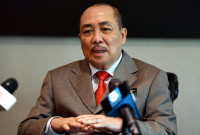
Meanwhile, Warisan deputy president Datuk Darell Leiking said that the state’s continued dependence on raw commodities shows that the GRS does not have any specific policy, direction or framework to improve the economy of Sabah after running state affairs for three years.
“If you are really serious about building our local manufacturing and downstream industries, then you would have been very aggressive in attempting to take control of the investment enablers in Sabah such as energy supply, water, infrastructure and ports.
“This is so since the largest group in our local manufacturing industry will consist of the light and medium industries that require low operating and logistic costs for profitable business ventures.
“It is now saddening to see GRS leaders are busying themselves with all sorts of proposals such as the carbon trading and moving the airport from Kota Kinabalu to Kimanis but not a single proposal has been made to revive the pulp and paper industry at Sipitang with the primary purpose of making Sabah the leader of this industry once again in Malaysia.
“I think GRS is aware that our local manufacturing and downstream industries are very crucial for Sabah but perhaps the leaders have no commitment to pursue this vigorously due to weak leadership and the political survival of respective components of this coalition,” he said. – The Vibes, August 4, 2023