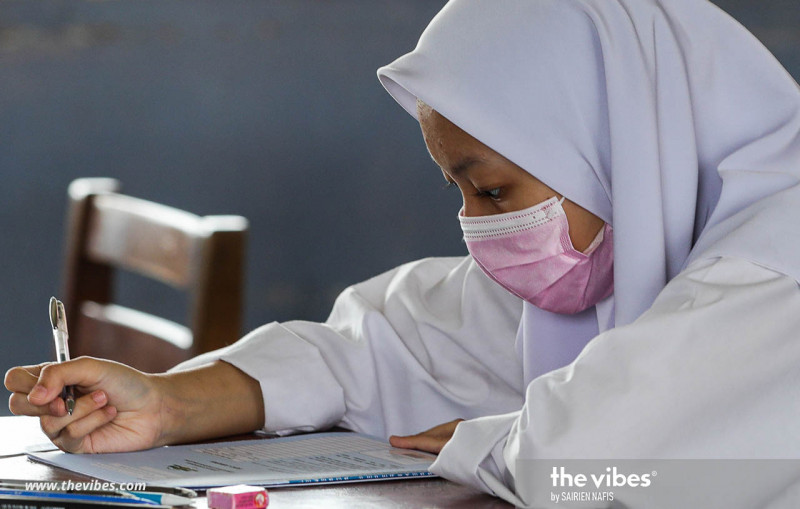
KUALA LUMPUR – Empowering school-based assessments (PBS) and classroom assessments (PBD), which starts this year, is the best approach to develop students holistically, says an expert.
Assoc Prof Azlin Norhaini Mansor, senior lecturer at the Centre Department of Education Leadership and Policy of Universiti Kebangsaan Malaysia (UKM), said this is because the assessments emphasise various aspects, including physical, spiritual and intellectual abilities, compared with the existing one, which focuses more on academic achievement through examinations.
“…and, when we switch to PBS, there will be less comparison and competition, like ‘5A’ is better than ‘4A’, then there may not be a situation where many pupils want to score 5As in the UPSR.
“The only concern now is standardisation, which has long been a practice in schools, so when it changes to this approach, the practices will be different and people may take time to accept these changes,” she said.
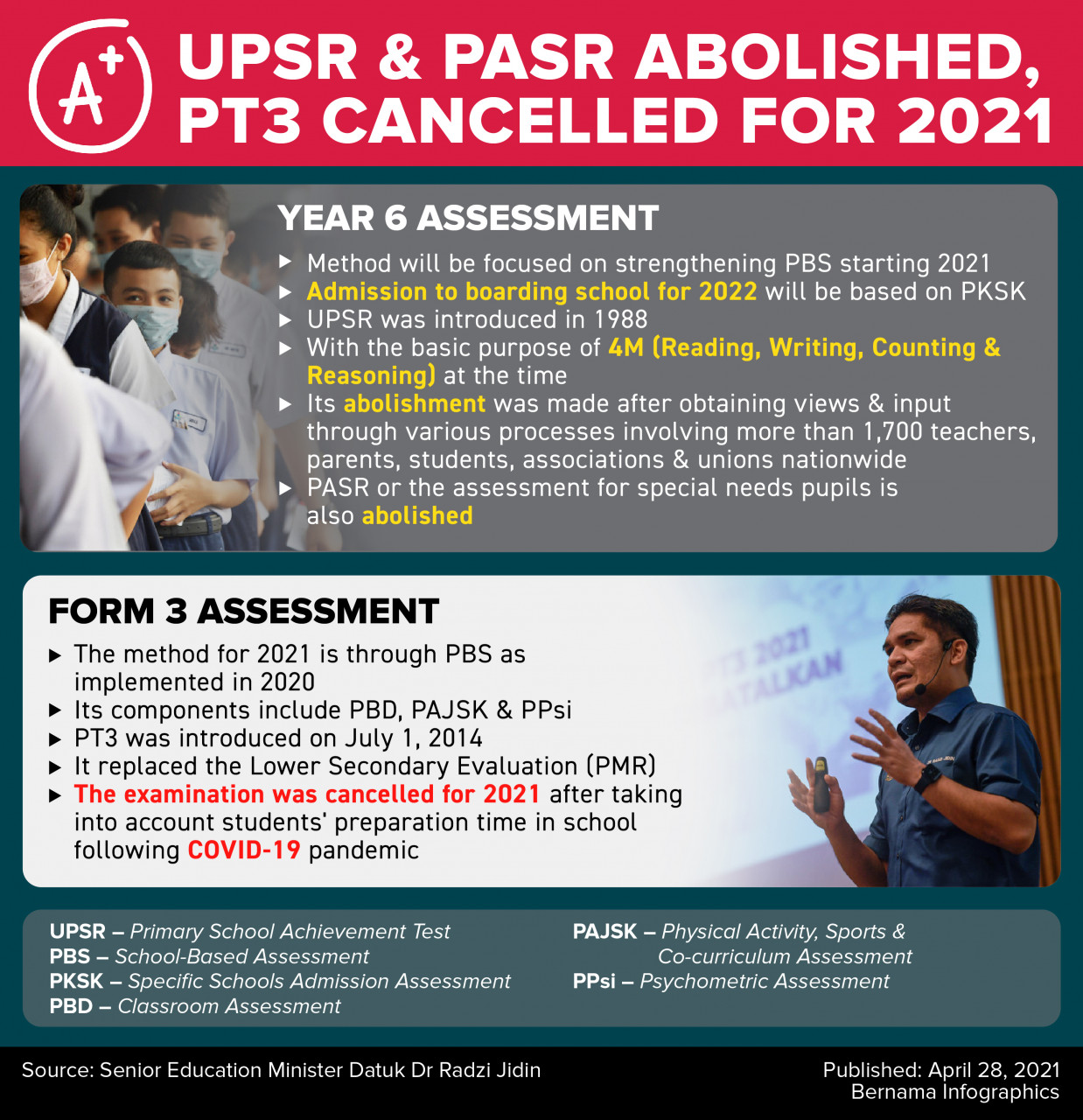
Senior Education Minister Datuk Radzi Jidin had yesterday announced the abolition of the UPSR examination, replacing it with PBS and PBD.
Radzi said the decision to abolish the UPSR, which was first introduced in 1988, was made after getting views and input from various quarters, including 1,700 participants of engagement sessions with the Education Ministry (MoE).
Through this method, Azlin Norhaini said teachers could evaluate student’s achievements and performance throughout their learning sessions.
Indirectly, a teacher will also be able to detect weaknesses and help increase the potential of the students, she said.
“I agree that we have to leave it to the school to manage the end-of-year tests of these Year 6 pupils for the purpose of admission to residential schools and so on.
“...and, if you want to go to the Sekolah Berasrama Penuh (SBP), let the assessment be provided by SBP and for SMKA (Sekolah Menengah Kebangsaan Agama); let the SMKA do assessment for the students,” she added.
Azlin Norhaini said the most important thing is total cooperation from the school and teachers, so that no student will be left behind during their studies.
She said the MoE also needs to monitor schools to ensure that assessments are carried out in accordance with the procedures and guidelines set; if not, the gap in academic achievement, including between urban and rural areas, will expand.
“Schools and teachers need to know their responsibilities. All this while, most of them have been striving to get good scores in exams, so when the benchmarking is no longer there, what are their KPIs (key performance indicators)? The MoE needs to have other KPIs.
“School administrators should be learning leaders while teachers should be learning teachers, who constantly learn to improve their practice. This is important because the impact or effect of a policy change can only be seen after 10 or 20 years,” she said. – Bernama, April 29, 2021