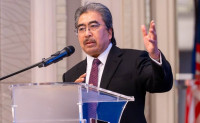

IT is time to consider growing strategic commercial crops overseas and reimporting them to be processed and marketed globally, said Plantations and Commodities Minister Datuk Seri Johari Abdul Ghani.
Taking cue from what has happened to both the natural rubber and cocoa segments, Johari said that the National Kenaf and Tobacco Board (LKTN) should consider exploring such avenues to boost production and reduce operating costs.
Although Malaysia was once a top producer of rubber and cocoa commodities worldwide, times have changed, as the country grapples with rising operating costs and an acute shortage of labour.
Many plantations with some exceptions accorded to the Felda schemes, now employ foreign workers to cultivate and harvest its produce.
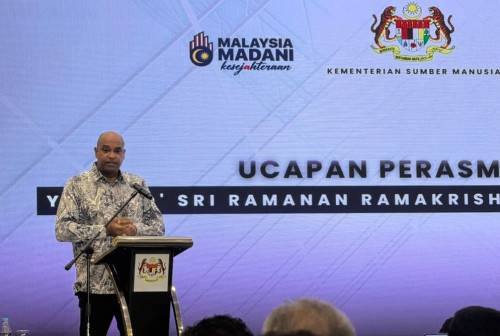
Speaking at the recent LKTN staff appreciation and Hair Raya Adil Fitri gathering, Johari said that the country needs to restrategise, in view of the threats of higher tariffs from the United States (US).
Johari said that kenaf or better known as jute for example, an old tropical plant which was reintroduced in Malaysia in 2001 to substitute the growing of tobacco due to public health concerns, can be grown in India or Bangladesh.
It can be grown widely with higher yield before it is reimported by LKTN to be processed into various downstream products from its fibre and core fibre seeds.
In Malaysia, kenaf makes bags, marine ropes, mattresses and pillows while Universiti Malaysia Kelantan has also produced it for a pharmaceutical product.
Johari sees Malaysia as a top producer for finished kenaf products and it can then be re - exported into new markets in Europe and Latin America besides in Asia.
Currently, kenaf is widely cultivated in the Chuping Valley in Perlis, Kedah, Kelantan and Terengganu where in Perlis, its wide fields have also become a tourism products due to the variant flowering when it matures.
LKTN is considering growing a similar kenaf garden in Langkawi, Kedah where it can also become an eco - tourism attraction.
Meanwhile, the Malaysian Nuclear Agency has also produced two new variants called the MK1 and MK 2, which its director - general Dr Rosli Darmawan expects to boost yield compared to the present species growing in the country.
It also copes well with the challenges from climate change, said Rosli.
There is a 20% to 60% increase in yield compared to the present crop grown in Beseri, Perlis. - May 2, 2025