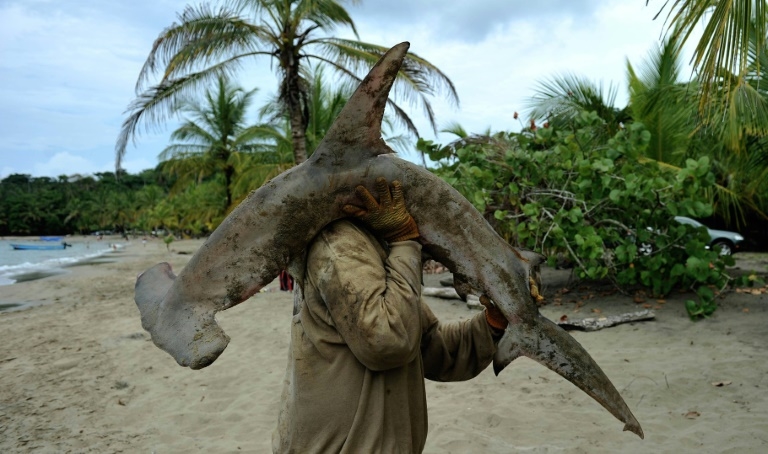
OVERFISHING has wiped out over 70% of some shark and ray populations in the last half-century, leaving a "gaping, growing hole" in ocean life, according to a new study.
Researchers found alarming declines in species ranging from hammerhead sharks to manta rays.
Among the worst affected is the oceanic whitetip, a powerful shark often described as particularly dangerous to man, which now hovers on the edge of extinction because of human activity.
Targeted for their fins, oceanic whitetips are caught up by indiscriminate fishing techniques. Their global population has dropped 98% in the last 60 years, said Nick Dulvy, the study's senior author and a professor at Simon Fraser University (SFU).
"That's a worse decline than most large terrestrial mammal populations, and getting up there or as bad as the blue whale decline," he said.
Dulvy and a team of scientists spent years collecting and analysing information from scientific studies and fisheries data to build up a picture of the global state of 31 species of sharks and rays.
They found three-quarters of the species examined were so depleted that they face extinction.
These are "the most wide-ranging species in the largest, most remote habitats on the earth, which are often assumed to be protected from human influence", the study's lead author Nathan Pacoureau said.

"We knew the situation was bad in a lot of places but that information came from different studies and reports, so it was difficult to have an idea of the global situation," added Pacoureau, a post-doctoral fellow at SFU's department of biological science.
The study, published Wednesday in the journal Nature, points the finger at overfishing and weak protection, and emphasises that species can stage a comeback when conservation efforts are made.
The research focuses on oceanic sharks and rays, species that primarily live in open water. While it found variation in the health of different populations, the overall trend was clear.
"The data revealed a gaping, growing hole in ocean life," Pacoureau said.
'Stunned into silence'
For 18 species where more data was available, the researchers concluded global populations had fallen over 70% since 1970.
Dulvy said the figure was likely to be similar, or even worse, for other oceanic sharks and rays, but gaps in data made it difficult to draw conclusions.
The results were a shock even for experts, Pacoureau said, describing specialists at a meeting on shark conservation being "stunned into silence" when confronted with the figures.
Andrea Marshall, a contributing author of the study and co-founder of the Marine Megafauna Foundation, said watching the decline of manta and devil rays in Mozambique where she works "has been a living nightmare".
"It happened quicker than we could have ever imagined and it demonstrated to us that we need to take immediate action," she said in an MMF press release.
Three sharks were found to be critically endangered, with their populations declining by more than 80% – the oceanic whitetip shark, scalloped hammerhead and great hammerhead.
Sharks and rays are especially vulnerable to population collapse because they grow slowly and reproduce comparatively infrequently.
The study notes a two-fold increase over the last half-century in the use of fishing with longlines and seine nets – methods that can snare marine life indiscriminately, including endangered animals.
Regional bodies that manage international fisheries "have not prioritised shark and ray protection", Pacoureau said. He backs catch bans for endangered and critically endangered species and limits for less threatened species.
"Proactive measures can prevent population collapses. And we know they work," he added, pointing to the recovery of great white sharks around the US after new regulations.
Dulvy said ordinary citizens had a role to play by pressing governments to meet their national and international commitments.
"Wherever you can, urge your government to care for sharks," he said. – AFP, January 28, 2021


.jpeg)