Animals

Endangered Australian songbird 'losing its song'

Scientists estimate just a few hundred regent honeyeaters remain in the wild

Updated 5 years ago · Published on 17 Mar 2021 6:00PM

Endangered Australian songbird 'losing its song'
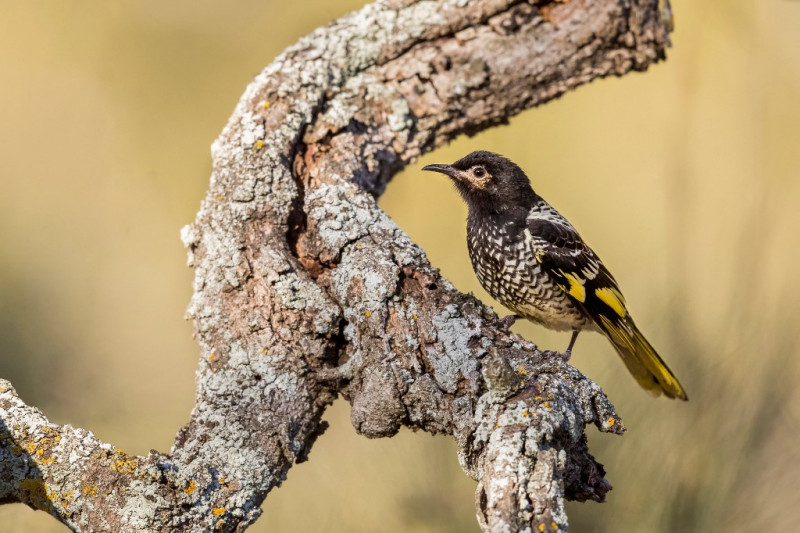
This undated handout photo received from Australian National University on March 17, shows a rare Australian songbird, a female regent honeyeater, at the Capertee National Park in New South Wales. – AFP pic, March 17, 2021

SYDNEY – Australia's endangered regent honeyeater bird is losing its song, a sign that it could be nearing extinction, scientists warned in new research released on Wednesday.

A rapid decline in the rare songbird means its young are struggling to learn mating calls as adults disappear, according to researchers at the Australian National University.

Male regent honeyeaters sang rich, complex tunes in more populated habitats, but resorted to simplified songs elsewhere, the scientists wrote in a study published in the peer-reviewed journal Proceedings of the Royal Society B.

Lead author Ross Crates said the findings were a "major warning sign the regent honeyeater is on the brink of extinction" – and the loss of song knowledge could also reduce chances of mating.

"It could also be exacerbating the honeyeater's population decline, because we know a sexy song increases the odds of reproduction in songbirds."

Scientists found 18 regent honeyeaters, or around 12% of the total remaining male population, who could only mimic other species' songs – not their own.

"This lack of ability to communicate with their own species is unprecedented in a wild animal," study co-author Dejan Stojanovic said. 

"We can assume that regent honeyeaters are now so rare that some young males never find an older male teacher."

Scientists estimate just a few hundred regent honeyeaters remain in the wild.

The rare bird, with its black and yellow markings, was once found across much of eastern Australia but is now largely confined to eucalyptus forests in the country's southeast.

The study also found regent honeyeaters born in captivity have different songs that could reduce their attractiveness to wild birds.

The scientists now hope to teach the captive birds to sing like their wild counterparts, by playing them audio recordings. – AFP, March 17, 2021


Related News

Malaysia / 2mth

Malaysia, Australia back Pope Leo's call for peace, urge dialogue to end global conflicts

Education / 5mth

Legal board withdraws recognition of law degrees from 2 Australian, NZ universities

Opinion / 8mth

The man who gave Malaysia its heart in a jungle — remembering Tan Sri Vic M. Hutson

World / 9mth

Australian authorities block 10 containers of illegal tyre waste export to Malaysia

Opinion / 11mth

Izzah: Statement by PAS leader an attempt to belittle, degrade the dignity of women

World / 1y

Australia PM Albanese makes stunning comeback with landslide win

Spotlight

Malaysia

Johor state election: MACC receives three reports of alleged corruption

Malaysia

Banks need to do more to help counter rising costs of living – Guan Eng

By Ian McIntyre

Business

BNM holds OPR at 2.75 per cent

Malaysia

MACC: No one off limits in probe into US$13 million luxury property deal

Malaysia

Govt rejects claims Jho Low secretly returned to Malaysia for 1MDB asset talks

Malaysia

School stabbing incident: Suspect claimed she was dissatisfied, allegedly bullied

Places

Four premier hotels in Penang to be restored, open doors soon

By Ian McIntyre

Malaysia

Rosmah demands action against Nga over alleged misleading election poster in Johor polls

Malaysia

Malaysia faces RM51.4b 1MDB burden after recovering RM31.3b in funds and assets

You may be interested

Events

HashMicro rolls out AI-powered manufacturing platform to help firms tackle rising costs, disruptions

By Alfian Z.M. Tahir

Places

Four premier hotels in Penang to be restored, open doors soon

By Ian McIntyre

Living

Matrix Concepts' home ownership campaign offers over RM30m rewards and prizes