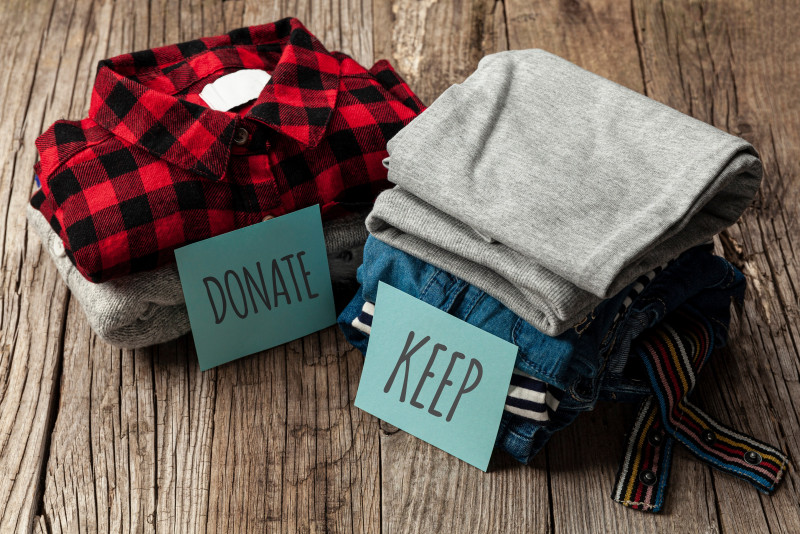
REGULARLY sorting through your closet allows you to save space, time and money, as well as do something for the planet. World Environment Day, on June 5, is the perfect opportunity to put your sartorial affairs in order, think about the way you consume (and dress), and get rid of all those clothes you haven't worn for years.
Here are some tips to help you make your closet greener.
Sort, empty, give
Sorting through your closet is a major endeavour! While the process may seem easy for some, others find it difficult to get rid of certain clothes for various reasons, which are often sentimental.
How many times have you thought that you could, one day, slip back into those jeans? Classic. But there's nothing green about keeping clothes that you don't wear. To sort properly, you need to start by emptying the contents of your closet and prepare three piles: what to keep, what to sell, and what to recycle (avoiding the garbage, of course).
From a green point of view, it's key to differentiate between durable clothes, which you will be able to wear again and again for several years, and the clothes you bought on a whim – which you wear, of course, but which have a very limited life span – and which you will soon have to sort through again.
Note that it is (truly) useless to keep clothes that do not fit anymore, whose cuts do not suit you anymore, or that are worn out. In the first two cases, they will likely be able to be used by someone else, who then will not have to buy new items, while clothes that fall into the third category can be recycled and used in the creation of new clothes.
Learn about labels
Take advantage of this spring cleaning session to take a look at the labels on your clothes. Where were they made? What materials were used? To meet consumer expectations, the fashion industry is working to make their clothes more transparent and traceable.
Labels could thus progressively become a practical source of a wealth of indispensable information to guide you when choosing a garment. New York start-up Eon has even been working on a digital identity card designed to trace a garment from the beginning to the end of its life cycle, demonstrating a real demand for traceability.
Beyond these criteria of transparency, labels can also help give you a clearer vision of how you consume and help you become aware of the number of clothes made from environmentally harmful fibres that you likely have in your wardrobe.
They can also tell you how far a dress or a pair of jeans has come before they arrived in your closet. It shouldn't be a shaming exercise, it's not designed to make you feel guilty or blame yourself for all the world's ills. It's simply about helping you adopt more environmentally friendly habits.
If the labels on your clothes seem indecipherable, you can turn to applications and platforms, such as Good on You. It analyses the commitments of ready-to-wear brands and provides the necessary information to find out if such and such a label respects a sort of specifications that includes the environmental aspect, the conditions of workers, health, or animal welfare, among others. A truly useful tool.
Take the time to reflect on your consumption
The hardest part is done! You've sorted out the pieces you no longer wear, as well as those you don't think are essential; now it's time to sit down and think about how you approach shopping – and your wardrobe.
In other words, ask yourself the right questions. Do you feel like you're over-consuming? What criteria do you look for when buying clothes? What's more important to you: having "only" three pairs of jeans made ethically with eco-responsible materials or, for the same amount of money, having a dozen pairs that won't last the year?
Once again, it's not a question of radically altering how you consume, dress or shop, but of modifying a few habits to make your wardrobe more sustainable.
"Clean" fabrics, renting clothes or buying second-hand, sustainable denim, local brands: there are many alternatives to look at when you're taking the first steps towards a wardrobe with a lower environmental impact.
Resell, recycle, repair
Last but not least: give your clothes a new lease on life. There's no question of throwing the clothes you wish to separate from in the garbage, but of making sure that they are reused, in one way or another, to reduce their environmental impact.
Several solutions are available to you. You can opt to sell them on the second-hand market, which will allow you to save not only space but also money without polluting the planet. Note that some brands have already launched their second-hand platform and take back your clothes in exchange for vouchers.
It is also possible to recycle your clothes, via collection points set up by dedicated organisations, but also in some stores (H&M has been offering Looop, an in-store recycling system, for a few months now in its Stockholm store).
If you opted for "consignable" clothes when you bought them, all you have to do is send the worn-out model back to the brand to get your deposit back.
Your used or damaged clothes can also be recycled. But if you don't want to part with them -- and you know you'll wear them again – it's also possible to repair them, either by yourself or through a dedicated service.
The global pandemic has brought sewing back into fashion, but also the many resourceful DIY tips (thanks to the host of tutorials available on the Internet) that allow you to touch up, patch up, and customize clothes in record time, even on a tight budget. All that's left to do is get started. – ETX Studio, June 3, 2021