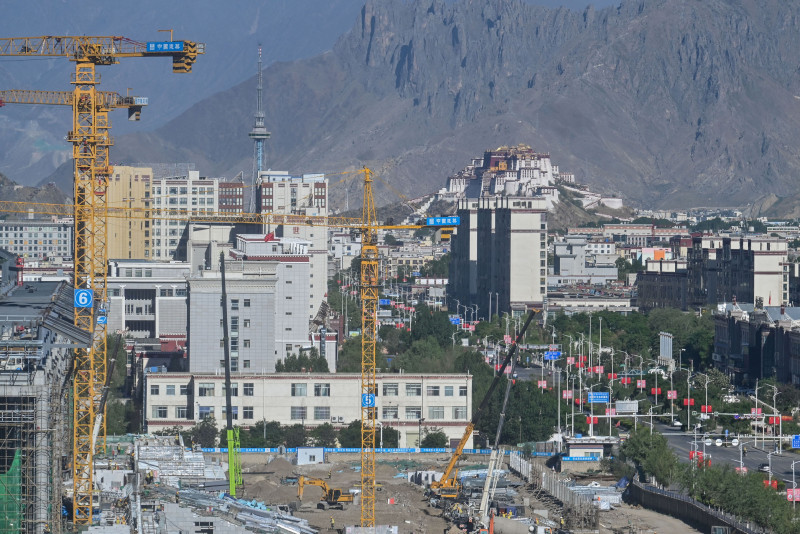
UNDER towering mountains, cranes and newly-built blocks of flats stretch up to blue skies around the Tibetan capital of Lhasa, as a construction boom creates a two-tier system of property wealth between state workers and everyone else.
A huge infrastructure and building drive in Tibet has brought airports, roads, railways and new flats, which Beijing says are improving lives across the remote mountainous plateau.
But the boom is also changing the historic Buddhist city and pushing property prices out of reach of many residents, Tibetans say, sharpening divisions in a region well-known for discontent under Chinese control.
A short distance from the Potala Palace, the former home of the exiled Dalai Lama, construction workers crawl over high-end condo towers being built by Chinese developer Country Garden.
They are priced similarly to many major Chinese cities, despite average Tibetan incomes still being among the country's lowest.
The development sits opposite billboards advertising other projects and near a modern new shopping centre.
AFP recently joined a rare and tightly controlled government-led tour of Tibet, which has heavily restricted entry for foreign journalists since deadly anti-China protests exploded across the region in 2008.
Haves and have-nots
China's government says development is the antidote to discontent in Tibet, where many people still revere the Dalai Lama – the region's spiritual leader – and resent an influx of Chinese tourists and settlers.
Since 2008 it has poured investment into the region, making Tibet one of China's fastest-growing regions economically and fuelling rising average incomes.
Many residents agree such modernisations are welcome, but experts have warned Lhasa's 860,000 people are also increasingly polarised between haves and have-nots.
The building binge is perhaps the most visible evidence, seen as largely benefitting educated government workers while Tibetan rural migrants struggle to keep up.
Nearly one million square metres of newly-built housing was sold in 2020, up 28% from the previous year.
Real estate listings show around three dozen new developments currently selling homes in Lhasa.
With prices rising, entering the market relies on public-sector jobs "because there are very few options outside of that to make the big bucks," said Andrew Fischer, a professor at Erasmus University Rotterdam.
"The property market opens up only once you've passed that gateway. That gateway is what controls people."
Rural migrants are moving from other parts of Tibet to Lhasa to seek better economic and educational opportunities but usually end up on society's lower rungs, said Emily Yeh, professor at the University of Colorado Boulder.
Many have low Mandarin language abilities, a prerequisite for many urban jobs.
Job competition
Even at the higher end, competition for top jobs is fierce as employment growth lags the numbers of new graduates.
Interviewing locals was difficult under the watchful eyes of government minders, but overseas Tibetans who are in close touch with those on the ground say a toxic social brew is developing.
"Most people who are educated work for the government. (But) you have increasing numbers of young Tibetans who are well-educated... and didn't get a government job," said an overseas Tibetan who spoke on condition of anonymity.
He says this is creating a pool of educated youths unable to earn enough to buy homes.
Tibetans also told AFP that government workers face extra controls and pressure to shun their Buddhist faith, which they fear endangers their religious and cultural heritage.
There is no public data on the ethnicity of Tibet's state workers.
But census data shows that numbers of Han Chinese – the country's dominant ethnic group – have grown over the past decade to comprise 12% of Tibet's overall population, fostering yet more competition for jobs.
Persistently high illiteracy in Tibet exacerbates the social gap.
"You have around 10% of the population with university education levels, simultaneously with a third of the population being illiterate," said Fischer.
'A sacred place'
Alongside new construction is a plan to reduce the population living in the narrow, winding streets of historic central Lhasa, in the name of modernisation.
Many locals have moved to apartments on the city's outskirts, with traditional homes often converted to hotels or shops targeting tourists.
Filmmaker Dhondup Wangchen, who spent six years in jail after making a bold documentary on Tibetan grievances against Chinese rule, said "the sole purpose of developing infrastructure is to benefit China".
"A change that is forced upon Tibetan people with the objective of eradicating the identity and culture of Tibet can never be compensated with a few urban developments," he told AFP from his current base in California.
Tibetans in exile point out that while Lhasa may have better housing than before, many fear change near the historic Jokhang Temple, an honoured place to live and destination for pilgrims.
Tourists pose for photoshoots in traditional Tibetan clothes outside the temple, on a historic prayer route now home to shops and American fast-food brands KFC and Pizza Hut.
Red Chinese flags, lanterns and pictures of the Chinese Premier Xi Jinping are hung across the city.
"Lhasa is not only a sacred place but also politically significant in the Tibetan identity," said Tenzin Choekyi, a senior researcher at NGO Tibet Watch.
"But when Tibetans see Tibet, how much of it is really left there?" – AFP, July 14, 2021