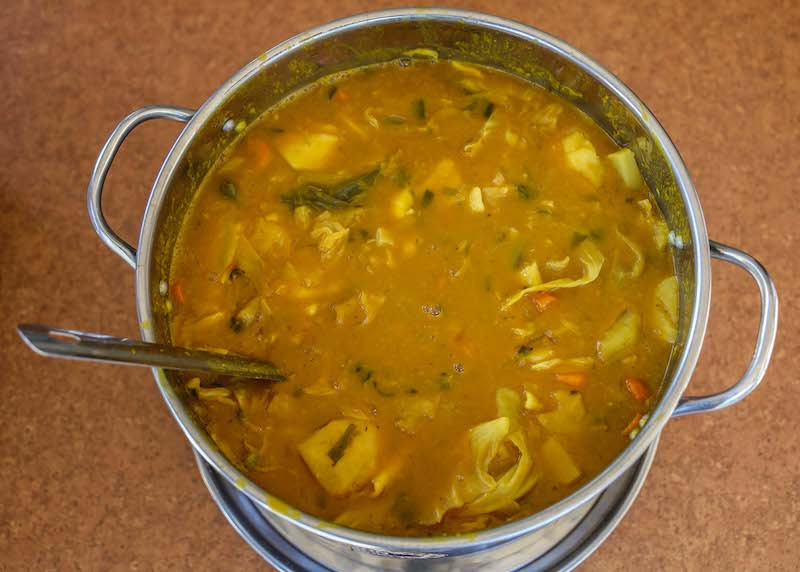
A MIX of meat, vegetables, pasta and the squash for which it is named, Haitians enjoy joumou soup every January 1 to celebrate the new year and their country's independence.
Before it became a symbol of Haiti's freedom, the soup was one of oppression.
The enslaved Haitians who grew the 'giraumon' or turban squash, the key ingredient, were forbidden from eating the dish. It was reserved solely for the French plantation masters.
But on January 1, 1804, when the first black-led republic was born, Marie-Claire Heureuse Felicite – the wife of Jean-Jacques Dessalines, a leader of Haiti's revolution and the independent nation's first ruler – chose to serve the soup.
Cooking joumou soup "was a way to mark those years of deprivation and oppression, and to claim victory over the colonisers," says Port-au-Prince resident Nathalie Cardichon as she buys ingredients for the national dish at the market.
"That's the meaning of this soup," she adds.
Traditionally, serving the dish is also a time of reunion for families. But for many, 2022 will be different.
Rise of gangs
In 2021, not long after Haiti's president was assassinated, the country suffered a devastating earthquake. Political turmoil and poverty have intensified, as have violence and kidnappings by gangs that have become all-powerful.
A lack of security and inability to travel on roads guarded by armed gangs have forced many Haitians to spend the symbolic day far from their loved ones.
"I have friends at university whose parents don't live in Port-au-Prince and who can't go home to the provinces because of the security situation, so I invited them" to my house, says Stephanie Smith, a student in the Haitian capital.
Her mother, Rosemene Dorceus, often makes joumou soup for their family. But for the national holiday, she makes whole pots of it.
It's enough to feed "about 20 people," the 54-year-old estimates modestly – but her daughter thinks it all could easily feed at least 30.
"We are eight in my family but unfortunately, in the neighbourhood, there are people who can't afford to make the soup, so we think of them," explains the 27-year-old Smith.
The work in the kitchen starts on December 31.
Before the sun has even risen on January 1, the women in the family are busy around the stove.
Dorceus recalls a time when she and her husband would make the soup together, when the children were small.
"Now that my daughters are grown, they help me," she says.
Delighted with the family time spent preparing the feast, Smith says her younger brothers do help a little, "but they mostly come by to eat, especially the meat."
'Tradition of our ancestors'
The richly historied soup has just received international recognition, with Unesco designating it as part of the "intangible cultural heritage of humanity."
"Haiti's struggle and its voice have been made invisible, and this is now a way to record it," said Dominique Dupuy, Haiti's ambassador to the UN cultural agency.
She noted Haiti's "fundamental and crucial role in humanity's history," as the first country to have abolished slavery.
The designation of joumou soup constitutes a "just historical rectification," according to Dupuy.
Her delegation did everything possible to obtain the listing, requesting accelerated processing for the request in August. On December 16, the designation was granted.
With 2021 having been an "exceptionally painful year," it was necessary to have "systems to help us keep our heads high," said Dupuy, a native of Cap-Haitien, which suffered a tragedy on December 14 when a gas truck exploded, killing dozens.
In Haiti, cooking joumou soup, a custom that dates back more than two centuries, is a way to honour the country and its past.
For Cardichon, the market-goer, it's a way of inviting the world to "discover Haiti's history" – and a way to show "how proud we are as a people, that we take and continue the tradition of our ancestors." – AFP, January 3, 2022