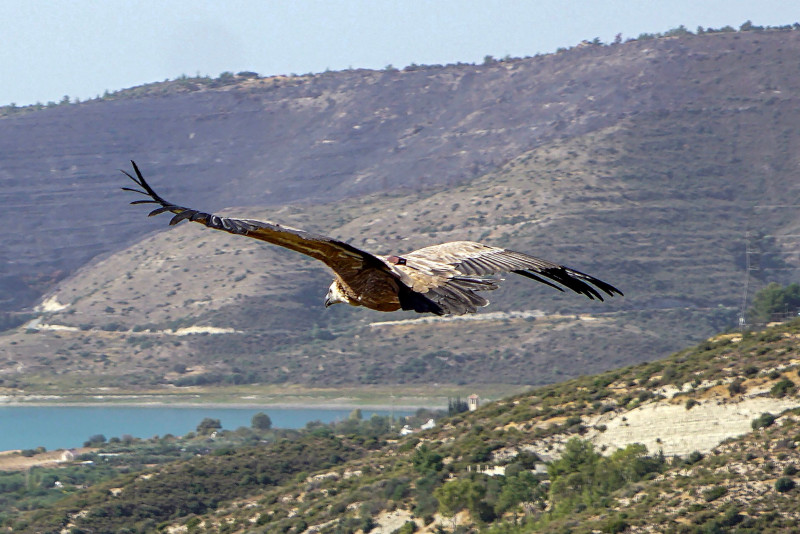
WITH a wingspan as wide as a basketball hoop is tall, it took just a few flaps for the vulture to soar to freedom towards the glittering seas off Cyprus.
Griffon vultures, birds that perform the vital job of clearing carcasses that could otherwise spread disease, are on the “brink of extinction” on the Mediterranean island due to poisoning, experts warn.
But 15 have been returned to the wild in recent weeks in a bid to boost numbers, nearly tripling the population to an estimated 23, helping restore an iconic species critical to the health of the ecosystem.
“They are nature's clean-up crew,” said Melpo Apostolidou, from BirdLife Cyprus, an environmental group coordinating the vulture reintroduction programme.
“They provide an efficient, cost-effective and environmentally beneficial carcass disposal service.”
With a white head and graceful sand-coloured wings stretching up to 2.8 metres they are as majestic as eagles.
The eight birds released on Wednesday were the last of a batch of 15 birds, rehabilitated after being injured as juveniles in Spain before being brought to Cyprus.
Since December, they were acclimatising in an aviary in the hills some 15 kilometres from the port city of Limassol.
‘Nothing to be afraid of’
Vultures are scavengers not hunters, neatly cleaning up fallen carcasses before they rot in the sun.
A dozen birds – known collectively as a “wake” of vultures – can clean a single sheep carcass in an hour.
They do have an image problem: their eating habits of dining on the dead means some see them sinister harbingers of doom.
But wildlife vet Constantinos Antoniou said there was no cause for alarm.
“They are an integral part of our ecosystem, and have been for thousands of years,” Antoniou said, who provided technical support for the release, including fixing GPS trackers to their backs.
“Unless you are dead, you have nothing to be afraid of, because vultures feed only on carcases: they have no interest in humans or pets.”
Once they were a common sight over Cyprus. In the 1950s, there were several hundred birds across the island.
But amid poisoning, hunting, habitat loss, disturbance of breeding colonies and birds flying into electricity wires, numbers had crashed to just eight earlier this year.
“Poisoning is a big problem,” said Andreas Christoforou, a government wildlife protection officer, who with sniffer dog Sophie searches for illegally-laid poison placed by farmers and hunters to kill foxes and feral dogs.
“Those laying poison face punishment, but it is hard to catch them.”
Christoforou and Sophie, a border collie, have located some 10 poisoned baits in the past six months.
He explained that since vultures often feast together, one poisoned carcass can wipe out several.
In May, at least three vultures were found dead after eating poison.
‘Flagship species’
If vultures went extinct, it could impact our own health and well-being in the long run, said Haris Hadjstyllis, from the Game and Fauna Service.
“In the past they were seen as very helpful because they were so important in clearing carcasses, removing sources otherwise of bacterial disease,” Hadjstyllis said.
“We cannot ignore history, for we never know what we might face in the future... everything that exists has a reason to exist, with a role to play in the ecosystem.”
Today, livestock carcasses are collected for cremation, but feeding them to vultures could provide a simpler and eco-friendlier way, even reducing greenhouse gas emissions, experts from BirdLife argue.
In time, conservationists hope the vultures could bring in revenues through tourism, noting that feeding platforms in Spain have become popular for visitors.
The birds were released as part of a wider €1.3 million (about RM5.89 million) programme, largely from the European Union's environment and climate action fund, to boost key species in a bid to restore ecosystems.
As the birds were freed, another vulture released in a previous batch soared on the other side of the valley, as if waiting for the rest to join.
“These are a flagship species, and if we are losing a flagship species, what is happening to the rest of biodiversity?” said Apostolidou. “It is a huge battle.” – AFP, October 10, 2022