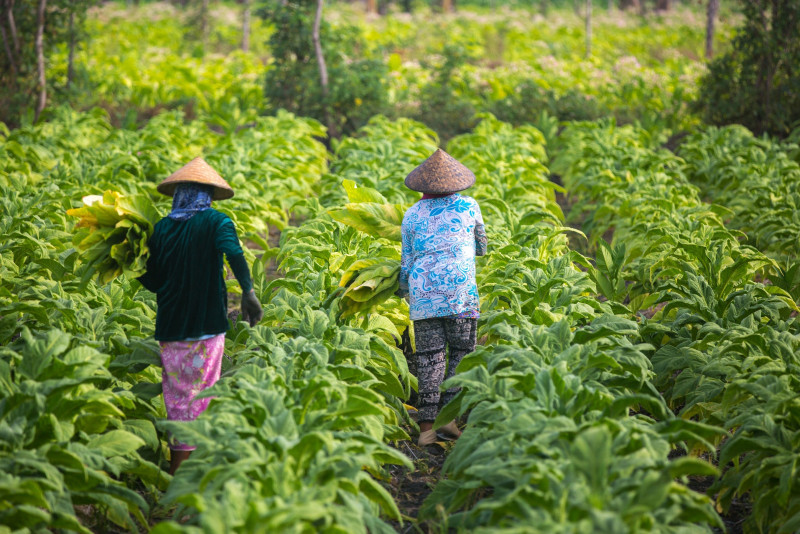
WHEN it comes to encouraging farmers to adopt sustainable agriculture practices, women could be in a strong position to convince them to take action in some communities. At least, so suggests research conducted in Indonesia by an Australian researcher in collaboration with the NGO Swisscontact.
Women throughout the world experience many forms of sexist discrimination, albeit to varying extents across cultures and countries. Still, the issue remains universal and systemic.
One of the effects of these patriarchal societies is that, regardless of their skills or determination, women can find it more difficult to make themselves heard without being interrupted, or to act as an authority figure.
English political journalist Mary Ann Sieghart theorised this concept, which she calls the "authority gap."
But new research helmed by Petr Matous, an associate professor at the Faculty of Engineering of the University of Sydney, has found that women have the potential to lead opinion and drive change in certain communities.
His team conducted a survey to measure the impact of opinion leaders among stakeholders in farming communities on the island of Sulawesi, Indonesia, northeast of Bali.
The objective was to determine which members of these communities were most likely to convince farmers to change their practices in order to begin their ecological transition and develop programmes centred around the notion of sustainability.
The survey was conducted among more than 2,000 farmers. Participants were asked to identify the most influential opinion leaders in their community.
These designated "leaders" were then asked to convince as many farmers as possible to improve the health of their cocoa crops by pruning them with a pair of specially provided scissors.
‘Hierarchical and paternalistic’ rural communities
In this first experiment, older men dominated among the agricultural opinion leaders identified by the group.
However, in a second experiment, the researchers found that a more inclusive group of supposed "leaders," picked at random, and including a larger number of women and young people, convinced twice as many of their peers to trial the new scissors as the older male "leaders" in the first experiment.
Moreover, among these less-prominent individuals, women and younger farmers were particularly successful at convincing others. All of which proved something of a surprise to the researchers.
"From farming and construction to banking and politics, older men are often perceived as the most influential in their networks, but in our study they didn't have the greatest impact," the scientists explain in a news release.
On paper, women were less likely to be seen as opinion leaders. But, in reality, they were the ones who demonstrated the greatest potential for persuasion, as their recommendations led to real action.
These findings suggest that attitudes may be changing, although agriculture in Indonesia is still largely a male-dominated sector.
"Few women occupy prominent roles in local farming groups – many of which are community-based organisations aimed at improving the lives of local inhabitants and which often channel support from the government and international organisations," said associate professor Petr Matous.
The study was conducted in collaboration with the NGO Swisscontact, which trains cocoa farmers to improve their skills throughout Indonesia, with the aim of encouraging them to adopt more sustainable approaches, both in terms of the environment and agricultural yield.
"The rural communities we work with are typically traditional, hierarchical, and paternalistic – high status individuals are typically older men. Our programme aims to promote diversity and inclusivity, ... the study's result strengthens the case for doing so," says Nadya Aulika Runnisa, Swisscontact Indonesia. – ETX Daily Up, February 24, 2023