IN a streak of light across the night sky, samples collected from a distant asteroid arrived on Earth on Sunday after being dropped off by Japanese space probe Hayabusa-2.
Scientists hope the precious samples, which are expected to amount to no more than 0.1 grams of material, could help shed light on the origin of life and the formation of the universe.
The capsule carrying samples entered the atmosphere just before 2.30am Japan time (1730 GMT Saturday), creating a shooting-star-like fireball as it entered Earth's atmosphere en route to a landing site in Australia.
"Six years and it has finally come back to Earth," an official narrating a live broadcast of the arrival said, as images showed officials from Japan's space agency JAXA cheering and pumping their fists in excitement.
A few hours later, JAXA confirmed the samples had been recovered, with help from beacons emitted by the capsule as it plummeted to Earth after separating from Hayabusa-2 on Saturday, while the fridge-sized probe was some 220,000 kilometres away.
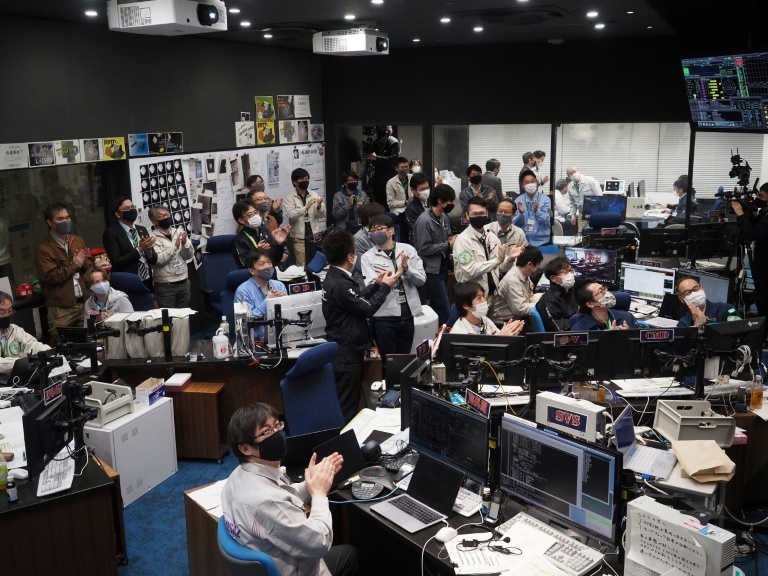
"We found the capsule! Together with the parachute! Wow!" the mission's Twitter account announced.
People who had gathered at a public viewing site near JAXA's office in suburban Tokyo – despite the event taking place a few hours after midnight – also erupted with cheers.
"I'm extremely happy because the capsule has returned home safely, Hayabusa-2 did a great job," a primary school boy said.
The capsule was recovered in the southern Australian desert, and will now be in the hands of scientists performing initial, non-invasive analysis including checking for any gas emissions.
It will then be sent to Japan.
Samples with organic material?
The samples were collected by Hayabusa-2, which launched in 2014, from the asteroid Ryugu, some 300 million kilometres from Earth.
The probe collected both surface dust and pristine material from below the surface that was stirred up by firing an "impactor" into the asteroid.
The material is believed to be unchanged since the time the universe was formed.
Larger celestial bodies like Earth went through radical changes including heating and solidifying, changing the composition of the materials on their surface and below.
But "when it comes to smaller planets or smaller asteroids, these substances were not melted, and therefore it is believed that substances from 4.6 billion years ago are still there," Hayabusa-2 mission manager Makoto Yoshikawa told reporters before the capsule arrived.
Scientists are especially keen to discover whether the samples contain organic matter, which could have helped seed life on Earth.
"We still don't know the origin of life on Earth and through this Hayabusa-2 mission, if we are able to study and understand these organic materials from Ryugu, it could be that these organic materials were the source of life on Earth," Yoshikawa said.
"We've never had materials like this before... water and organic matters will be subject to research, so this is a very valuable opportunity," said Motoo Ito, senior researcher at the Japan Agency for Marine-Earth Science and Technology.

Half of Hayabusa-2's samples will be shared between JAXA, US space agency NASA and other international organisations, and the rest kept for future study as advances are made in analytic technology.
More tasks for Hayabusa-2
The work is not over for Hayabusa-2, which will now begin an extended mission targeting two new asteroids.
It will complete a series of orbits around the sun for around six years before approaching the first of the asteroids – named 2001 CC21 – in July 2026.
The probe will not get as close as it did to Ryugu, but scientists hope it will be able to photograph CC21 and that the fly-by will help develop knowledge about how to protect Earth against asteroid impact.
Hayabusa-2 will then head towards its main target, 1998 KY26, a ball-shaped asteroid with a diameter of just 30 metres.
When the probe arrives at the asteroid in July 2031, it will be approximately 300 million kilometres from Earth.
It will observe and photograph the asteroid, no easy task given that it is spinning rapidly, rotating on its axis about every 10 minutes.
But Hayabusa-2 is unlikely to land and collect samples, as it probably would not have enough fuel to return them to Earth. – AFP, December 6, 2020


.jpeg)