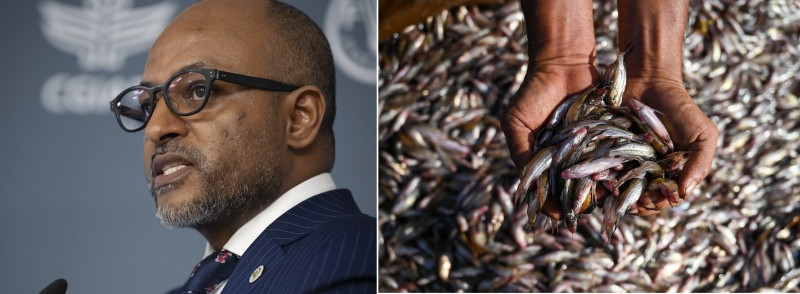

WASTAGE is a major cause of the present global food shortage which is now apparent following the global supply chain crises after some two years of lockdowns due to the deadly Covid-19 pandemic.
While there is no denying that the growing population is also a factor, with the population expected to reach nine billion by 2040 from 7.88 billion in 2021, WorldFish's director-general Dr Essam Yassin Mohammed said one of the main contributors is the alarming level of food wastage.
"We of course face challenges over how to increase supply to meet demands from population growth. But the main culprit is food-wastage which accounts for one-third of the total output of food the world produces, Essam told The Vibes in Penang.
WorldFish is an international aquatic organisation with a presence across 20 countries while Batu Maung in Penang is now its global headquarters.
Its core business is in the research and development of commercial seafood.
According to Essam, the food chain is bountiful but the shortage comes from wastage and mishandling such as the lack of refrigeration.
"We can increase output through our food chain and systems but on the same token we must reduce wastage," he said.
Each country must undertake campaigns to reduce food wastage, including in Malaysia, said Essam.
Among WorldFish's notable achievements is multiplying the tilapia species through genetic improvements at the aquaculture schemes in fish farms (GIFT).
The United Nations Food and Agriculture Organisation (FAO) says that by 2032, fish consumption is projected to reach 21.2 kg per capita globally – up from 20.4 kg in the base period (average 2020 - 2022).
Differences across continents will persist and increase, as the strongest growth is expected in Asia, which already has the highest per capita consumption.
Another interesting point is that currently, Asia as a region (excluding China) contributes around 50% of global fish and seafood production with Africa contributing around 6.6%.
There is immense opportunity in aquaculture to produce abundant and nutritious food that improves people’s livelihoods.
With Asia as the region with the most experience and expertise in aquaculture, WorldFish has recently begun a programme called the Africa-Asia BlueTech Superhighway, which focuses on south-south collaboration, which essentially means the sharing and adapting of practices across nations.
Essam also acknowledges that climate change is altering fish breeding and in some cases, endangering certain species, and the task ahead to save the planet of aquatic life needs stronger willpower from all stakeholders.
Asked about the effects of reclamation on marine life, Essam replied that it is not unique to Penang, it has been a problem for centuries in many parts of the world.
"As we reclaim from the water bodies, it essentially destroys the habitat for some fishes such as mangrove swamps which are nurseries for fishes."
Therefore, there is a need to strike a balance and town planners need to understand that by destroying mangrove swamps or forests is destroying the nursing grounds for the fish.
The fishing grounds would also be disrupted by reclamation and the impact can be huge on the fishermen, and on the ecosystem as a whole, said Essam.
WorldFish believes that sustainable management of the ecosystem is a crucial lifeline for the marine industry to thrive so areas such as coral reefs, mangroves and other wetlands need more attention in terms of environmental protection, he said.
As for the shortage of seafood on the dining table, Essam said that it is a global phenomenon with many nations suffering from high inflation owing to the disruption in the supply chain.
There is also a depletion of resources, which is driving up the prices.
"What it means is that a significant part of the population's low-income groups may see seafood as no longer affordable for them to consume."
It is a worrisome trend as price hikes affect the people, with malnutrition as a result.
There needs to be a policy intervention by countries to address poverty and hunger besides the malnutrition which comes from it, said Essam.
WorldFish employs 90 Malaysian staffers at its headquarters of which 60% are women.
Its common messaging is that there is a need for collective responsibility to provide quality food globally and the need to live in harmony with the planet, which provides an abundance of resources for life to persist. - The Vibes, March 28, 2024.



.jpeg)











.jpeg)