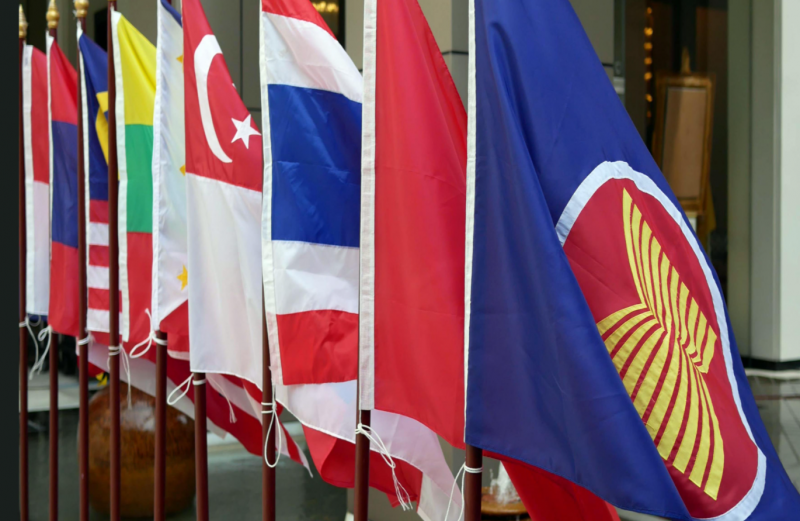
THE LEAD of a key intergovernmental platform in the Asia-Pacific has urged Southeast Asian economies to strengthen regional cooperation and boost investment.
This to cushion against the fallout from US President Donald Trump’s move to impose steep tariffs on imports from China, Canada and Mexico.
“With economic uncertainty from US tariffs, ASEAN has an opportunity to build a stronger, more resilient trade network by deepening regional integration,” Under-Secretary-General of the United Nations Armida Salsiah Alisjahbana told Bernama in an interview.
Alisjahbana, who is also Executive Secretary of the United Nations Economic and Social Commission for Asia and the Pacific (ESCAP), said UN bodies were monitoring the impact of the tariffs, which were imposed only weeks ago, on regional economies, including ASEAN.
ESCAP, the largest UN body promoting regional development in the Asia-Pacific, includes ASEAN and Malaysia among its members.
She did not rule out the possibility that US tariffs, along with Washington’s broader trade policies—including levies on steel and aluminium imports—could weigh on the economies of America’s trading partners.
After Trump signed executive orders imposing tariffs of up to 25 per cent on imports, economists raised concerns that any hit to China could reverberate across ASEAN, whose economies are closely tied to the Asian superpower.
“Instead of relying solely on external markets, ASEAN should continue enhancing intra-regional trade, sustainable investment and digital connectivity,” she said in a Bernama exclusive recently.
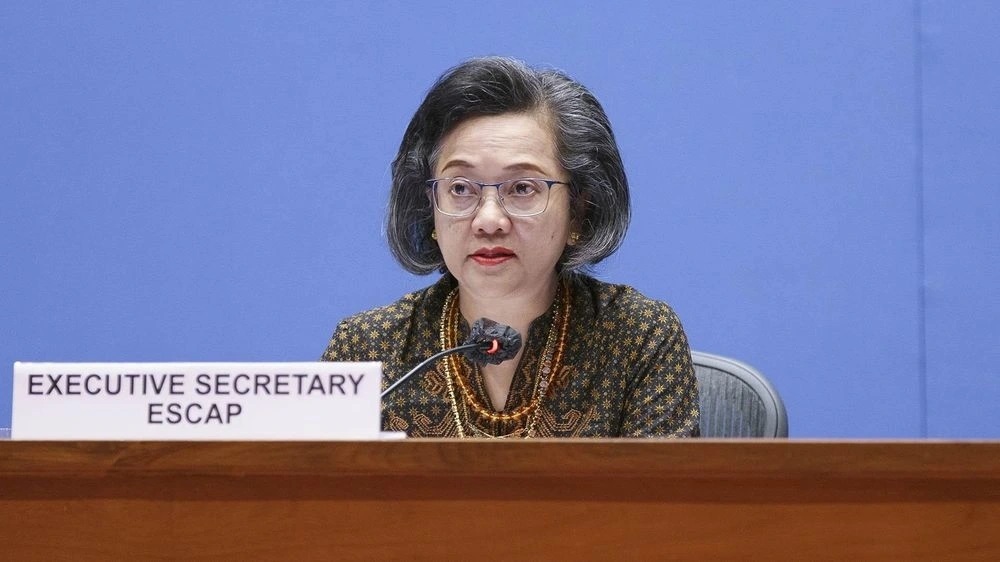
With global economic uncertainty persisting, Alisjahbana (pic, below) urged ASEAN nations to be proactive in diversifying trade partnerships and advancing open, fair and rules-based economic policies.
“We are closely monitoring the evolving US trade policy, particularly its increasing reliance on tariffs and bilateral agreements, which could have significant implications for global trade and investment,” she said.
“I am not in a position to comment on the policies of a specific country, but we do see that many are watching closely as the US shifts its trade and investment stance.
“Their (America’s) approach appears to be moving towards more bilateral engagements, with tariffs and non-tariff measures as key instruments,” she said.
Alisjahbana was on a two-day visit to Malaysia from Feb 17-18, 2025.
She met Prime Minister Datuk Seri Anwar Ibrahim, Foreign Minister Datuk Seri Mohamad Hasan, Housing and Local Government Minister Nga Kor Ming and the Economy Ministry’s Deputy Secretary-General (Macro) Datuk V Valluvan to discuss regional issues.
She acknowledged concerns about the increasing use of trade barriers and their potential to disrupt global supply chains.
ASEAN Must Collaborate To Combat Impacts Of Climate Change, Disaster Risk
Meanwhile, ESCAP has urged ASEAN to adopt a more coordinated approach to tackling climate change, warning that worsening climate-related disasters threaten economic and social stability in the region.
Speaking in an interview with Bernama recently, Armida said the frequency and intensity of natural disasters—such as floods, droughts, and extreme temperatures—have increased due to climate change.
“We are seeing a worrying trend – climate disasters are becoming more frequent and severe, exacerbating economic vulnerabilities. It is no longer just an environmental issue; it is an economic and humanitarian crisis,” she said.
Elaborating, she pointed out that ASEAN countries must scale up both climate mitigation and adaptation efforts, particularly in reducing carbon emissions and strengthening disaster resilience.
“This cannot be done in isolation. ASEAN must act collectively to build a climate-resilient future, integrating climate action into economic planning, trade, and infrastructure development,” she added.
ESCAP is working closely with ASEAN nations to promote policies that integrate climate considerations into regional development strategies, Alisjahbana noted.
She further highlighted Malaysia’s leadership in championing renewable energy, particularly through the expansion of the ASEAN Power Grid.
“Malaysia’s role in promoting renewable energy within ASEAN is commendable. The expansion of the ASEAN Power Grid will help accelerate the adoption of renewables and reduce reliance on fossil fuels,” she said.
She also called for ASEAN’s collective action in disaster preparedness and climate finance, urging regional leaders to develop a robust framework for attracting sustainable investments.
“ASEAN has the potential to be a leader in climate action, but it must move beyond discussions and take decisive action. The upcoming ASEAN summits will be a critical moment for the region to demonstrate its commitment to climate resilience,” she said.
With ASEAN leaders set to deliberate on regional climate policies, ESCAP hopes that Malaysia, as ASEAN Chair, will push for stronger commitments and concrete actions in climate governance.
“We have confidence in Malaysia’s ability to drive ASEAN’s climate agenda forward. It is time for the region to act, and Malaysia’s leadership will be crucial in setting the tone,” she said. – February 23, 2025