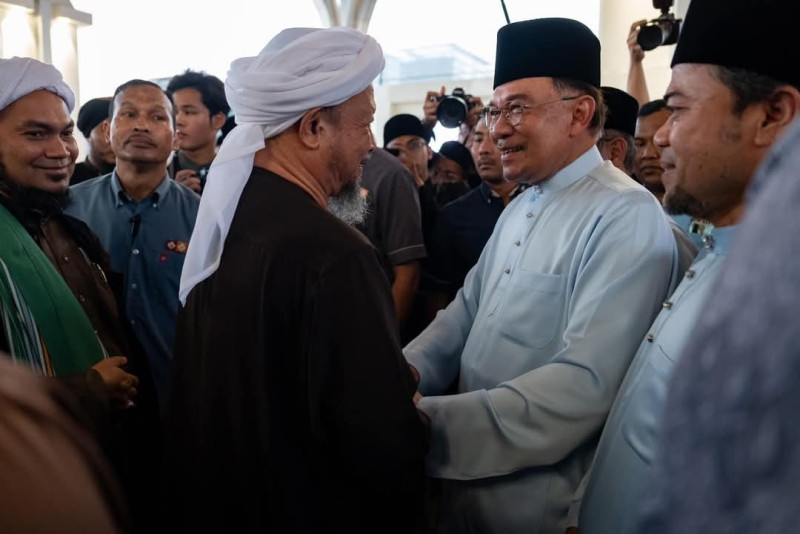
PRIME MINISTER Datuk Seri Anwar Ibrahim has reiterated the importance of reinforcing Islamic policies, particularly in the realm of education, as part of broader efforts to enhance the strength and welfare of the Muslim community in Malaysia.
This was shared during his meeting with a delegation of religious scholars from ‘pondok’ institutions and madrasah in Kelantan, where discussions focused on key Islamic issues, education, and community development.
The Prime Minister’s senior press secretary, Tunku Nashrul Abaidah, revealed that Anwar welcomed the religious scholars to his office this morning, following an invitation extended to them after they attended a breaking-of-fast event at the Tuanku Mizan Zainal Abidin Mosque in Putrajaya the previous day.
Tunku Nashrul explained that the discussions centered on various matters, with the scholars’ sharing insights on strengthening Islamic education and fostering a deeper sense of community.
“The Prime Minister values the scholars’ perspectives, particularly on the importance of turath (heritage books) education and their proposals for empowering ‘pondok’ institutions in Malaysia,” he said.
“They also provided advice on promoting unity, understanding, and love among the Muslim community while eliminating division, and emphasized the need for a clearer explanation of the MADANI government’s initiatives regarding Islam.”
The discussions underscored the shared belief between the Prime Minister and the scholars that more could be achieved through collaboration, especially on matters related to Islam, instead of focusing on differences of opinion.
Tunku Nashrul added Anwar expressed appreciation for the scholars' contributions, acknowledging their role in ensuring that the government’s initiatives align with the best interests of the people and the nation.
Collaborate to enhance national cybersecurity ecosystem
In a separate development, Anwar chaired the National Cyber Security Meeting today, where he urged local cybersecurity experts to collaborate with the government in enhancing Malaysia's cybersecurity ecosystem.
Tunku Nashrul conveyed that the Prime Minister emphasised the government’s strong confidence in local expertise to tackle emerging cyber threats.
“The collaboration between agencies, educational institutions, and local industries will ensure that Malaysia remains well-equipped to face current and future cybersecurity challenges,” he said.
During the meeting, Anwar reaffirmed that cybersecurity is a national priority, with the government, private sector, and citizens all playing vital roles in strengthening the nation's resilience to cyber threats.
Tunku Nashrul added that the meeting addressed several key developments, including a report on the country’s cybersecurity situation, which showed a decrease in cybersecurity incidents from 2023 to 2024.
The status of the implementation of the Cyber Security Act 2024 (Act 854) was discussed, with additional appointments of experts in the National Critical Information Infrastructure (NCII) sector and cybersecurity being noted as part of ongoing efforts to strengthen the nation’s cyber defense.
The meeting also touched on upcoming initiatives, including the organisation of the Cyber Games and an ASEAN-level conference on cybercrime, set to take place in May, hosted by the National Cyber Security Agency (NACSA) in collaboration with the Council of Europe and Interpol. - March 11, 2025