CHINA has reaffirmed its commitment to safeguarding the multilateral trading system, calling on members of the World Trade Organization (WTO) to stand together against what it described as rising unilateralism and trade protectionism, particularly from the United States.
In a video call with WTO Director-General Ngozi Okonjo-Iweala on Friday, Chinese Commerce Minister Wang Wentao criticised Washington’s recent move to impose retaliatory tariffs, saying it amounted to “unilateral bullying” that disproportionately harms developing economies.
“Such actions could bring serious negative consequences for developing countries, especially the least developed nations, and even trigger a humanitarian crisis,” Wang warned, according to a statement from China’s Ministry of Commerce released on Saturday.
The two officials exchanged views on a range of pressing trade issues, including China’s response to the United States’ escalating tariffs and the broader role of the WTO in maintaining stability within the global trade framework.
Wang urged WTO members to resist what he described as protectionist and coercive trade practices by advocating for “openness, cooperation, and multilateralism” in response.
Echoing these concerns, Okonjo-Iweala acknowledged the increasing strain on global commerce and economic growth prospects due to heightened trade tensions. She said it was essential that WTO member states “work together to uphold a multilateral trading system that is open and rules-based” and resolve their disputes “through dialogue and cooperation under the WTO framework”.
The renewed tensions come in the wake of a sweeping tariff announcement by US President Donald Trump on 2 April. The US is imposing a 10% baseline tariff on imports from most countries, with steeper duties of up to 24% on imports from a select group of nations, including Malaysia.
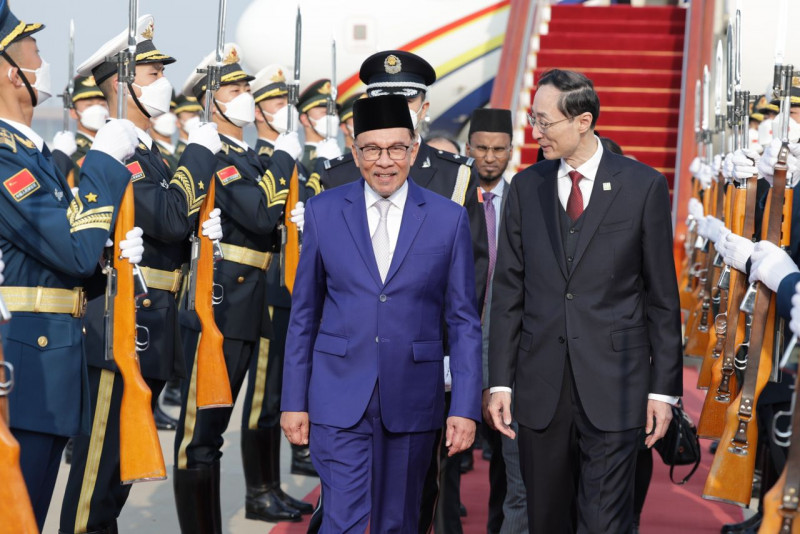
In line with China’s call, Malaysia will lean on diplomatic efforts and regional cooperation to navigate the growing headwinds of international trade tensions, Prime Minister Datuk Seri Anwar Ibrahim said, following the United States’ latest round of tariff announcements that could significantly affect the country’s key export sectors.
Speaking at the 2025 state-level MADANI Hari Raya celebration in Butterworth, Penang, on Saturday, Anwar expressed concern over the implications of US President Donald Trump’s newly imposed tariffs, which he said could deal a direct blow to Malaysian industries — especially semiconductors.
“Sixty-five percent of Malaysia’s semiconductor exports are dependent on the US market,” Anwar said, highlighting the country’s vulnerability to shifts in American trade policy.
“However, we are not without options,” he continued. “We can either surrender to these challenges or find a way out of this situation. I firmly believe we must make full use of our strong ties with the United States, China, Europe and ASEAN to forge a comprehensive solution.”
Malaysia’s semiconductor industry, one of the pillars of its manufacturing and export economy, stands particularly exposed amid the spiralling trade friction between major global powers.
Analysts have warned that even indirect effects — such as disruptions in supply chains or reduced demand due to tariffs on intermediary goods — could hinder Malaysia’s economic momentum.
Anwar’s remarks come in the wake of Washington’s decision to introduce a 10% baseline tariff on most imports, with higher rates targeting selected countries, including Malaysia, though the latter has been temporarily exempted.
Despite the exemption, the prime minister made it clear that Malaysia must act strategically. Rather than escalating tensions or taking a confrontational stance, he said the country would prioritise dialogue, partnerships and regional unity to protect its economic interests.
“Our position is to focus on diplomacy and regional consensus,” Anwar said. “We will not act recklessly. The world is watching, and Malaysia must remain a responsible, pragmatic voice in global trade.”
The Prime Minister also reiterated the importance of aligning Malaysia’s trade strategy with broader ASEAN efforts, noting that regional unity will be essential in responding effectively to growing protectionism in global markets.
Anwar warned that the US tariffs — though temporarily exempting Malaysia — could still deal a blow to the country’s trade-dependent economy due to the indirect impact on its key trading partners.
“This situation not only affects China’s economy but also has repercussions for Malaysia, even though we are currently exempted from the implementation of these tariffs,” Anwar said.
“When high tariffs are imposed on China, it inevitably affects our trade and investment ties with them,” he added.
Malaysia, he noted, remains highly vulnerable to disruptions in global trade policy due to its role as an export-driven nation. “We are a trading and exporting country. When the US imposes high tariffs on China, we will certainly feel the impact as well.”
The prime minister welcomed the temporary exemption granted to Malaysia and several ASEAN countries, but cautioned that the risk remains as long as tariffs on China are in place. – April 13, 2025