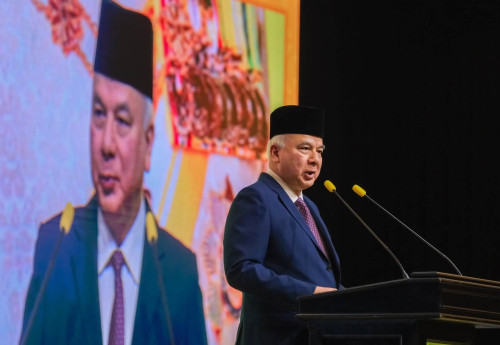
ASEAN’s longstanding policy of neutrality in navigating relations between the United States and China continues to be central to the bloc’s diplomacy and regional cohesion, said Finance Minister II Datuk Seri Amir Hamzah Azizan.
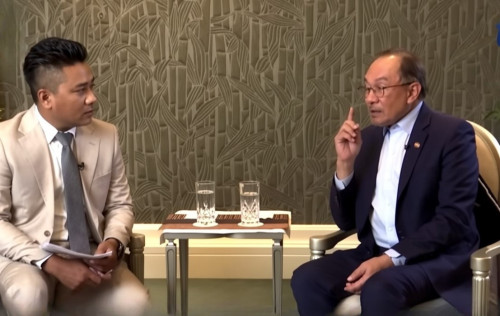
Speaking at the ASEAN Leadership Forum hosted by the Centre for Strategic and International Studies (CSIS) in Washington, DC, on Friday, Amir said the bloc’s ability to engage both superpowers without taking sides has proven successful over the years and will remain a core strategy.
“So, while the US position and the Chinese position may have very different stances along the way, what ASEAN has been good at over all these years is to maintain some sense of neutrality – some sense of being able to trade with each other, to trade with both sides without getting into very difficult ‘gaps or mess’ along the way,” he said.
“And I think that's what we will continue to want to do, because a much more harmonious, much more open mechanism allows for a better outcome than a fractured mechanism. This has been proven in the past, and ASEAN wants to continue to work towards that in the future.”
Amir, who represented Malaysia in its role as ASEAN Chair, said the bloc’s neutral stance allows its 10 member states to manage global competition while preserving regional stability and pursuing economic growth.
Responding to a question on whether individual ASEAN members pursuing separate ties with the US undermines regional unity, Amir said ASEAN’s diversity must be acknowledged.
“Singapore is probably very high up the value chain, and other members may not be so high up, and the nature of their exports and imports is also very different (from each other) and the skill sets that exist in the countries are very different,” he said.
He emphasised that while each country has different priorities, the bloc continues to identify shared areas of cooperation, including enhancing intra-ASEAN trade, improving infrastructure, and fostering economic predictability.
“So, there is no misalignment in that instance, and we will continue to push to enable greater inter-ASEAN trade and predictability, and deployment of joint projects in infrastructure and so on that are beneficial for the ASEAN economy overall.”
Touching on the impact of global trade tensions, particularly tariffs imposed by the US, Amir said ASEAN’s initial response was guided by restraint.
“So the first response that ASEAN said was actually, ‘Don’t fight it,’ because when you actually dig in positions, you don’t create an environment where conversations can actually occur. Hence the non-retaliatory mechanism that we talked about,” he explained.
While the tariffs are now on hold, countries such as Cambodia, Laos, and Vietnam had faced combined baseline and retaliatory duties of over 40 per cent. Malaysia and Brunei were each subjected to 24 per cent, while Singapore faced the lowest rate at 10 per cent.
Amir reiterated that ASEAN remains committed to a multilateral, rules-based system.
“We want a rule-based mechanism to continue to exist. And I think each member state has a grip on those high-level principles,” he said.
However, he added that the bloc also recognises the need for flexibility. “We are also practical in understanding that there may be differences between each state, and there may be differences in prioritisation that each state may want. Hence, bilaterals will continue to exist.”
He said member states are free to pursue what makes sense for their national interest, but they are also expected to avoid actions that may inadvertently disadvantage others.
“There are regular ongoing communications between ASEAN members to make sure we don’t pin other members into corners,” Amir said. “I think that’s the best outcome – giving flexibility that addresses the gaps in development growth while allowing members to exercise their sovereign rights to move on.”
He concluded that ASEAN’s diversity should not be viewed as a weakness, but rather as a strength that enables the bloc to operate cohesively while accommodating the unique needs of each member. - April 26, 2025