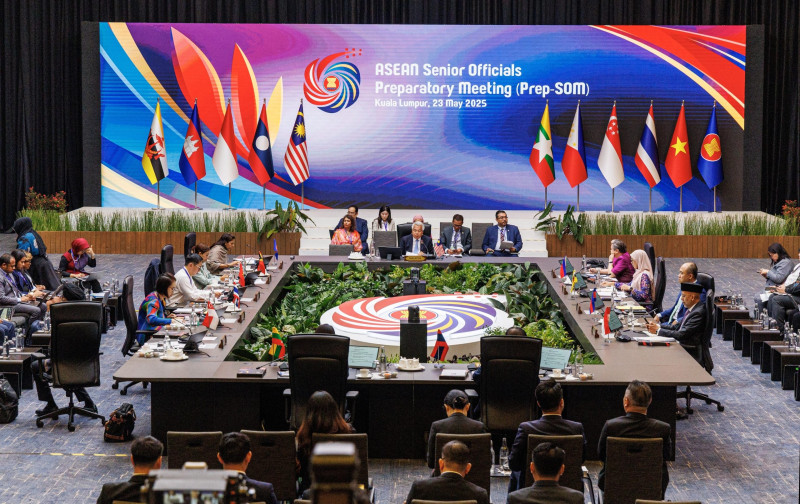
AS ASEAN prepares to convene its 46th Summit next week, regional experts are calling for urgent reform of the ASEAN Political-Security Community (APSC), warning that its current framework is ill-equipped to deal with mounting traditional security threats and the rising geopolitical tensions reshaping the Indo-Pacific.
Dr Rahul Mishra, Associate Professor at the Centre for Indo-Pacific Studies, Jawaharlal Nehru University, and Collins Chong Yew Keat, Foreign Affairs and Security Analyst at Universiti Malaya, argue that ASEAN’s existing security architecture must evolve if it is to remain credible and effective in the face of increasingly complex global challenges.
“The limited response to the post-coup crisis in Myanmar highlights ASEAN’s institutional weaknesses in enforcing norms and responding decisively to internal conflicts,” said Dr Mishra, who also serves as Senior Research Fellow at the German-Southeast Asian Centre of Excellence for Public Policy and Good Governance, Thammasat University. “Similarly, progress on resolving the South China Sea dispute remains negligible.”
As the ASEAN Community Vision 2045 is expected to be launched during the summit, he stressed the need for an agile and inclusive APSC 2.0, designed to anticipate emerging challenges over the next two decades.
“APSC must strengthen internal cohesion and present a united, collective stand on issues that matter most. A revised policy approach on the Indo-Pacific, Myanmar, and South China Sea dispute is urgently needed,” he said.
Mishra urged Malaysia, as the 2025 ASEAN Chair, to steer a more action-oriented approach to the bloc’s Five-Point Consensus on Myanmar, reinvigorate efforts on the Code of Conduct in the South China Sea, and advocate for multilateral frameworks in dispute resolution.
He also called for the APSC to assume a firmer leadership role in promoting regional rules-based mechanisms, particularly in maritime conduct, cyber governance, and regional crisis management.
Chong echoed the call for reform, warning that the APSC risks irrelevance unless it breaks from what he described as “past stagnation.”
“It must have the audacity to initiate new defence alliances and create a robust, credible, and multi-layered deterrence capacity, beyond reliance on diplomacy and goodwill,” he said. “The new model will have to be based on external support and deterrence in security, and cannot be confined to a regionally based self-defence capacity alone.”
He noted that the APSC has largely been confined to managing non-traditional threats, with little success in addressing state-led high-intensity conflicts due to varied geopolitical alignments among ASEAN member states.
“These differing degrees of engagement with China and the United States have limited the bloc’s ability to present a unified front on security matters,” he added.
Chong also emphasised Malaysia’s expected role in pressing for the acceleration of the Code of Conduct in the South China Sea and in addressing the simmering India-Pakistan conflict by advocating for regional de-escalation.
On Myanmar, he said Malaysia should capitalise on its new engagement strategy involving both the junta and the National Unity Government (NUG), while building consensus among key ASEAN members, especially Thailand.
“This is a new opportunity to break with past divisions and push for innovative, parallel solutions outside the narrow confines of the Five-Point Consensus,” he said.
The 29th APSC Council Meeting will take place on Sunday, ahead of the 46th ASEAN Summit at the Kuala Lumpur Convention Centre from 26 to 27 May. Key items on the agenda include regional security alignment in light of US-China tensions, economic fallout from protectionist policies, and transnational issues such as cyber fraud and crime.
Themed “Inclusivity and Sustainability,” the 2025 summit marks Malaysia’s fifth time chairing ASEAN, after its previous terms in 1977, 1997, 2005, and 2015. - May 24, 2025