TRADERS across Malaysian wet markets are facing increasing difficulties in maintaining prices of goods following the expansion of the Sales and Services Tax (SST), as higher raw material costs and a noticeable drop in customers take their toll.
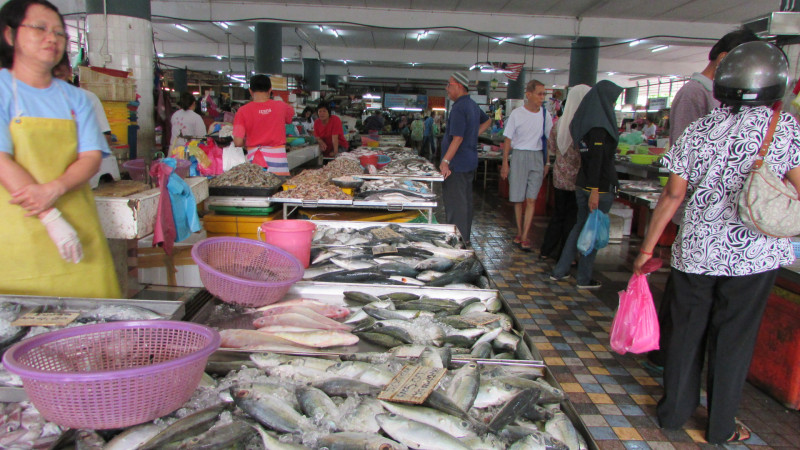
A survey conducted by Harian Metro at Chow Kit Market revealed that the impact of the SST, which came into force earlier this month, has led to a marked decline in daily sales. Many traders reported that customers are now spending more cautiously, resulting in fewer purchases.
While imported goods have become more expensive, local staples such as fish, squid, prawns and chicken have also recorded price hikes ranging from 50 sen to RM5, depending on quality and size. Prices remain unstable and are heavily influenced by market supply.
Jack Lee, 34, who sells wet goods, said the cost of salmon had risen to RM90 per kilogram from RM80 prior to the five per cent sales tax.
“Salmon now costs RM90 per kilogram, compared to just RM80 previously — that’s a RM10 difference. For local fish like mackerel, it’s RM13 per kilogram, compared to around RM9 before,” he said.
“There’s no denying the number of customers has declined, probably due to SST. I believe people are planning their daily spending more carefully.”
Lee added that large squid was currently priced between RM36 and RM40 per kilogram, though rates varied with supply and demand.
Chicken seller Mohd Ismail, 61, said prices now hover between RM9 and RM9.50 per kilogram, and that the increase had begun even before the SST came into effect.
He noted a significant drop in customer numbers, making it difficult to recover his capital.
“When prices go up, they go up significantly — but when they come down, it’s only by a little. Now that buyers are fewer, it’s hard to even recover my capital,” he said.
“But as long as I can endure, I’ll continue — this is my family’s livelihood.”
Private sector employee Muhd Idris Edy Yanto, 30, said the SST has impacted his household budget, despite not all essential goods being affected.
He said the prices of key children’s items such as milk formula and disposable nappies had risen over recent months, making him more discerning in his spending.
“Not just daily essentials, but wet goods have also gone up in price. So, we need to shop around for cheaper places or the burden becomes real,” he said.
Separately, two companies — one involved in ice production and the other in frozen food supply — have agreed to delay planned price increases following discussions with the Ministry of Domestic Trade and Cost of Living (KPDN).
Minister Datuk Armizan Mohd Ali said the ministry met with company representatives after social media posts suggested that they would raise prices due to the expanded SST.
“So far, they’ve postponed their initial plans to increase prices this July to a later date, pending further review,” he said.
“However, during the meeting on 1 July, neither party cited SST as the reason. They mentioned operational costs as the main factor.”
Armizan noted that any decision to raise prices must be supported by specific documentation as required under Section 21 of the Price Control and Anti-Profiteering Act 2011.
He also urged the public to continue reporting any businesses suspected of unjustified price hikes.
Earlier, viral claims suggested that one ice producer planned to raise the price of a block of ice from RM3.70 to RM6, while a frozen food firm was allegedly preparing a 10 per cent price increase starting this month. - July 3, 2025