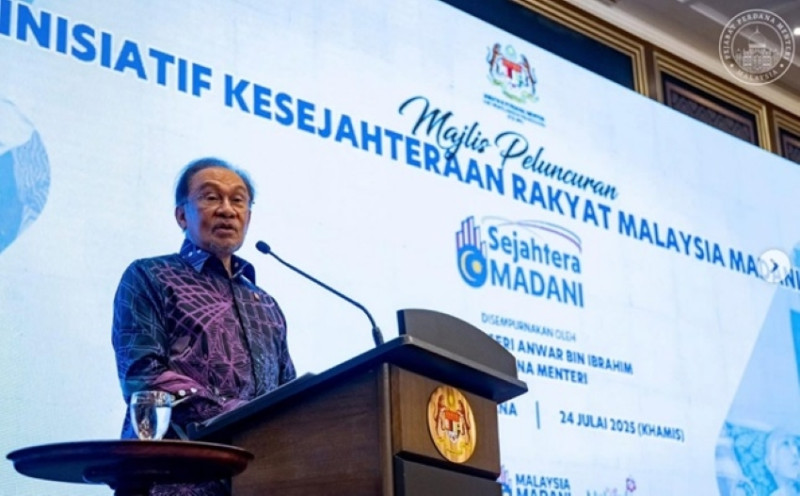
THE newly launched Sejahtera MADANI initiative represents a decisive shift in Malaysia’s approach to poverty, merging the strength of national policy with local wisdom, precise data, and community-centred implementation.
Bernama reported that according to scholars, this holistic framework goes beyond welfare assistance to reframe poverty as a structural and multidimensional challenge requiring systemic reform.
“This is not simply another social aid programme,” said Professor Dr Zainal Abidin Sanusi of the International Islamic University Malaysia’s Department of Political Science and MADANI Studies. “Sejahtera MADANI signals a strategic transformation in our understanding of poverty – it is about structural reform and unified, people-centred action.”
The initiative, officially launched by Prime Minister Datuk Seri Anwar Ibrahim on 24 July, is spearheaded by the Implementation Coordination Unit of the Prime Minister’s Department (ICU JPM). It has already secured over RM120 million and is focused on assisting poor and hardcore poor households registered under the national eKasih database.
Professor Zainal, who also leads the university’s Sejahtera Centre for Sustainability and Humanity, explained that Sejahtera MADANI harmonises previously fragmented programmes – including the Rakyat Sejahtera Housing Programme (PPRS), Amanah Ikhtiar, and Tekun – through a household-based model that targets Heads of Households (KIR) and their dependants (AIR), anchored in four key domains: income, education, housing, and welfare.
“This unified model marks a critical shift in how we deliver aid,” he said. “It acknowledges that poverty is not just about financial deprivation, but is tied to education access, mental health, dependence on aid, and the silencing of community voices in development.”
He noted that the initiative also responds to long-standing challenges in micro-level governance and outdated data, which have historically weakened the impact of otherwise sound policy designs.
“A major strength of Sejahtera MADANI is its grassroots empowerment,” he added. “It reframes local implementers as development enablers, rather than mere aid distributors.”
Among the community-based components of the initiative are programmes such as Sekolah Angkat MADANI, Kampung Angkat MADANI, Komuniti\@UniMADANI, and Bakti MADANI – all of which, Zainal argued, should be strategically consolidated under the Sejahtera MADANI umbrella to avoid duplication and fragmented delivery.
“The vision is for a mutually reinforcing ecosystem of action, guided by community values and grounded in real-time, localised data,” he said.
A transparent monitoring system has also been embedded into the initiative to ensure adaptability to changing socio-economic conditions, and to reinforce accountability in both design and delivery.
Professor Zainal further called for the remapping of poverty hotspots through community-level assessment, warning against over-reliance on outdated macro indicators.
Crucially, he welcomed the government’s decision to upgrade the eKasih database, stating that more precise, inclusive data is essential for fairer distribution and long-term impact.
“Sejahtera MADANI is a forward-looking strategy,” he concluded. “It not only empowers poor communities through financial literacy and self-worth, but calls for a complete cultural shift in governance – one anchored in integrity, consistent political will, and genuine local engagement.”
With its emphasis on dignity, inclusion, and sustainability, Sejahtera MADANI is being hailed by experts as a vital blueprint for reshaping Malaysia’s poverty alleviation landscape, rooted in the values of the Malaysia MADANI framework. - July 29, 2025










.jpeg)