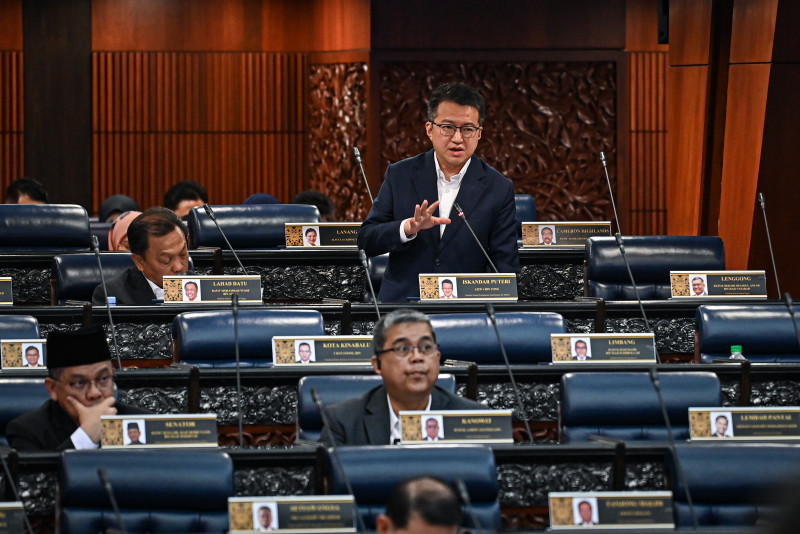
MALAYSIA’S furniture industry is under considerable strain, with MP Tan Hong Pin (Bakri) urging urgent policy reforms and the formulation of a 10-year master plan to safeguard the sector’s future. Speaking in the Dewan Rakyat on 5 August 2025 under Standing Order 17, he cautioned that without intervention, the industry — particularly concentrated in Muar — risks losing global market share.
“Muar alone contributes 60 per cent of Malaysia’s furniture exports, worth over RM11 billion a year. Yet the industry now teeters on the brink due to global inflation, disrupted supply chains, and a surge in operational costs,” Tan said.
He highlighted two immediate policy concerns: the widened scope of the Sales and Services Tax (SST) implemented from 1 July 2025, and a new 19 per cent US tariff on Malaysian furniture exports, effective 8 August.
“This will severely undermine our price competitiveness, particularly against Vietnamese exporters who face only a 20 per cent tariff,” he said, questioning whether Malaysian authorities had secured any tariff exemptions during negotiations with Washington.
In a written reply, the Deputy Investment, Trade and Industry (MITI) Minister Liew Chin Tong confirmed the US tariff rate at 19 per cent, not 25 as previously reported, and acknowledged that concerns over SST expansion had been escalated to the Ministry of Finance for consideration.
Tan also raised structural challenges in labour recruitment, particularly the rigid enforcement of an 80:20 local-to-foreign worker ratio — a policy he deemed ill-suited to labour-intensive sectors such as furniture manufacturing.
“Employers are struggling to source local labour, which in turn disrupts production. Will the government consider implementing targeted, industry-specific quotas and provide incentives for hiring Malaysians?” Tan asked.
Liew responded that the 80:20 quota had been suspended since December 2024 and would remain so until the multi-tiered levy mechanism (MTLM) is fully rolled out.
The deputy minister added that MITI is considering extending the work tenure of skilled foreign labourers beyond the existing 12-year cap, while reiterating its broader shift — as outlined in the 13th Malaysia Plan — away from dependence on low-skilled foreign workers.
Tan further raised concerns about export delays linked to the Non-Preferential Certificate of Origin (NPCO), following MITI’s takeover of the process in May 2025. He cited complaints of processing delays, inconsistent standards and understaffing.
MITI acknowledged the feedback and noted several contributing factors, including incomplete applications, third-party disruptions and exporters misrepresenting origin status. In some cases, it said, materials are sourced entirely from China and only undergo light assembly in Malaysia, yet exporters falsely declare the products as Malaysian-made.
“This practice contravenes Rules of Origin. Site inspections are therefore essential to uphold the integrity of Malaysia’s export documentation,” MITI said.
The Ministry also set out its Key Performance Indicators for NPCO applications: five working days for cost analysis, 14 days for US-specific cases, and three days for fully compliant standard applications.
It added that NPCOs are not a legal requirement for exports to the United States but are usually furnished at the request of importers. Applications that fail to meet eligibility or documentation standards will not be certified.
On the issue of market distortion by foreign entities, Tan flagged the abuse of Malaysia’s visa-free policy by unregistered companies allegedly undercutting prices and operating without proper licensing.
MITI acknowledged the problem and revealed that the Malaysian Investment Development Authority (MIDA) would no longer actively promote foreign direct investment (FDI) in the furniture sector. “MIDA’s overseas offices will be informed that the domestic furniture industry has reached global maturity and no longer requires FDI in labour-intensive segments,” Liew said.
In terms of government support, MITI confirmed continued access to the Market Development Grant (MDG) under MATRADE, with funding of RM25,000 for overseas trade promotion events and RM5,000 for domestic ones.
To date, 314 furniture companies have benefited from the MDG scheme, with 4,148 applications approved, amounting to RM12.25 million disbursed and RM1.46 billion in export value generated between January 2021 and July 2025.
On investment trends, MIDA reported the approval of 1,533 furniture-related projects with a total investment value of RM11.62 billion as of March 2025 — 62 per cent of which came from domestic sources.
Liew said that a broader vision for the furniture sector had been embedded in the New Industrial Master Plan 2030 (NIMP 2030), which lays out a strategy to transition manufacturers from Original Equipment Manufacturers (OEMs) to Original Design (ODM) and Own Brand Manufacturers (OBM), supported by stronger ESG compliance and improved market access.
Tan, however, called for a dedicated 10-Year Furniture Industry Master Plan that addresses labour realities, raw material supply, and long-term export competitiveness.
“The furniture sector supports tens of thousands of jobs and contributes meaningfully to GDP. It deserves strategic policies that are not only realistic but also future-ready,” Tan added. - August 5, 2025