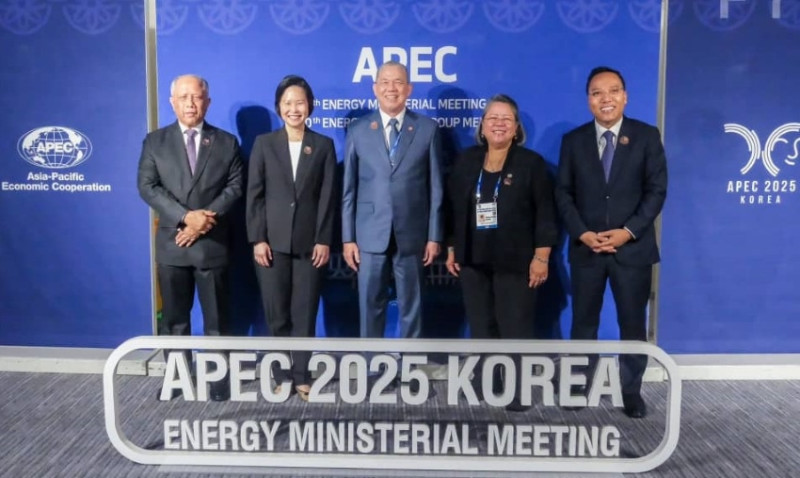
DEPUTY Prime Minister Datuk Seri Fadillah Yusof’s recent official visit to Busan has underscored Malaysia’s growing leadership in the regional clean energy transition, reaffirming the country’s commitment to achieving 70 per cent renewable energy capacity by 2050.
Representing Malaysia at the 15th Asia-Pacific Energy Ministerial Meeting (Apec EMM15) and the 16th Clean Energy Ministerial (CEM16), Fadillah outlined Malaysia’s strategic direction on clean energy, highlighting the role of solar, hydropower, green hydrogen, and digital demand-side management in achieving its long-term energy goals.
“Our interventions have reinforced Malaysia’s readiness to strengthen regional cooperation while accelerating our clean energy ambitions both domestically and within ASEAN,” Bernama cited him saying.
A central focus of Malaysia’s energy diplomacy was the ASEAN Power Grid, which Fadillah described as a key initiative for enhancing regional electricity supply security through greater interconnectivity.
Fadillah, who also holds the Energy Transition and Water Transformation portfolio, expanded Malaysia’s bilateral engagements through meetings with regional counterparts, including Hong Kong’s Secretary of Energy Chin Wan Tse, Brunei’s Minister at the Prime Minister’s Office Major General (Retired) Dato Paduka Seri Halbi Mohammad Yussof, and South Korea’s Minister of Trade, Industry and Economy Jung-Kwan Kim.
Malaysia also engaged with New Zealand, which offered expertise in geothermal energy and expressed interest in liquefied natural gas (LNG) regasification, while industry players from the United States and South Korea showed readiness to support Malaysia’s nuclear energy ambitions.
“We also met with industry players from the United States and South Korea who offered their expertise and technology in nuclear energy, showing their willingness to collaborate and support Malaysia,” Fadillah said.
As part of the working visit, the Malaysian delegation toured South Korean energy companies, including Doosan Enerbility, to assess turbine manufacturing capabilities—a crucial component for future power plant projects amid ongoing supply challenges.
Bilateral discussions also covered hydrogen technology, energy efficiency, nuclear energy for power generation, waste-to-energy projects, and deeper cooperation to enhance ASEAN power grid links.
Malaysia’s position as a significant global energy player remains strong, ranking as the world’s fifth-largest LNG exporter, with nearly 28 million tonnes exported last year, primarily to Japan, China and South Korea.
In the renewable energy sector, Malaysia has begun exporting 50 megawatts of electricity to Singapore via the Energy Exchange Malaysia (Enegem), with plans to scale up exports in the coming years.
Guided by the National Energy Transition Roadmap (NETR) and the New Industrial Master Plan (NIMP) 2030, Malaysia’s target of 70 per cent renewable energy capacity by 2050 is projected to require RM637 billion in investments, spanning grid modernisation, energy storage, and capacity expansion.
During Apec EMM15, energy ministers from member economies jointly recognised the urgency of deploying technologies that expand energy access, modernise infrastructure, and foster innovation while respecting national circumstances.
“Through these efforts, we will foster strong, balanced, secure, and sustainable economic growth,” the ministers said in a joint statement.
The conference, hosted in Busan on 27–28 August under the theme “Accelerating Sustainable, Affordable, Reliable, Secure and Innovative Energy for a Prosperous Future”, aligns with Apec Korea’s overarching 2025 theme: “Building a Sustainable Tomorrow: Connect, Innovate, Prosper.”
The joint communiqué also highlighted the importance of voluntary cooperation, knowledge exchange and capacity building to enhance energy security and resilience across the Asia-Pacific region.
Fadillah concluded his trip with an engagement session with the Malaysian diaspora in Busan, in conjunction with the upcoming 68th Merdeka celebration.
He was accompanied by Malaysia’s Ambassador to South Korea, Datuk Mohd Zamruni Khalid, and Deputy Secretary-General (Energy) of the Energy Transition and Water Transformation Ministry, Mareena Mahpudz.
According to the Malaysia External Trade Development Corporation, South Korea was Malaysia’s 11th largest trading partner and export destination between January and July 2025. Total trade during the period stood at US$15.69 billion, with Malaysia’s exports rising 12.9 per cent to US\$8.77 billion and imports from South Korea increasing 15.2 per cent to US\$6.91 billion.
For the full year of 2024, bilateral trade totalled US$24.42 billion. For 2024, bilateral trade totalled US$24.42 billion. - August 30, 2025