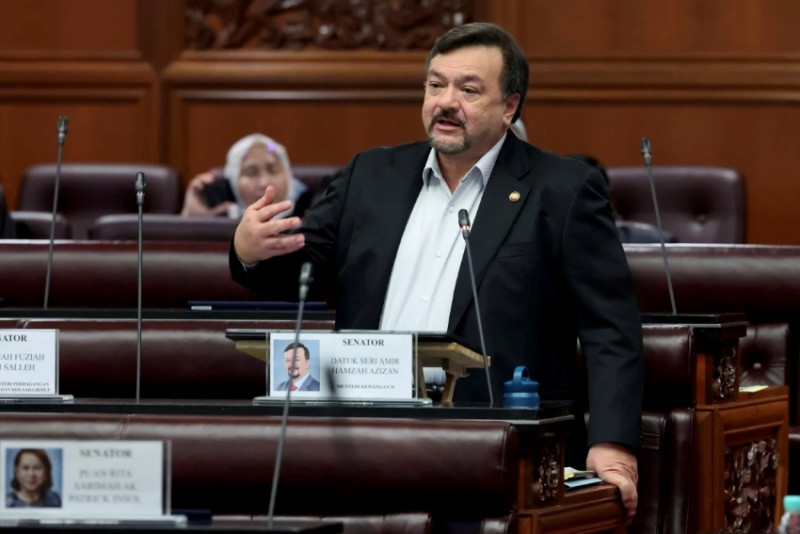
THE Government Procurement Bill 2025 is a pivotal instrument in Malaysia’s commitment to institutional reform and financial integrity under the MADANI economic framework, said Finance Minister II Datuk Seri Amir Hamzah Azizan, in his winding-up speech in the Dewan Negara on Monday.
Responding to interventions from 18 Senators, Amir underscored that the Bill codifies transparent procurement practices into law, replacing the current administrative regime and placing clear limits on ministerial discretion.
“This Bill does not enhance ministerial powers — quite the opposite. It restricts them,” Amir stated, addressing concerns about perceived overreach by the Finance Ministry.
“Previously, the Finance Minister had wide latitude under the Financial Procedure Act 1957. Now, the powers are codified, subject to legal oversight, and challengeable under law,” he said, referencing provisions on mandatory disclosure of interests (Clause 37), mechanisms for review and appeal (Clauses 61 and 63), and legal liability for interference (Clause 38).
He added, “No one is above the law. Under the Government Procurement Bill, even the Minister of Finance may face punitive measures — fines or imprisonment — if found guilty of interference or non-disclosure.”
Amir noted that government procurement will, for the first time, be governed by statute rather than merely by Treasury circulars. The Bill enshrines key principles including public accountability, transparency, value for money, open competition, and fairness.
Under Clause 10, ministerial approval is only required for high-value procurements — specifically, those exceeding RM50 million for supplies and services or RM100 million for construction works — or where consensus is lacking at the respective ministry’s procurement board. These approvals are now formally regulated and open to scrutiny.
The Bill outlines extensive punitive measures against corruption and abuse. These include fines and imprisonment for offences such as transferring contracts without approval (Clause 35), external interference in procurement decisions (Clause 38), and falsification of information (Clause 82).
“These provisions apply not only to serving officers but also to retired officials, companies, and individuals involved in procurement,” Amir explained. He added that Clause 44 compels procurement officers to report any breach of law to enforcement agencies such as the Malaysian Anti-Corruption Commission (MACC), the Royal Malaysian Police (PDRM), and the Malaysia Competition Commission (MyCC).
On the matter of oversight and dispute resolution, Amir highlighted the establishment of an independent Government Procurement Review Tribunal (Clause 63). This body, he said, will be chaired by members of the Judicial and Legal Service with no fewer than 10 years’ experience, and will exclude anyone with political or commercial interests.
“This is a significant advancement,” he said. “We are institutionalising due process where none previously existed.”
Addressing concerns that the Bill was rushed, Amir pointed out that the drafting process dates back to 2018, though temporarily halted by changes in government in 2020. Under the current administration, engagement resumed in 2023 with more than 2,600 participants consulted — including state governments, statutory bodies, government-linked companies, academics, and civil society organisations such as C4, IDEAS, Transparency International, and Rasuah Busters.
“These inputs were carefully considered in finalising the Bill,” he said.
Amir affirmed that while the law covers both federal and state procurement, decision-making at state level remains the prerogative of Chief Ministers and state-appointed authorities, in accordance with Clause 10 and other relevant provisions.
He added that key national policies — including support for Bumiputera contractors, local SMEs, green procurement, and research-based products — would continue through subsidiary instruments issued by the Treasury Secretary-General. The government is also reviewing proposals to support women and disabled entrepreneurs.
Responding to queries regarding the use of direct negotiations, Amir clarified that such methods would only be allowed under Clause 28 where specific conditions are met — including urgency in the public interest, standardisation, sole-source availability, strategic security concerns, or Bumiputera-exclusive contracts.
“These exceptions are narrowly defined, disclosed publicly, and subject to legal challenge,” he said. “Non-compliance with these requirements constitutes an offence under Clause 85.”
In his closing remarks, Amir urged the Senate to support the legislation as a foundational reform in public sector governance.
“Today, we take a major step toward ensuring that public funds are spent with integrity. Let us not wait for perfection that never arrives. This is a meaningful reform,” he said.
“Ultimately, the principle is simple: public money is a trust — and this Bill reinforces our duty to protect it.”
The Government Procurement Bill 2025 builds on the Public Finance and Fiscal Responsibility Act 2023 and proposed amendments to the Audit Act 1957, collectively representing a significant realignment of Malaysia’s financial governance architecture. - Sept 8, 2025