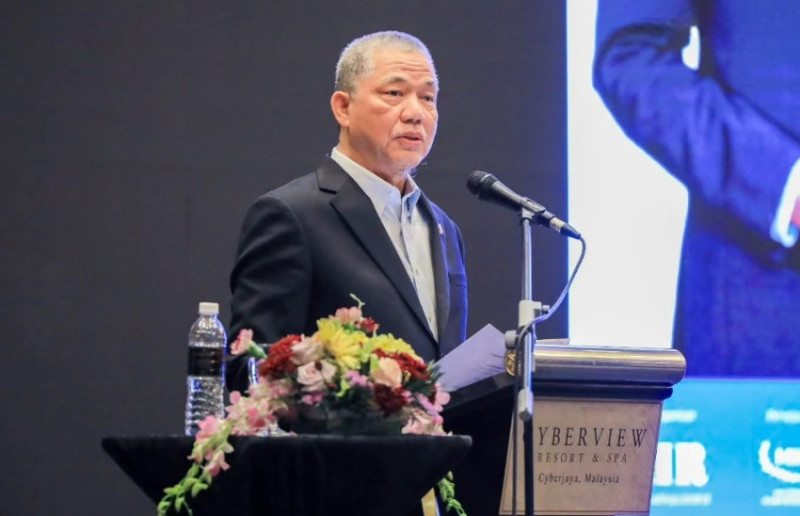
MALAYSIA’S journey toward a cleaner, smarter, and more resilient energy future must be driven by innovation, inclusive partnerships, and enforceable legislation, Deputy Prime Minister and Minister of Energy Transition and Water Transformation Datuk Seri Fadillah Yusof said today.
Speaking at the opening of the International Conference on Chemical and Energy Engineering (ICChEE 2025), held at Universiti Teknologi Malaysia (UTM) in Kuala Lumpur, Fadillah underlined the nation’s firm commitment to its net-zero ambitions under the National Energy Transition Roadmap (NETR).
“This is not a symbolic pledge, but a defining global movement that will reshape economies, societies, and our shared environment for generations,” he said, noting that Malaysia stands with over 140 countries representing 90 per cent of global emissions in setting net-zero targets.
Outlining Malaysia’s strategic six-lever approach to achieving Net Zero Emissions by 2050—including energy efficiency, renewable energy, bioenergy, hydrogen, green mobility, and carbon capture—he emphasised that implementation was already well underway.
“Practical measures are already in motion: large-scale building retrofits, stronger efficiency standards for appliances, and expanded use of biodiesel from B10 to B20 in transport. These are not abstract ideas; they are tangible steps creating visible progress on the ground,” he said.
Fadillah highlighted the rapid expansion of Malaysia’s electric vehicle (EV) ecosystem, supported by over 4,600 public charging points, as part of the country’s green mobility strategy. Simultaneously, the renewable energy share in the national power mix is targeted to reach 70 per cent by 2050, with energy efficiency savings to be doubled.
Key legislative frameworks, including the recently passed Energy Efficiency and Conservation Act 2024 and the New Industrial Master Plan (NIMP) 2030, were also cited as pillars that would ensure Malaysia’s transition is grounded in law and accountability.
The hydrogen economy, Fadillah said, offered “a new frontier of opportunity”, with Malaysia’s Hydrogen Economy and Technology Roadmap (HETR) aiming to position the country as a clean hydrogen hub in the Asia-Pacific by mid-century. The roadmap projects over RM400 billion in revenue and the creation of 200,000 jobs by 2050.
“Pilot projects such as ammonia co-combustion at TNB facilities, achieving up to 60 per cent blending, prove that cleaner fuels can be both scalable and safe,” he said.
Green financing incentives, including the Green Investment Tax Allowance (GITA), Green Income Tax Exemption (GITE), and the Domestic Investment Accelerator Fund for ESG (DIAFESG), are mobilising capital to support this transition.
These instruments are expected to help Malaysia avoid more than 10 million tonnes of CO₂ emissions annually by 2050.
The conference’s theme, “Innovating Net Zero Solutions”, he noted, aligns with Malaysia’s 5D Strategy—Decarbonisation, Decentralisation, Digitalisation, Diversification, and Democratisation—designed to create a future-proof energy ecosystem.
“The path to net zero is not one any nation can walk alone; it is a collective journey that demands shared responsibility and solidarity,” he said, thanking speakers and delegates from Europe, the United States, Asia, Africa, ASEAN, and across Malaysia for their contributions.
Fadillah closed by commending the UTM Faculty of Chemical and Energy Engineering and its partners for hosting the conference, before officially declaring ICChEE 2025 open.
“Let us use this platform to innovate boldly, collaborate deeply, and together, build a brighter and more sustainable future for Malaysia and the world,” he said. - Sept 8, 2025