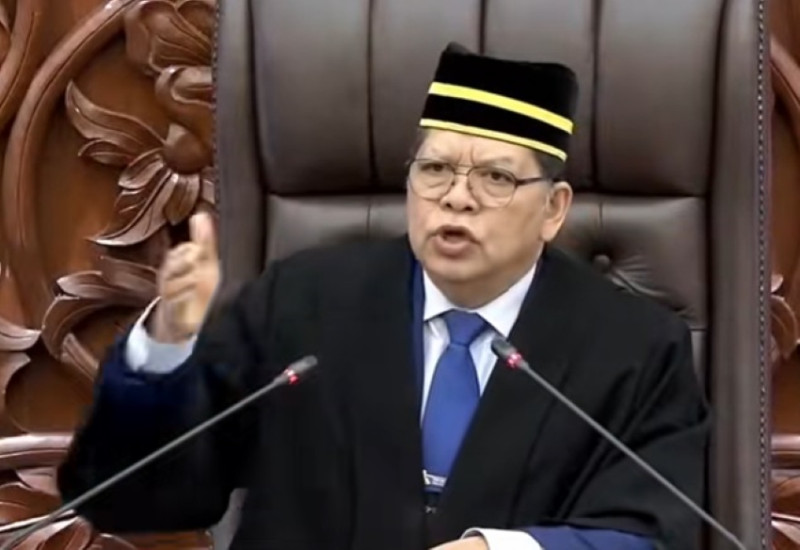
THE Speaker of the Dewan Rakyat Tan Sri Johari Abdul has expressed his satisfaction with the level of maturity shown by Members of Parliament from both the government and opposition during Malaysia’s first-ever Prime Minister’s Question Time (PMQT), calling it a positive step in democratic evolution.
“I am actually satisfied because there is a sense of maturity. I observed that both sides—government and opposition—were well-prepared with their questions,” he said in an exclusive interview with ‘Podcast Utama Buletin TV3’ aired today.
“There were those who praised the Prime Minister, and there were others who were critical of his answers—that’s normal. But it was clear there was maturity, the questions were fact-based, and the Prime Minister responded with facts,” Johari added.
Introduced for the first time in the history of the Malaysian Parliament, the PMQT allows the Prime Minister, Datuk Seri Anwar Ibrahim, to respond directly to questions posed by MPs on government actions and policies.
“Typically, we are supposed to stop after half an hour, but this time the session went on for 45 minutes. I would say that’s a sign of maturity and we should continue to make improvements,” Johari remarked.
“God willing, we will see what else can be improved to ensure PMQT time is fully utilised to explain procedures and the Prime Minister’s intentions and the government’s direction on raised issues.”
Johari, who has served as Speaker since 2022, acknowledged that he has had to contend with disorderly conduct during debates in the chamber.
“This is the nature of politicians in Parliament, not just in Malaysia. In Taiwan and other countries, it’s the same,” he noted.
“In Taiwan, they even pull chairs off the floor. Sometimes MPs cannot control their emotions, sometimes their nature is provocative. I see whatever happens—whether intentional or not—as part of the process.”
“That’s why we have the Standing Orders. We have no choice, as Speaker we have to entertain it. Even if it doesn’t make sense, once they invoke Standing Orders, what can we do? It’s the MPs’ right,” he said.
Reflecting on broader parliamentary reforms, Johari highlighted ongoing efforts to modernise Parliament both physically and substantively, with Malaysia remaining open to further enhancements.
“I’ve had the opportunity not only to visit ASEAN Parliaments but also others around the world—in Europe, Africa, Uganda, Japan, and South Korea.”
“I learned a great deal from their practices. Of course, there are aspects we can implement here in Malaysia,” he said.
“For example, in Japan last year, I saw how issues were digested outside the chamber. Say the government wants to introduce a new Bill affecting the community, the Special Select Committee and government would hold extensive discussions involving various stakeholders. Once consensus is reached, then the Bill is tabled.”
“When it finally reaches Parliament, it’s passed in ten minutes because it has already been debated and negotiated. Even contentious issues are resolved beforehand. That, I think, is one method we can use to improve our current system.”
The ‘Podcast Utama’ episode titled ‘Reformasi Parlimen dan Peranan Malaysia di Peringkat Serantau’ (Parliamentary Reform and Malaysia’s Role at the Regional Level) also explored Malaysia’s position as Chair of the ASEAN Inter-Parliamentary Assembly (AIPA) and its vision for strengthening regional cooperation. - September 14, 2025





_director_Datuk_M._Kumar.jpg)