AS financial crime in Malaysia grows in scale and sophistication, the Malaysian Anti-Corruption Commission (MACC) is intensifying its efforts by expanding forensic investigation capabilities and pushing for stronger legislation to stem systemic corruption and losses amounting to hundreds of billions.
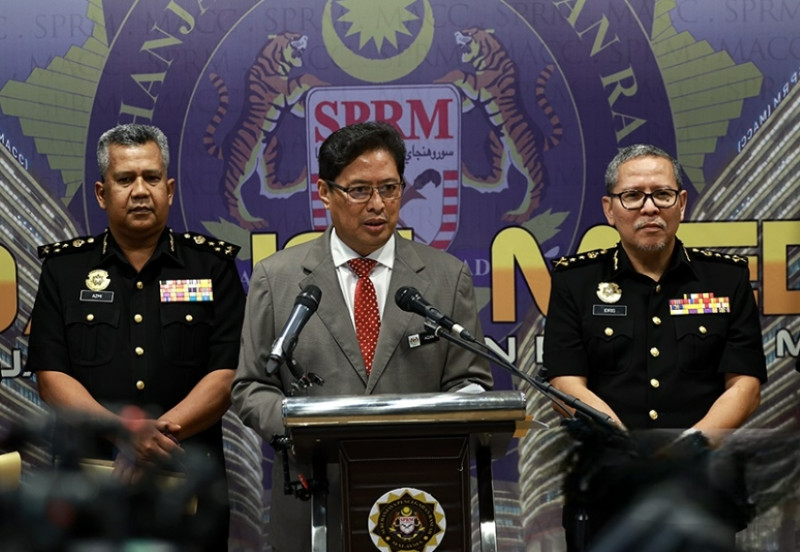
“Training is key,” Bernama cited Chief Commissioner Tan Sri Azam Baki saying in a special interview marking SPRM’s 58th anniversary at its headquarters in Putrajaya.
“We are investing in forensic skills so our officers are able to detect and trace corrupt transactions effectively.”
Azam noted that government procurement remains one of the most vulnerable sectors, with manipulation of tenders—often in collusion with authorities—frequently leading to inflated costs to cover illicit payments.
Over the past six years alone, the country has suffered an estimated RM277 billion in losses due to corruption, fraud and abuse of power.
To address the evolving challenges, the agency has widened its collaboration with both local and international bodies. Training efforts are being coordinated through the Malaysian Anti-Corruption Academy (MACA), including joint programmes with other enforcement agencies and the private sector to bolster governance and share expertise.
Among the initiatives is the Accreditation of Prior Experiential Learning (APEL.Q) programme, introduced through MoUs with the Malaysian Institute of Chartered Secretaries and Administrators (MAICSA) and Asia e University, aimed at producing highly qualified investigators.
Since 2017, 517 SPRM officers have received advanced diplomas through programmes run with Nottingham Trent University in the UK.
From January to July 2025, MACC opened 728 investigation papers, including 109 high-profile cases. Most cases involved the private sector (280), followed by federal civil servants (198), members of the public (104), state government officers (95), statutory bodies (38), and government-linked companies and political entities (13).
In terms of offences, false claims led the list with 251 cases, followed by receiving bribes (239), abuse of position (89), money laundering (54), giving bribes (47) and other violations (48). During the same period, 906 individuals were arrested and 308 charged in court, resulting in 135 convictions.
Between 1 January and 29 August 2025, MACC successfully seized assets worth RM6.81 billion, froze RM31.71 million, and forfeited RM5.73 million.
Azam emphasised that the agency is now prioritising complex, syndicate-linked, and large-scale cases to ensure stolen assets are returned to public coffers.
“We want the money stolen from the people to be recovered and used for their benefit,” he said. “MACC has never closed any case arbitrarily. In fact, some are reopened when new information arises.”
In line with international best practices, the agency is also supporting the introduction of a Deferred Prosecution Agreement (DPA) law, scheduled for tabling in the first parliamentary session of 2026.
Approved in principle by the Cabinet Governance Committee chaired by the Prime Minister, the legislation would allow charges to be deferred if companies or individuals agree to restitution and corrective measures.
“Countries like the United States, United Kingdom and Singapore already have such laws,” Azam said. “For example, if a company pollutes a river, it would be required to carry out remediation and compensate affected communities. Failing that, prosecution would proceed.”
MACC is also developing digital and AI-based systems to screen government procurement applicants more rigorously, aiming to reduce human interference and improve transparency.
Additionally, the agency backs the upcoming Government Procurement Act 2025, particularly provisions on declaring beneficial ownership to identify individuals who control companies bidding for public contracts—part of broader efforts to dismantle cartels and monopolies in government tenders. - October 1, 2025