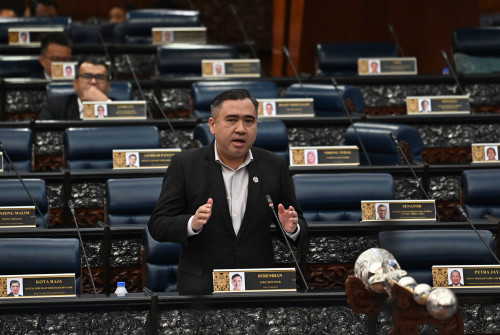
TENGKU Zafrul Abdul Aziz told the Dewan Rakyat today that the Agreement on Reciprocal Trade (ART) with the United States represents a “practical, firm and principled” effort to safeguard national interests, protect jobs, and maintain Malaysia’s access to one of its most critical export markets.
The Malaysian Government has formally concluded the long-anticipated Agreement on Reciprocal Trade (ART) with the United States, following six months of intense negotiations that began in May and culminated with the signing by Prime Minister Datuk Seri Anwar Ibrahim and US President Donald J. Trump on 26 October 2025.
Tengku Zafrul, who is the Minister of Investment, Trade and Industry, said: ““Alhamdulillah, after five months of negotiations, Malaysia and the United States have signed the Agreement on Reciprocal Trade,” he said, noting that the talks were necessary after Washington imposed unilateral tariffs on hundreds of trading partners.
“This is not a negotiation we sought. But as a trading nation, facing the world’s largest economy, we had to act to defend our market access and the livelihoods of our people.”
Despite criticism, the minister said the deal “does not surrender Malaysia’s sovereignty” and stressed that “the Government is not afraid of criticism, but it must be based on facts, not slander or unfounded allegations.”
Under the ART, tariffs on Malaysian exports to the US will fall from 25% to 19%, the lowest rate among ASEAN countries with trade surpluses against the United States. In addition, Malaysia secured exemptions for 1,711 tariff lines — including palm oil, rubber, cocoa, aerospace components and pharmaceuticals — worth about RM22 billion, or roughly 12% of total exports to the US in 2024.
The minister warned that failure to finalise the agreement could have led to “tariffs returning to 24%, or rising as high as 30%, 40%, 50% — even 100%,” jeopardising Malaysian exporters, small and medium enterprises, and millions of jobs.
The US remains Malaysia’s top export destination, with bilateral trade reaching RM325 billion in 2024 and Malaysian exports amounting to RM198.65 billion.
For January to September 2025 alone, exports to the US stood at RM166.38 billion.
The agreement also upgrades Malaysia–US relations to a ‘Comprehensive Strategic Partnership’, placing Malaysia among Washington’s closest trading allies. This, said the minister, provides “a direct line of sight to high-tech investment, technology transfer and more secure supply chains.”
Malaysia has now been designated a “trusted supply chain partner,” a status expected to boost high-value investment flows, particularly in semiconductors and advanced manufacturing.
The US has also pledged to give Malaysia “due consideration” in its ongoing Section 232 investigation into the semiconductor sector — which accounts for nearly RM56.2 billion in exports to the US.
“This is not a symbolic elevation,” he said. “It means Malaysia is now seen as a reliable partner in the global supply chain, which will further advance our New Industrial Master Plan 2030 and Madani Economic Framework.”
The minister rejected claims that Malaysia was compelled to commit to RM1 trillion in purchases from the United States.
“The list of commercial procurements under Section 6 of the agreement has nothing to do with Government spending,” he said. “These are existing corporate acquisition plans that would have proceeded regardless.”
He cited Malaysia Aviation Group’s aircraft purchases and PETRONAS’s long-term liquefied natural gas imports from the US as examples.
“This is not political direction from Washington. It is a commercial decision by PETRONAS to ensure stable supply and national energy security.”
On halal certification, the minister dismissed suggestions that Malaysia’s standards would be compromised.
“Standard Halal is a red-line issue that was never compromised,” he said. “Only products certified by halal bodies in the US recognised by JAKIM will be approved for import.
Malaysia retains full control over halal standards. To those saying our halal standards will be dictated by America, that is false. Standard Halal Malaysia is determined by Malaysia — full stop.”
Addressing concerns over rare earth exports, the minister affirmed that Malaysia’s ban on the export of unprocessed rare earth elements (REE) remains.
“Our policy is clear — no export of raw REE. Value addition must take place in Malaysia. Jobs and technology must come to Malaysia. We welcome collaboration, but always within our laws and with Malaysia’s sovereignty intact.”
He added that the Government seeks to develop an integrated domestic REE industry, potentially through tripartite cooperation between Malaysia, the US and Australia’s Lynas Corporation.
“This agreement is not a blank cheque for America,” the minister declared. “It is a fence — a safeguard — ensuring that any future actions must go through consultation, not unilateral coercion.”
He acknowledged the extraordinary effort of Malaysian civil servants during the six-month negotiation.
“With a 12-hour time difference, our teams negotiated through the night and worked through the day. I personally arranged a call between President Trump and Prime Minister Anwar Ibrahim at 6 a.m. Malaysia time.”
He lamented public ridicule of these officials: “I can accept political attacks against the Government, but do not belittle the dedication of our public servants. To say this agreement ‘sells out the country’ is an insult to their service and to Malaysia itself.”
Tengku Zafril appealed for unity across the political divide.
“This issue is not about me or any political party. It is about the future of Malaysia’s economy and the livelihoods of millions of our citizens.
“We can compete in politics, but when it comes to defending our economy and sovereignty, we must stand as one nation — united, firm, and dignified. Let the world see that Malaysia is a country that can negotiate with confidence, protect its sovereignty, and defend its people.” - October 29, 2025