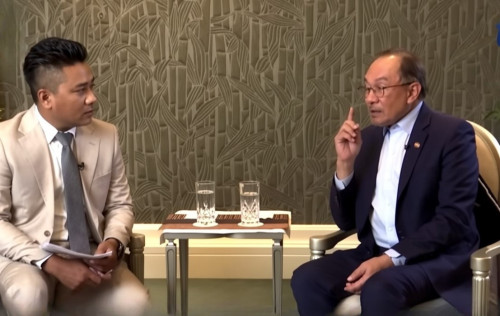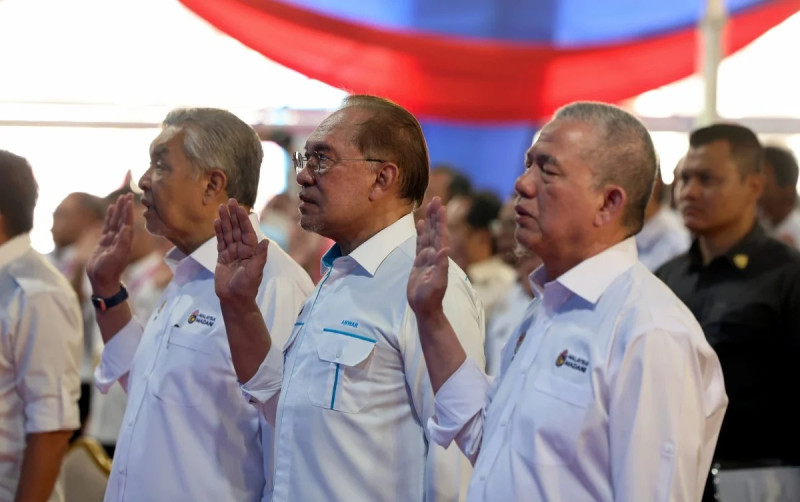
THE MADANI administration has reaffirmed its commitment to expediting all pledges made during the Sabah state election, Prime Minister Datuk Seri Anwar Ibrahim announced today, emphasising that the government has a duty to translate electoral promises into concrete actions for the people.
“Elections have passed. Our responsibility is to expedite what we promised.
“This is different from politicians and political leaders who make promises before elections and then leave them unfulfilled,” Anwar said during his keynote address at the Rancakkan MADANI Bersama Malaysiaku programme at Dataran Putrajaya.
He outlined a comprehensive monitoring framework for project implementation, stating that “within a week we will determine the method of execution.
“There are still lingering issues with electricity, water, and roads. We have scheduled coordination meetings in December to monitor every project.
“If there are 250 major projects, each will be overseen. There will be monthly meetings between the Federal and State governments, and this is the best example of how we can turn our words into action.”
Highlighting tangible progress under the Malaysia Agreement 1963 (MA63), Deputy Prime Minister Datuk Seri Fadillah Yusof said that 19 items have been resolved to date, including the transfer of Sabah Electricity Sdn Bhd (SESB) to the state government via the Energy Commission of Sabah (ECoS).
“Although the entity has been handed over, the federal government continues to support Sabah with an allocation of RM3.54 billion in electricity subsidies until 2030,” he added during a public dialogue at the closing of the three-day Rancakkan MADANI programme.
Fadillah noted that several matters remain unresolved due to differing legal interpretations between federal and state perspectives, particularly regarding the Federal Constitution and state laws.
“Because these are legal matters, perspectives at the state level may differ from those at the federal level. Resolution is therefore not straightforward. A few issues remain pending, but the majority have already been settled,” he said.
The Deputy Prime Minister II also emphasised Malaysia’s leadership in regional energy integration through the ASEAN Power Grid (APG), citing the initiative as critical for providing a stable, sustainable, and competitive electricity supply across Southeast Asia.
“The APG is essential for creating a regional grid network that allows ASEAN member states to exchange electricity across borders, helping any country experiencing supply shortages. For instance, if Thailand faces an energy shortfall, other countries can supply electricity.
“This system provides flexibility and strengthens regional energy security,” Fadillah said.
He noted that Borneo, with its abundant renewable energy resources, will be linked to Peninsular Malaysia and Singapore via undersea cables, with plans to eventually extend connections to the Philippines.
Prime Minister Anwar also reaffirmed that the Pan Borneo Highway, connecting Sabah and Sarawak, will continue in an orderly and timely fashion.
“The Pan Borneo Highway, valued at RM6.9 billion for Sabah and RM6 billion for Sarawak, will proceed in a more structured and effective way. Congratulations… it has been successfully completed in Sarawak, and we have agreed to provide additional red-line access to Sarawak and Sabah.
“For the first time since the project’s approval ten years ago, its implementation is far more organised and effective and, God willing, on schedule,” he said.
The three-day Rancakkan MADANI programme, which began last Friday, offered over 300 public services, career fairs, interactive exhibitions, family entertainment, and special promotions, continuing the government’s annual tradition of direct engagement with the people. - December 7, 2025