THE swearing-in of Bersatu’s Abu Bakar Hamzah as the new Mentri Besar of Perlis has brought a simmering internal struggle within Perikatan Nasional into the open, with analysts warning that the move prioritises power-sharing over principle and may exact a heavy political price.
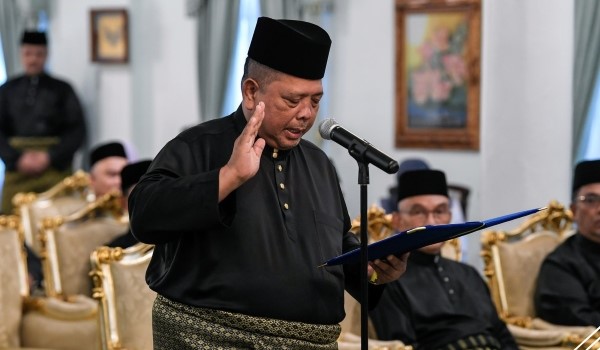
Abu Bakar, the Kuala Perlis assemblyman and Perlis Bersatu chief, was sworn in at Istana Arau yesterday after receiving the consent of the Raja of Perlis, Tuanku Syed Sirajuddin Jamalullail.
His appointment marks the first time Bersatu has taken charge of the state government, following the resignation of PAS’ Mohd Shukri Ramli on Thursday, who cited health reasons.
The leadership change comes after a political crisis triggered by reports that eight Perikatan assemblymen had signed statutory declarations withdrawing support for Mohd Shukri. Among them were three PAS assemblymen, whose party memberships were subsequently terminated.
Prof Datuk Dr Sivamurugan Pandian of Universiti Sains Malaysia said the choice of a Bersatu leader could help recalibrate the coalition’s internal balance of power, but warned that it risked alienating PAS supporters on the ground.
“The move helps to rebalance power within the coalition but it risks dissatisfaction from PAS grassroots, who feel they have stronger electoral legitimacy in Perlis,” he said when contacted, adding that the episode highlighted deep structural issues within Perikatan.
“Either way, the appointment is less about ideology and more about managing internal power-sharing.”
He described the Perlis episode as proof that Perikatan is “strong at the ballot box but weak in internal governance”, noting that while the coalition may hold together for now, the longer-term implications could be damaging.
“Trust deficits arising from the latest development will weaken coordination, seat negotiations and campaign cohesion going into the next general election,” he said.
Prof Sivamurugan added that unresolved tensions between PAS and Bersatu were likely to continue eroding unity, particularly at grassroots and state levels.
Turning to the unity government, he said the crisis did not automatically translate into electoral gains for Pakatan Harapan, but did reinforce its narrative as a more stable governing option, provided it delivers on economic management and cost-of-living pressures ahead of the next general election.
A more scathing assessment came from Universiti Malaya’s Dr Mohammad Tawfik Yaakub, who characterised the change in leadership as a direct political coup against PAS.
“In my view, PAS should immediately reconsider its cooperation with Bersatu,” he said, arguing that the move undermined PAS’ political dignity given its numerical strength in the Perlis state assembly.
Tawfik predicted that the rift within Perikatan would deepen rather than heal.
“This is only the beginning of a deeper split. Perikatan’s survival is doubtful due to the absence of sincerity in managing political cooperation,” he said.
He added that the situation could become even more volatile should by-elections be held for the three vacated seats and PAS retain its majority.
“For PAS to remain silent in such a scenario is impossible.”
National Council of Professors fellow Dr Azmi Hassan said the appointment had come as a surprise, but argued that PAS’ own decisions had weakened its hand.
“This is a big blow for PAS because they have effectively lost control of one of their SG4 states, even though they remain part of Perikatan,” he said, describing the expulsion of the three assemblymen as a “critical turning point”.
Azmi said the episode reinforced perceptions that Bersatu now holds the upper hand within the coalition.
“They cannot even agree on basic matters such as a prime ministerial candidate.
“This shows PAS and Bersatu are slowly moving in different directions,” he said, adding that the Perlis crisis reflected a combination of PAS miscalculations and shrewd political manoeuvring by Bersatu. - December 29, 2025