THE Office of the Leader of the Opposition on Tuesday night confirmed that a resignation letter circulating on social media, purportedly from Datuk Seri Hamzah Zainudin, is false.
An officer from the office confirmed the matter when contacted, dismissing the viral document as fabricated.
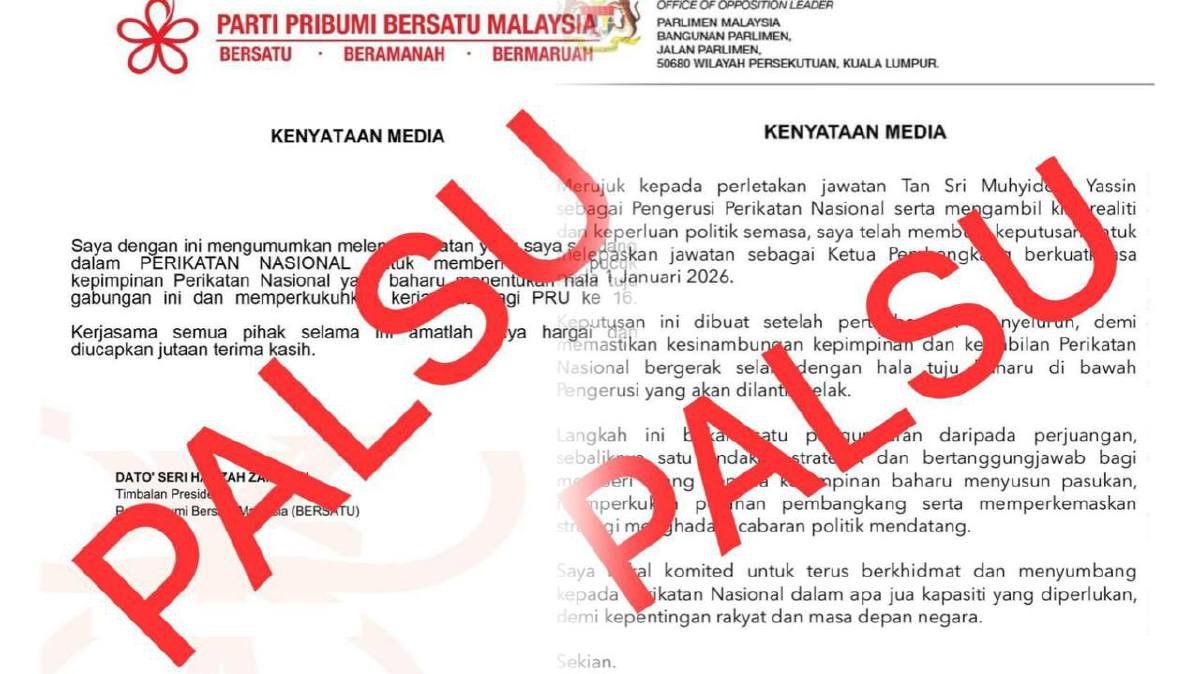
Earlier, two letters bearing the letterheads of the Office of the Leader of the Opposition and Parti Pribumi Bersatu Malaysia (Bersatu) were widely shared online, claiming that Hamzah had resigned as Opposition Leader.
The contents alleged that the decision was made following the resignation of Tan Sri Muhyiddin Yassin and after taking into account current political realities and needs.
The letters further claimed that the resignation was the result of careful consideration to ensure continuity of leadership and stability within Perikatan Nasional (PN), in line with a new direction under a chairman yet to be appointed.
The denial came on the same day Muhyiddin confirmed that he will step down as PN chairman with effect from Jan 1 next year. Datuk Seri Mohamed Azmin Ali also announced his resignation as PN secretary-general and PN Selangor chairman, effective Jan 1, 2026.
Similar announcements followed from several other PN leaders. Datuk Seri Ahmad Faizal Azumu relinquished his post as PN Perak chairman, while Datuk Dr Sahruddin Jamal stepped down as PN Johor chairman. Mohamad Hanifah Abu Baker also resigned as PN Negeri Sembilan chairman.
These developments have intensified perceptions of growing tension within PN, particularly involving Bersatu’s top leadership.
The political temperature was already elevated by a crisis in Perlis, where eight state assemblymen signed statutory declarations withdrawing support for then-menteri besar Mohd Shukri Ramli, undermining confidence in his leadership.
Bersatu was reported to have submitted three names as candidates for the Perlis menteri besar position: Abu Bakar Hamzah of Kuala Perlis, Megat Hashirat Hassan of Pauh and Izizam Ibrahim of Titi Tinggi.
The situation escalated further when several PAS leaders issued statements suggesting that relations between PAS and Bersatu within PN were becoming strained.
Not long after, Mohd Shukri, who is also the Sanglang assemblyman, confirmed that he had voluntarily resigned as Perlis menteri besar. Abu Bakar Hamzah was subsequently appointed as the 12th Menteri Besar of Perlis.
The PN Perlis deputy chairman was sworn in before the Raja of Perlis, Tuanku Syed Sirajuddin Putra Jamalullail, at Istana Arau on Dec 28.
In the wake of these events, further resignations followed. Sahruddin Jamal stepped down as PN Johor chairman, while Dr Afif Bahardin, the Taman Medan assemblyman, resigned as PN Selangor secretary, effective the same date as Azmin Ali’s resignation.
PAS leaders have since indicated that discussions are under way on PN’s future leadership.
PAS deputy president Datuk Seri Tuan Ibrahim Tuan Man, quoted by Bernama, said the party would submit several names for consideration as the new PN chairman, with the matter expected to be discussed at an upcoming PN supreme council meeting.
In a separate statement, PAS secretary-general Datuk Seri Takiyuddin Hassan said the party was prepared to lead PN in order to strengthen the coalition and prepare for upcoming state elections and the 16th General Election.
Political analysts have warned that the internal turmoil could weaken PN’s standing. Speaking to Astro AWANI, Universiti Malaya senior lecturer Dr Mohamad Tawfik Yaakub said the situation appeared to benefit UMNO and the Unity Government, without them needing to seek new political adversaries.
Asia Global Consulting senior consultant and political analyst Dr Ahmad Zaharuddin Sani Ahmad Sabri said tensions between PAS and Bersatu highlighted weaknesses in PN’s top leadership, particularly in acting as an effective bridge between component parties.
“Whoever is appointed to lead this coalition must be someone who can act as a bridge between the component parties in Perikatan Nasional,” he said.
“The strength of an individual reflects the strength of the party. If a commander fails to steer the party, how can he lead the country? If a party leader lacks aura and cannot control individuals or entities within the coalition, then he must find a way to bind them together. If that fails, perhaps the best step is to step aside,” Zaharuddin said on Agenda AWANI.
He added that Muhyiddin’s resignation reflected internal pressures that were not managed before escalating into a major crisis, pointing to the Perlis situation.
“The root issue was the lack of consensus over the Perlis menteri besar at the time. Muhyiddin may have been reluctant to intervene because Mohd Shukri Ramli was from PAS,” he said.
“PAS should have taken proactive steps by advising Mohd Shukri to step down honourably. Then there would have been no issue of statutory declarations being signed to withdraw support. A suitable replacement from PAS could have been made.”
Zaharuddin said matters worsened when PAS demanded that Bersatu assemblymen involved be expelled, which would have left Bersatu without representation in Perlis.
“So what is the solution? Through a by-election?” he asked.
He argued that it was unreasonable to hold by-elections every time an internal party conflict arose, as it involved significant costs and disrupted policy implementation.
“The people are increasingly weary of Malaysian politics. We can see this in Sabah, where voter turnout has declined over the years. Trust in the political system is eroding,” he said.
Returning to his main point, Zaharuddin stressed that individual leadership strength remained critical in holding a party and coalition together.
The question now facing PN is whether PAS figures such as its president Tan Sri Abdul Hadi Awang, Terengganu Menteri Besar Datuk Seri Ahmad Samsuri Mokhtar or Kelantan Menteri Besar Datuk Mohd Nassuruddin Daud can serve as the ‘bridge’ needed to stabilise the coalition.
There is also growing speculation over whether Perikatan Nasional will remain intact heading into 2026, amid the possibility of new political realignments. - December 31, 2025