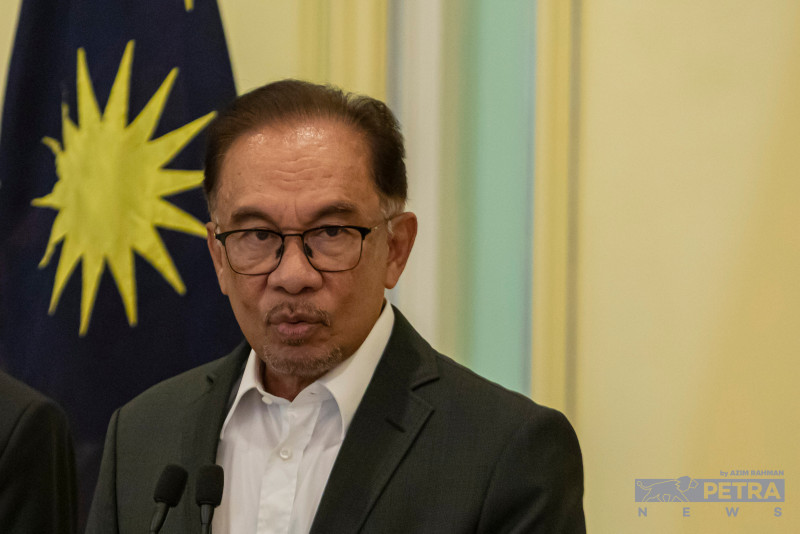
PRIME MINISTER Datuk Seri Anwar Ibrahim has delivered a sharp rebuke of global leadership over the humanitarian catastrophe in the Gaza Strip, warning that hypocrisy and moral failure are undermining justice and accountability, even as he reiterated the need for integrity-based leadership and people-focused economic policies at home.
Speaking during an interview with Turkish public broadcaster TRT World’s One on One programme while on an official visit to Turkiye, Anwar said the international community’s inability to halt the suffering in Gaza reflected a profound erosion of conscience and ethical values.
“For me, I always use the term the loss of moral judgment and the lack of moral values. In fact, it is hypocrisy and a disregard for reason and ethics,” he said.
Anwar was in Turkiye on a three-day official visit at the invitation of President Recep Tayyip Erdogan, part of efforts to strengthen the long-standing bilateral ties between the two countries.
He said the scale of the crisis in Gaza raised serious questions about whether the world truly understood the historical roots of the Palestinian issue.
“What I mean is after everything that has happened in the world, you still fail to understand the historical background of Palestine? I don’t believe that,” he said.
According to Anwar, such failure could not be attributed to ignorance alone.
“Unless you take a very strong fanatical Zionist position, or a racist or anti-colour position, whatever it is. But there is no reason or excuse why someone cannot understand,” he said.
Drawing comparisons with Europe’s own history, Anwar questioned whether humanity had learned anything from past atrocities.
“So, I think in Germany, what happened to our humanity? What happened to our historical experience in Germany? Have we learned nothing?” he said, stressing that the lessons of history appeared to have been ignored.
He described the situation in Gaza as not a new development but a continuation of colonial injustice.
“Colonialism should have ended, finished and died, but colonialism still exists. It grows in Palestine, in Gaza, before the eyes of billions of people,” he said, adding that the suffering of Palestinians had endured for decades.
“People die, people are treated like slaves, and not this year, not after Oct 7, but for decades, half a century, more than half a century,” he said.
Anwar warned that continued inaction by the international community would only worsen the consequences.
“It will only invite more anger, hostility, extremism,” he said.
On humanitarian access, he voiced frustration over restrictions on aid delivery into Gaza.
“Hundreds of containers are waiting, abandoned, to cross the border. And people are dying on the other side,” he said, highlighting the impact on civilians, particularly children dying of hunger due to the blockade.
Separately, Anwar stressed that effective national leadership must be anchored in integrity, a firm stand against corruption and economic policies that directly address the daily struggles of the people, especially the cost of living and income pressures.
In the same interview, he said leaders must remain close to the people and understand their everyday challenges, even as the government pursues institutional reforms.
As head of a unity government, Anwar said governance requires collective decision-making rather than unilateral action to maintain stability and balance.
“I am not a dictator, I need to deal with issues properly. I imagine a leader who does not seek wealth for himself, who takes only the minimum salary allowance, who takes a firm stand against corruption and who has programmes focused on driving economic growth,” he said.
He cautioned that reforms should not be rushed without learning from the experiences of other countries, warning that unmet basic needs could turn public expectations into backlash.
Anwar said one of the toughest challenges for his administration was acting against powerful individuals involved in corruption, noting their influence over the media, the judiciary and enforcement agencies.
“I myself have faced attacks and accusations, including claims questioning the reforms carried out at the early stage of my administration,” he said.
The Prime Minister, who is also Finance Minister, said the government had recently announced a second phase of reforms, including freedom of information, the establishment of an ombudsman and fixed terms for the position of prime minister.
He added that the Fiscal Responsibility Act was a key step towards greater accountability.
“It is not easy for a Finance Minister to fully hand over power to Parliament, but it must be done,” he said. - January 10, 2026



.jpeg)