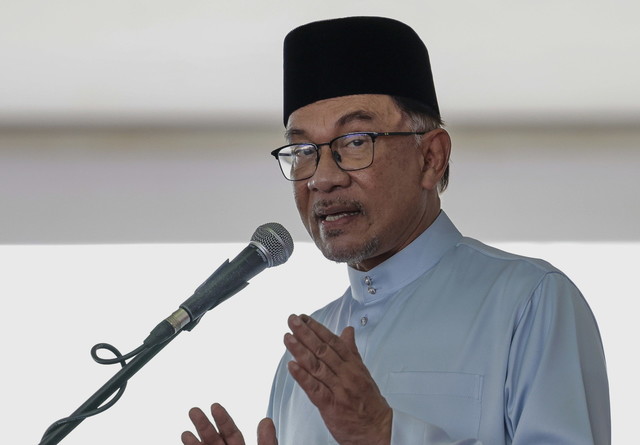
MALAYSIA cannot afford to be complacent with economic growth alone and must chart a clear national direction to avoid being stuck in the so-called middle-income trap, Prime Minister Datuk Seri Anwar Ibrahim said in Bukit Mertajam on Saturday.
He said many countries experienced promising early growth but later stagnated due to their failure to translate policies into effective implementation at the grassroots level.
“When this country has laid a more convincing economic foundation, it must be followed by a clear direction so that Malaysia does not get trapped in what is known as the ‘middle-income trap’,” Anwar said.
“We see many countries advance for a while and then get stuck at a certain level. That is why we have formulated several key policies, including the Industrial Plan and the National Digital Transformation Plan,” he added.
Anwar was speaking at the launch of the Seberang Perai Aspire Centre (SPACE) and the Seberang Perai City Council’s Santuni Komuniti programme at the MBSP building here.
He said a key thrust of the government’s strategy is ensuring that federal-level policies are translated into tangible outcomes at the local level, particularly through the development of data centres, artificial intelligence and the semiconductor industry.
“In the context of SPACE, we ensure that policies at the top are translated through the proliferation of data centres. With AI, Malaysia has become a major attraction,” he said.
“In the semiconductor industry, Malaysia has already emerged as a hub. Infineon’s largest investment outside Germany is in Malaysia. Nvidia and Google have also made Malaysia and Johor their regional centres,” he added.
However, Anwar cautioned that these advantages would not yield maximum benefits if advanced technological infrastructure and ecosystems are not effectively utilised at the local level.
“If we have such sophisticated machinery but fail to translate it at the grassroots level, we will not reap the benefits,” he said.
In this regard, Anwar praised the Seberang Perai City Council, describing it as among the earliest local authorities to implement smart city initiatives despite various constraints.
“I congratulate MBSP for being among the early adopters, even if done in stages and under limited conditions, of what is meant by a Smart City,” he said.
He stressed that smart city development requires more than incremental change, calling instead for a major leap encompassing infrastructure, training and talent development.
“Smart city development is not just an ordinary change. It requires a major leap involving infrastructure, training and talent development. This is not merely a ‘paradigm shift’,” he said.
Referring to the work of philosopher of science Thomas Kuhn, Anwar said paradigm shifts demand time and thorough preparation, including readiness of human capital.
“MBSP must ensure that existing basic talent is given the opportunity to master new technologies because this field is extremely challenging and falls within new technologies that we are not yet familiar with,” he said.
Anwar also underlined the importance of education as the foundation for smart cities and the digital economy, including early exposure to artificial intelligence and strong proficiency in English.
“In the national education planning that we launched last week, one of the key emphases is introducing new subject disciplines, including AI, from an early stage,” he said.
“For smart cities, the use of English is a necessity. While Malay remains the core, English must be mastered well, not just for communication but for the mastery of knowledge and technology,” he added.
He further stressed the need for an inclusive education system that allows mastery of other languages such as Chinese, Tamil and Arabic without sidelining Malay, history and national foundations.
“What is the problem if someone masters other languages? The core remains the Malay language and English must be mastered well. Educational pathways must be opened as widely as possible,” he said.
“Stop fighting over trivial matters. Save our country. Focus on what is important. The economy must be strong and jobs must be created,” he added. - January 24, 2026

.jpeg)