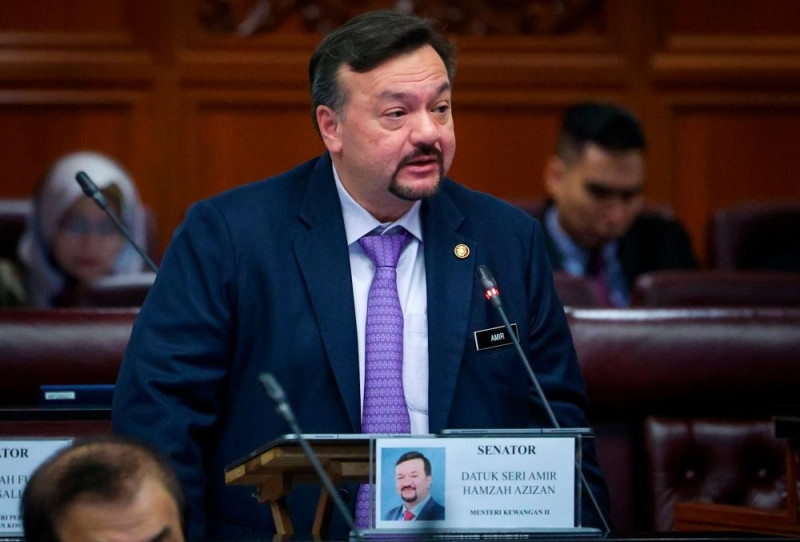
MALAYSIA’S economy is showing clear signs of renewed strength after years of fiscal strain, with disciplined reforms beginning to translate into faster growth, stronger investment inflows and improved living standards for ordinary Malaysians, Finance Minister II Datuk Seri Amir Hamzah Azizan said on Wednesday.
In winding up the debate on the Motion of Thanks for the Royal Address in the Dewan Rakyat, Amir said the MADANI government’s focus on fiscal responsibility, subsidy reform and governance had begun to yield results earlier than expected, despite ongoing global economic volatility.
“Despite the MADANI government being in office for only three years, bold and necessary reforms have been implemented, and we are now seeing clear results in strengthening the economic ceiling while lifting the welfare floor for the people,” he said.
He told lawmakers that Malaysia’s fiscal position had improved markedly since 2021, anchored by the Public Finance and Fiscal Responsibility Act 2023, which set a medium-term deficit target of three per cent.
The fiscal deficit has been reduced progressively from 6.4 per cent in 2021 to 4.1 per cent in 2024, with further reductions projected to 3.8 per cent in 2025 and 3.5 per cent in 2026.
“These improvements were achieved through a broader tax base and subsidy targeting, particularly for electricity, diesel and RON95,” Amir Hamzah said, adding that the International Monetary Fund had recognised Malaysia’s reform efforts in its December 2025 assessment.
He said renewed confidence in Malaysia’s economic management was reflected in international indicators, including an 11-place jump to 23rd in the IMD World Competitiveness Ranking.
Bursa Malaysia’s benchmark index reached its highest level in more than seven years in January 2026, while the ringgit strengthened to RM3.92 against the US dollar, its strongest level in nearly eight years.
Investment approvals continued to accelerate, with RM285.2 billion recorded in the first nine months of 2025, a 13.2 per cent increase from the same period a year earlier.
Amir added Malaysia remained on course to exceed record investment figures achieved in both 2023 and 2024.
He said subsidy rationalisation had freed up RM15.5 billion in savings, allowing the government to redirect funds towards social assistance and essential public services. Malaysia’s fiscal recovery has also been endorsed by major credit rating agencies, with Moody’s, S&P Global and Fitch maintaining sovereign ratings with stable outlooks.
Economic growth, he added, had outperformed forecasts despite global headwinds, with 2025 growth estimated at 4.9 per cent following a strong final quarter. Trade expanded by more than six per cent, reaching a record RM3 trillion.
Amir Hamzah said the government was determined to ensure that stronger macroeconomic numbers translated into tangible gains for households.
Unemployment fell to 2.9 per cent in November 2025, the lowest level in 11 years, while the minimum wage was raised to RM1,700.
Government-linked investment companies and corporations adopted a living wage benchmark of RM3,100, benefiting 169,000 workers.
He said gross national income per capita increased by more than 18 per cent between 2021 and 2024, while inflation remained contained at around 1.4 per cent in 2025 despite subsidy targeting and tax reforms.
Cost-of-living pressures were addressed through RM1 billion in allocations, including RM600 million for Rahmah MADANI sales offering affordable essentials nationwide.
Cash assistance reached unprecedented levels through the Rahmah Cash Contribution and Rahmah Basic Contribution, with total allocations rising to RM15 billion and beneficiaries increasing to nine million by 2026.
Amir said these programmes also supported domestic demand by channelling spending to local retailers and small businesses.
Responding to concerns over foreign fund movements, he said that while the equity market recorded net outflows in 2025, foreign inflows into the bond market were larger, signalling sustained confidence in Malaysia’s economic fundamentals.
Both equity and bond markets recorded net foreign inflows in January 2026.
He also addressed criticism of tax administration reforms, including the introduction of e-invoicing, stressing that it did not constitute a new tax but was designed to improve transparency and curb revenue leakages.
Nearly one billion e-invoices had been issued nationwide by early February 2026, supported by phased implementation and exemptions for small traders.
Turning to Budget 2026, Amir said the government remained committed to balancing fiscal discipline with growth support.
Total public spending is set to rise to RM470 billion, including catalytic investments by government-linked entities, with development expenditure exceeding four per cent of GDP, higher than in several neighbouring ASEAN countries.
He reaffirmed the federal government’s commitment to reviewing Sabah’s special grant based on 40 per cent of net federal revenue from the state, following High Court rulings and ongoing negotiations with the Sabah government.
Amir also cautioned against complacency, saying continued cooperation across sectors was essential to sustain progress.
“We cannot afford to be satisfied too quickly. There is still much to be done, and all parties must work together to sustain this momentum for the sake of our beloved Malaysia,” he said. - February 4, 2026