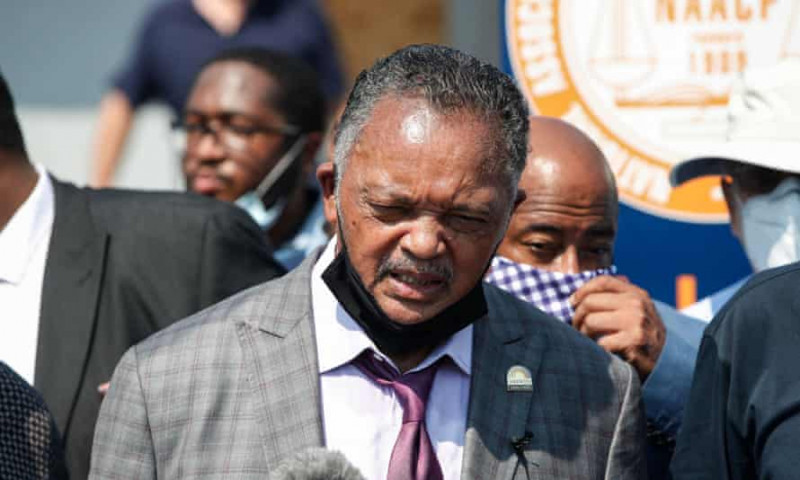
THE Rev. Jesse L. Jackson, the veteran American civil rights leader who rose from the segregated South to become the most prominent Black political figure of his generation after the assassination of the Rev. Martin Luther King Jr., has died at the age of 84.
Jackson, a Baptist minister and two-time candidate for the Democratic presidential nomination, died at home in Chicago on Tuesday, surrounded by family, his daughter Santita Jackson confirmed. He had been living with a rare neurological disorder in his later years.
AP reported on Wednesday that, Jackson, a protégé of King and present in Memphis when the civil rights leader was assassinated in 1968, Jackson went on to shape the course of the Civil Rights Movement for decades, combining street protest, electoral politics and corporate pressure campaigns in pursuit of racial and economic justice.
“There is no joy after we lost our family and loved ones,” he once said in another context of national grief, but throughout his life he sought to instil hope, most memorably in the refrain of a poem he often recited: “I am Somebody. I may be poor, but I am Somebody; I may be young; but I am Somebody; I may be on welfare, but I am Somebody.”
In a statement posted online, his family said: “Our father was a servant leader — not only to our family, but to the oppressed, the voiceless, and the overlooked around the world. We shared him with the world, and in return, the world became part of our extended family.”
The Rev. Al Sharpton, a fellow activist and longtime associate, described him as transformative. He “was not simply a civil rights leader; he was a movement unto himself,” Sharpton said.
“He taught me that protest must have purpose, that faith must have feet, and that justice is not seasonal, it is daily work,” adding that Jackson taught “trying is as important as triumph. That you do not wait for the dream to come true; you work to make it real.”
Born on 8 October 1941 in Greenville, South Carolina, Jackson was the son of a teenage mother and was later adopted by his stepfather.
A gifted athlete, he began at the University of Illinois on a football scholarship before transferring to North Carolina A&T, where he became student body president and immersed himself in the burgeoning Civil Rights Movement.
By 1965 he was working alongside King, joining the Selma to Montgomery march and later leading Operation Breadbasket in Chicago, an initiative of the Southern Christian Leadership Conference aimed at securing jobs for Black workers. Jackson called his years with King “a phenomenal four years of work”.
He was at the Lorraine Motel in Memphis on 4 April 1968 when King was shot dead. Jackson later said the slain leader died in his arms, an account that some other aides questioned.
In the days that followed, he wore a turtleneck he said was stained with King’s blood and declared at a memorial service: “I come here with a heavy heart because on my chest is the stain of blood from Dr. King’s head.”
In 1971 he founded Operation PUSH, later the Rainbow/PUSH Coalition, based on Chicago’s South Side, using boycotts, lawsuits and negotiation to press corporations to diversify their workforces and invest in minority communities.
His activism extended internationally, securing the release of hostages and political prisoners from countries including Syria, Iraq and the former Yugoslavia.
Jackson sought the Democratic presidential nomination in 1984 and 1988, winning 13 primaries and caucuses in the latter contest and galvanising a multiracial coalition under the slogan “Keep hope alive”. Though unsuccessful, his campaigns were widely seen as expanding the horizons of American politics for women and people of colour.
“I was able to run for the presidency twice and redefine what was possible; it raised the lid for women and other people of color,” he told the Associated Press. “Part of my job was to sow seeds of the possibilities.”
Former president Barack Obama later acknowledged that Jackson’s campaigns helped lay the groundwork for his own. On the night of Obama’s election victory in 2008, Jackson wept in Chicago’s Grant Park. Reflecting years later, he said: “I wish for a moment that Dr. King or (slain civil rights leader) Medgar Evers ... could’ve just been there for 30 seconds to see the fruits of their labor. I became overwhelmed. It was the joy and the journey.”
Jackson’s career was not without controversy. In 1984 he apologised for referring to New York as “Hymietown” in remarks he believed were private. In 2008 he was caught on an open microphone criticising Obama. Yet his influence endured across decades.
Ordained in 1968 and awarded the Presidential Medal of Freedom by President Bill Clinton in 2000, Jackson remained active even as illness curtailed his mobility and speech. He disclosed in 2017 that he was being treated for Parkinson’s disease, and was later diagnosed with progressive supranuclear palsy. Even so, he continued to appear at rallies and court hearings, including during the Black Lives Matter protests.
In one such address in Minneapolis, he warned: “Even if we win, it’s relief, not victory. They’re still killing our people. Stop the violence, save the children. Keep hope alive.”
Late in life, reflecting on America’s racial divisions during the coronavirus pandemic, he said: “It’s America’s unfinished business — we’re free, but not equal. There’s a reality check that has been brought by the coronavirus, that exposes the weakness and the opportunity.”
For more than half a century, Jackson sought, in his own words, “to tear down walls and build bridges”. “Sometimes when you tear down walls, you’re scarred by falling debris, but your mission is to open up holes so others behind you can run through,” he said.
His son, Jesse Jackson Jr., said in October: “I get very emotional knowing that these speeches belong to the ages now.”
In life and in death, Jackson’s voice — resonant with the cadences of the Black church — remains woven into the modern history of American civil rights. - February 18, 2026