PRIME MINISTER Datuk Seri Anwar Ibrahim has urged governments, institutions and technology leaders to ensure that artificial intelligence (AI) remains firmly rooted in human values, arguing that the future of innovation must be shaped not only by technical excellence but also by ethics, responsibility and social consciousness.
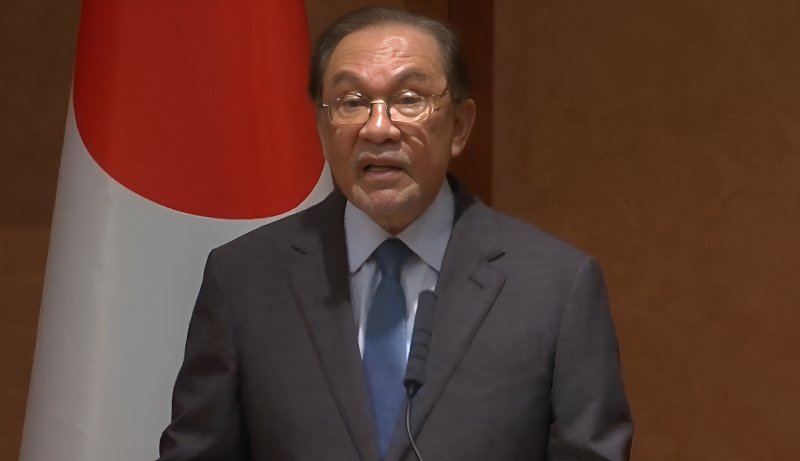
Delivering a special lecture titled Humanity in a Human-Machine Civilisation at the University of Tokyo, Anwar said the rapid rise of AI presents one of the defining challenges of the modern era, requiring societies to balance technological advancement with humanity’s enduring moral principles.
“The future lies in multidisciplinary knowledge, grounded in ethics and humanity,” he said.
Positioning AI as a transformative force extending far beyond the realm of technology, Anwar said its influence now reaches economics, governance, education, healthcare and virtually every field of study, making ethical oversight more important than ever.
He stressed that Malaysia’s MADANI development framework places human-centred values at the heart of national progress, even as the country embraces digital transformation and emerging technologies.
“The better ambition is the capability to decide where AI should be used, where it should be limited, and where human judgement must remain paramount,” he said.
Anwar argued that artificial intelligence should ultimately be judged by its ability to address real-world challenges and improve people’s lives, including enhancing public services, increasing productivity and strengthening sectors such as education, healthcare, agriculture, engineering and the civil service.
He added that AI could play a crucial role in helping nations address structural issues, including ageing populations, but cautioned that such benefits would require robust investment in talent development, infrastructure and data governance to ensure technology is deployed responsibly.
Highlighting the broader philosophical questions raised by AI, Anwar said technology itself is neither inherently good nor bad, but derives its purpose from human choices and the institutions that govern its use.
“AI does not arrive with a fixed purpose,” he said, explaining that its direction is ultimately determined through laws, public institutions and moral responsibility.
The Prime Minister also warned against measuring progress solely through technological achievement while ignoring persistent global crises, including conflict, inequality and oppression.
He noted that despite remarkable advances in artificial intelligence and digital systems, humanity continues to grapple with profound social and political challenges that technology alone cannot resolve.
“We support technological progress, including AI. But when it enters homes, schools, hospitals, offices, public institutions and even our imagination, the challenge becomes immense,” he said.
He added that the expanding presence of AI in everyday life makes it essential for societies to preserve values that machines can never replicate.
“We must build systems that serve human beings and enrich our humanity, not debase it; institutions that remain answerable to them; and societies that remember what no machine can inherit on our behalf: conscience, responsibility, integrity and care for one another,” he said.
Reinforcing the same message, Anwar said: “We must build systems that serve people and enrich human values, not undermine them.”
He further emphasised that institutions must remain accountable to citizens and that societies must continue to uphold qualities beyond the reach of artificial intelligence, including conscience, compassion, mercy, responsibility and integrity.
Responding to a question from a Malaysian student on how graduates in Japan could contribute to Malaysia’s AI ambitions, Anwar said their role extended far beyond academic achievement.
“That is why you are sent here,” he said, adding that studying in Japan provides not only academic rigour but also exposure to a society renowned for its discipline, values and social cohesion.
He said the future would belong to individuals capable of combining technological expertise with a deep understanding of people, culture and society.
The lecture drew a capacity audience, filling the University of Tokyo’s 500-seat hall with students, academics and invited guests.
During the session, Anwar briefly lightened the atmosphere by joking that the abbreviation “AI” could refer not only to artificial intelligence, but also to “Anwar Ibrahim”, drawing laughter from the audience.
Anwar is currently undertaking a three-day official visit to Japan. Prior to the lecture, he received a courtesy call from University of Tokyo President Prof Teruo Fujii.
More than 2,000 Malaysian government-sponsored students are presently pursuing their studies in Japan. - June 9, 2026