


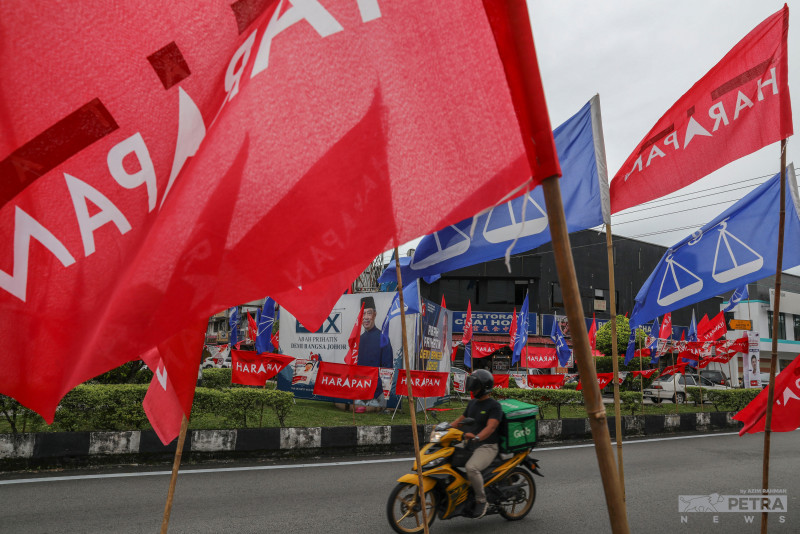
PROPOSALS to hold Malaysia’s 16th General Election (GE16) concurrently with the Johor and Melaka state elections could offer strategic advantages to Pakatan Harapan (PH), while simultaneously testing cohesion within the ruling coalition, political analysts say.
Political analyst Dr Mazlan Ali told Berita Harian that synchronising the polls would not only reduce costs for the Election Commission but could also drive higher voter turnout.
“The Melaka and Johor state elections are not far apart in terms of timing and it would be better if they were held simultaneously as this could save costs for the Election Commission in conducting them,” he said.
He added that combined elections would likely encourage more outstation voters to return home, potentially benefiting both PH and Perikatan Nasional (PN).
“If many outstation voters return, parties within PH may dominate, and PN could also reap benefits,” he said.
Speculation has mounted that GE16 could be called this year, despite more than a year remaining in the current parliamentary term.
Political observers suggest the fourth quarter – between October and December – as the most plausible window, though some do not rule out an earlier date.
Professor Datuk Dr Sivamurugan Pandian of Universiti Sains Malaysia described the final quarter of the year as an optimal period, aligning with the state election cycle while allowing time for positive economic sentiment to build.
However, while PH and PN may gain from simultaneous polls, Mazlan suggested that Barisan Nasional (BN) could face disadvantages.
He argued that BN relies heavily on traditional voters in rural and FELDA settlements, areas that historically provide an edge to UMNO.
“BN will lose out because the coalition depends greatly on traditional voters living in villages and FELDA areas. These areas give UMNO an advantage,” he said.
He added that if UMNO and PH were to cooperate electorally, the Unity Government could secure a commanding victory.
“If UMNO and PH join forces in facing the election, it is not an exaggeration to say that the MADANI Government would win big. If PH and UMNO choose to contest separately, only PH would have the advantage of winning more seats, particularly in Johor and Melaka,” he said.
Dr Ariff Aizuddin Azlan, a senior political science lecturer at Universiti Teknologi MARA, cautioned that simultaneous elections would also present internal political challenges, particularly for parties within the ruling bloc.
“I see this as a challenge that must be faced by the parties contesting, especially those in the government bloc, because at the state level many of them appear not to be aligned and often display dissatisfaction with one another,” he said.
He noted that unresolved issues such as seat allocations could strain relationships within the Unity Government if not managed carefully. “If these matters are not given serious attention, they could affect relations among parties within the Unity Government,” he added.
The debate over election timing underscores the delicate balance between electoral strategy, coalition management, and public sentiment as Malaysia approaches its next political crossroads. - February 28, 2026









.jpeg)
