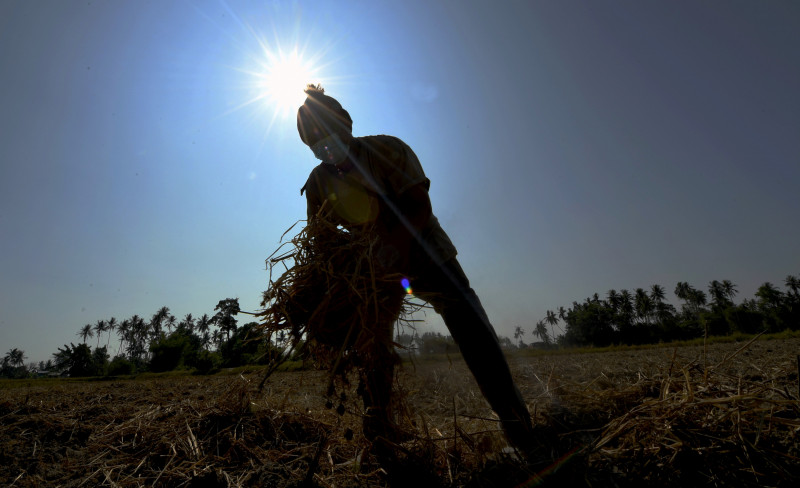
THE nation’s current spell of hot weather is expected to persist until the onset of the Southwest Monsoon in June, as the country experiences drier atmospheric conditions and reduced rainfall, according to the Malaysian Meteorological Department.
Meteorological Department deputy director-general (operations) Ambun Dindang said the nation is now in the final phase of the Northeast Monsoon, a period typically marked by lower rainfall and hotter, drier conditions, particularly in the northern and inland regions of Peninsular Malaysia.
He said weather models indicate that below-normal rainfall is likely to persist over the coming months, contributing to sustained dry conditions across the country.
“During the monsoon transition phase expected to begin at the end of March to May, the west coast and interior areas of Peninsular Malaysia, western Sabah and Sarawak are expected to receive rain, especially in the afternoon and early evening. This rain is expected to bring down temperatures in Malaysia a little,” he said.
Ambun added that rainfall is expected to increase towards the end of the week, affecting most western and interior regions of the peninsula as well as parts of Sabah and Sarawak.
However, rainfall distribution remains uneven. Some areas, including Limbang in Sarawak and Sandakan and Tawau in Sabah, have recorded above-normal rainfall, while locations such as Ipoh in Perak, Subang in Selangor, Kudat in Sabah and Mulu in Sarawak have experienced near-normal levels.
In contrast, many other stations have recorded below-average rainfall, with several areas in Kedah and Perlis experiencing extended dry spells.
“However, most other stations showed rainfall below normal levels, with Kedah (Alor Setar, Kubang Pasu and Langkawi) and Papar (Sabah) each recording up to 17 days without rain, while Perlis recorded 15 days without rain as of March 23,” he said.
Ambun said northern parts of the peninsula, including Kedah districts such as Pendang, Baling and Padang Terap, are more susceptible to hot weather due to geographical factors and prevailing wind patterns during the Northeast Monsoon, which tend to channel moisture towards the east coast and parts of Sabah and Sarawak.
“In January, the focus of wind flow and weather systems is more active in the area, causing the northern and western areas of Peninsular Malaysia to experience drier and hotter weather conditions,” he said.
He noted that hot weather is typically more pronounced during the final phase of the Northeast Monsoon between February and April, though its intensity can vary depending on broader climate phenomena such as ENSO.
Ambun said global climate models suggest an increasing frequency of extreme heat days, particularly when influenced by El Niño conditions.
“The country’s highest temperature record shows a reading of 40.1 degrees Celsius in Chuping, Perlis in 1998, followed by Batu Embun, Pahang (39.3 degrees Celsius) in 2016 and Alor Setar (39.1 degrees Celsius) in 1998, all of which occurred during strong El Nino phenomena,” he said.
He added that Malaysia could experience a Level 3 heatwave if a strong El Niño develops, although the situation remains under close monitoring.
MetMalaysia defines a heatwave as daily maximum temperatures exceeding 37 degrees Celsius for three consecutive days, with Level 1 warnings issued at 35 to 37 degrees Celsius, Level 2 at 37 to 40 degrees Celsius, and Level 3 when temperatures exceed 40 degrees Celsius over the same period.
The public has been advised to stay hydrated, limit outdoor activities especially during peak afternoon hours, wear suitable clothing, avoid open burning and practise prudent water use.
Ambun also warned that prolonged dry conditions could lower dam levels, heighten drought risks and potentially disrupt water supply, while also posing health risks such as heatstroke and dehydration. - March 25, 2026