MALAYSIA has sought to reassure regional and international stakeholders that security and stability in the Strait of Melaka remain firmly intact, dismissing concerns that the vital shipping lane could face disruptions similar to those affecting the Strait of Hormuz.
Defence Minister Datuk Seri Mohamed Khaled Nordin said comparisons between the two waterways were misplaced, emphasising that regional cooperation and adherence to international law underpin stability in Southeast Asia.
“What is happening in the Strait of Hormuz is not something that should be emulated, and we will ensure it does not occur in the Strait of Melaka.
“Malaysia, Indonesia and Singapore are countries that abide by international law and uphold the principle of freedom of navigation and trade, so it is not appropriate to equate the two routes,” he said.
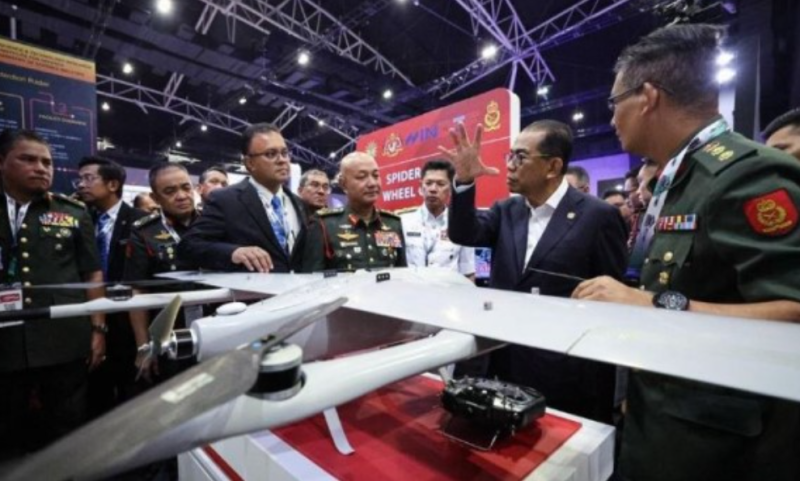
He was speaking after inspecting final preparations for the Defence Services Asia (DSA) and National Security (NATSEC) Asia 2026 exhibition at the Malaysia International Trade and Exhibition Centre in Kuala Lumpur today.
In a related development, Khaled confirmed that Iran had withdrawn from the exhibition at the last minute, attributing the decision to operational and logistical constraints arising from the ongoing conflict in West Asia.
“The country of Iran had initially expressed readiness to participate, but this time companies from that country withdrew due to the challenges they faced.
“If they want to move or send products, there are certainly difficulties, including issues related to the Strait of Hormuz and other matters that affect their logistics,” he said.
He stressed that the withdrawal was not politically motivated, but rather a reflection of practical difficulties in transporting assets under current conditions.
Despite global tensions, Mohamed Khaled said the DSA exhibition would remain a neutral platform focused on defence cooperation and industry engagement, rather than a forum for geopolitical disputes.
“We want all countries to see that peace can be achieved and conflicts can be ended as soon as possible.
“We do not make that issue an official subject in the forum because it could affect the negotiation processes currently taking place between the parties involved,” he said.
However, he acknowledged that ongoing conflicts inevitably feature in informal and closed-door discussions among defence leaders.
“In bilateral or closed meetings between ministers, deputy ministers and military leadership, these matters cannot be avoided.
“In addition to the desire to see peace, we also assess how current conflicts are being conducted and to what extent existing defence approaches remain relevant in an era of new technology,” he said.
The minister noted that modern warfare is increasingly shaped by evolving technologies and cost-effective strategies.
“We see many new technologies, but to face challenges from countries with advanced assets, the ability to produce assets quickly and at low cost is also important.
“We do not necessarily counter aircraft with aircraft; instead, the use of drones, rockets and missiles in large numbers is seen as a more effective approach,” he said.
He also defended the participation of companies from various countries in the exhibition, saying it did not contradict Malaysia’s position despite concerns linked to global conflicts.
“This is a trade exhibition and a neutral platform. We respect the views of all parties, but this event gives us the opportunity to evaluate and make decisions based on national needs.
“In the end, we may become buyers, and this platform allows us to compare and assess the available products,” he said.
The four-day DSA and NATSEC Asia 2026 exhibition is scheduled to begin on Monday, with Prime Minister Datuk Seri Anwar Ibrahim set to officiate the opening. - April 19, 2026