THE nation is under sustained pressure from a widening global supply shock that has moved beyond the energy sector to disrupt food prices, logistics, construction materials and employment conditions, Economy Minister Akmal Nasrullah Mohd Nasir said today.
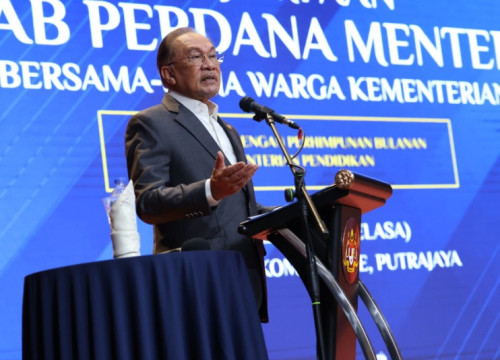
Speaking at the Global Supply Crisis briefing on Tuesday, he said the government is responding through phased, data-driven interventions supported by industry engagement and field assessments, with priorities focused on stabilising prices, securing energy and essential supplies, and strengthening long-term economic resilience.
Akmal said what initially appeared to be an oil supply disruption has now evolved into a broader systemic shock affecting multiple sectors.
“The country is facing increasingly complex global economic pressures. Initially, this crisis was seen as an oil supply issue. However, its effects have now expanded to supply chains, logistics costs, energy supply, industrial raw materials, agricultural inputs, food prices, the construction sector and the labour market.”
He outlined five immediate government priorities: stabilising energy and critical inputs such as fuel, electricity, petrochemicals and fertilisers; containing household cost pressures; ensuring continuity of key public projects; protecting employment and household incomes; and strengthening long-term resilience through energy security, food security and domestic supply chain development.
On global oil markets, he said volatility remained elevated despite some short-term easing, with Brent crude showing fluctuating movements in April 2026 amid ongoing supply uncertainty.
He cautioned that recovery from prolonged disruptions would not be immediate, particularly where infrastructure damage is involved.
“In the scenario of prolonged disruption, recovery of crude oil supply is expected to take 3 to 12 months, while damage to oil and gas infrastructure takes longer to restore.”
Despite external pressures, he said Malaysia’s equity market had shown resilience, with the FTSE Bursa Malaysia KLCI rising above pre-crisis levels, reflecting continued investor confidence in the country’s fundamentals.
However, he stressed that economic strength cannot be measured solely through financial markets.
“The true strength of the economy must be seen in the ability of households to manage daily spending, businesses to maintain operations, workers to retain jobs, and industries to continue receiving the necessary input supplies.”
On food inflation, he said most items remained broadly stable, although early cost pressures were emerging from upstream inputs such as fertilisers, diesel and logistics.
He said monitoring would be expanded beyond retail prices to include the full supply chain.
“Monitoring cannot only be done at the retail price level, but must start from the upstream level.”
Energy security remains a key concern, with electricity supply described as stable but exposed to global fuel price volatility due to Malaysia’s reliance on coal and gas.
As of April 2026, coal accounted for 54 per cent of the generation mix and gas 40 per cent, leaving the system highly sensitive to global market movements.
He said electricity generation costs were expected to rise in May following higher coal prices, but the government would take steps to cushion the impact on consumers.
He noted that 7.5 million domestic users, or 85 per cent of households consuming below 600kWh, would continue to be exempt from the Automatic Fuel Adjustment mechanism.
“Electricity supply in the country remains secure, but generation costs must be managed prudently.”
He urged households and businesses to adopt energy-saving practices to help stabilise demand.
The construction sector is also under pressure from rising diesel, bitumen and logistics costs, with industry data showing average increases of 12.59 per cent in key materials including aggregates, steel and bricks.
He said these cost pressures directly affect infrastructure delivery and contractor cash flow.
“The government takes this situation seriously because development projects are not merely figures in the budget. They involve roads used by the public, schools for children, and clinics for communities.”
He said mitigation measures are being implemented in phases, including engagement with financial institutions and support schemes to assist affected contractors.
On the labour market, he said job loss claims remained relatively stable, although delayed effects of the crisis are expected to become more evident in the second quarter of 2026.
Key affected sectors include manufacturing, services, ICT, hospitality and transport.
The government, he added, is strengthening social protection systems, retraining programmes, gig economy support and SME resilience initiatives.
On medium-term risks, Akmal said investment decisions are increasingly driven by energy security, supply chain resilience and operational stability, rather than low labour costs alone.
He said Malaysia retains strong structural advantages, including its strategic location, diversified industrial base and established electrical and electronics ecosystem, but these must be reinforced through coordinated policy execution.
He also highlighted visits to key facilities such as the Pengerang Integrated Complex to assess energy security and petrochemical supply chain stability.
The government is expanding biodiesel and biofuel initiatives to reduce import dependence and strengthen domestic energy resilience.
In agriculture, efforts are underway to stabilise fertiliser supply through diversification and increased production of bio-organic fertilisers, including the use of biomass and agricultural waste under a circular economy approach.
He concluded that while domestic indicators remain broadly stable, the full impact of the global crisis will emerge gradually across prices, jobs, infrastructure delivery and business operations.
“The government’s approach is to stabilise supply, control cost pressures, protect jobs, continue key projects that have direct impact on the people, strengthen domestic resources and maintain confidence in the national economy.” - April 28, 2026