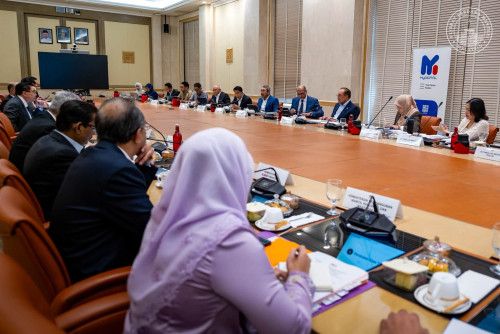
MALAYSIA has strengthened its renewable energy ambitions with the launch of two Large-Scale Solar (LSS5) projects in Pasir Mas, Kelantan, as the government pushes ahead with efforts to enhance energy security and accelerate the nation’s transition towards a low-carbon economy.
Deputy Prime Minister and Minister of Energy Transition and Water Transformation (PETRA) Datuk Seri Fadillah Yusof launched the solar projects involving Samaiden Legasi Timur Sdn Bhd with a capacity of 99.99 megawatts (MW) and GVU Fajar Timur with a capacity of 27.60MW.
Fadillah said the projects represented a significant milestone beyond electricity generation, reflecting investor confidence in Malaysia’s energy policies and demonstrating strong collaboration between the Federal Government, the Kelantan state government and the private sector.
He said the developments underscored Malaysia’s commitment to creating a sustainable, competitive and resilient energy sector.
"Today’s ceremony is not merely the launch of solar energy projects. It represents investor confidence in the country’s energy policies, a symbol of close cooperation between the Federal Government, the state government and the private sector, and proof that Malaysia is moving confidently towards a more sustainable and competitive low-carbon economy," he said.
Fadillah said the government would continue implementing the national energy transition agenda based on three key principles — energy security, affordability and sustainability — in line with the National Energy Transition Roadmap (NETR).
"The energy transition is not an option, but a strategic necessity to ensure national energy security, strengthen economic resilience, attract quality investments and fulfil Malaysia’s commitments towards the global climate agenda," he said.
He said Malaysia had achieved 31% renewable energy capacity in its installed electricity generation mix by December 2025, meeting the government’s earlier target.
The country has since raised its renewable energy ambitions, targeting 35% renewable energy capacity by 2030 and 70% by 2050. As of June 2026, renewable energy capacity had reached nearly 32%.
Highlighting the Pasir Mas solar projects, Fadillah said the developments had successfully completed key milestones, including receiving Letters of Notification from the Energy Commission, securing land lease agreements with the Kelantan Economic Development Corporation (PKINK), signing power purchase agreements with Tenaga Nasional Berhad, obtaining development approvals, procuring major equipment and achieving financial closure through financing facilities provided by Bank Islam Malaysia Berhad.
He said the progress demonstrated the strong commitment of all stakeholders to ensuring the projects were delivered according to schedule.
The projects are expected to contribute to Malaysia’s electricity supply while creating employment opportunities, stimulating local economic activity, strengthening supporting industries and generating wider benefits for communities in Pasir Mas and across Kelantan.
Fadillah said Kelantan had strong potential to expand renewable energy development, particularly solar power generation, due to its availability of suitable land, state government support and growing private sector participation.
"I believe Kelantan has the potential to further increase its renewable energy capacity, particularly solar energy for electricity generation. With suitable land, support from the state government and participation from the private sector, the state can play an important role in advancing the national energy transition agenda," he said.
He stressed that renewable energy projects must continue to prioritise safety, environmental protection, good governance and engagement with local communities.
Fadillah also encouraged households, mosques, other places of worship and commercial premises to adopt rooftop solar systems through PETRA’s Solar ATAP programme, which is available throughout Peninsular Malaysia.
He urged Kelantan residents to take advantage of the initiative to expand solar adoption at their respective premises.
"The success of projects such as this will serve as a catalyst for more green investments that can strengthen Malaysia’s position as a leading renewable energy development destination in the region," he said.
Fadillah said Malaysia’s energy transition required collective commitment from the government, industries and the public.
"Let us continue our efforts to build a cleaner, greener and more sustainable energy future for Malaysia. The success of the energy transition is not solely the responsibility of the government, but a shared responsibility among all citizens, industries and stakeholders," he said.
He expressed confidence that Malaysia could emerge as a regional leader in green energy development through sustained commitment and cooperation. - July 23, 2026