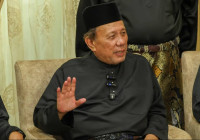
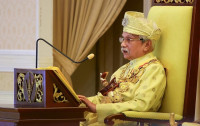
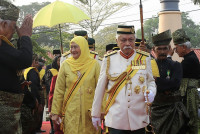
.jpg)
THE Negeri Sembilan executive council had no authority to declare the state’s Yang di-Pertuan Besar position vacant, the Attorney General’s Chambers said today, throwing fresh legal weight behind the dispute over the state throne.
The AGC said the Menteri Besar and the state Exco could not unilaterally terminate or vacate the position, adding that the validity and effect of the April 19 proclamation must be determined through the constitutional and legal processes set out in the Negeri Sembilan Constitution 1959.
It further said its preliminary view was that the proclamation itself was invalid as it did not meet the mandatory requirements of Article 10.
It added there was no evidence that any of the circumstances listed under Article 10(1) for the removal of the Yang di-Pertuan Besar applied to Tuanku Muhriz Tuanku Munawir.
While the Dato’-Dato’ Undang have the power to take action to remove the Yang di-Pertuan Besar, the AGC stressed they must first comply with the procedure and consider the grounds prescribed under Article 10.
“To date, there are no facts showing that the prescribed procedure has been complied with,” it said.
The AGC also raised questions over whether the Undang Yang Empat was properly constituted when the proclamation was signed.
It said the validity of several of the Undang who signed the proclamation was disputed because they had been removed according to adat in their respective luaks.
The Chambers then explained that this raised the issue of whether the composition of the Undang Yang Empat was complete at the time the proclamation was made.
It nevertheless stressed that it respected the position of the Dato’-Dato’ Undang and recognised that their appointment and removal were governed by the adat of their respective luaks.
The AGC pointed to Article 16 of the state constitution, which places questions concerning Malay customs — including the selection, appointment, resignation and removal of an Undang — under the jurisdiction of the Dewan Keadilan dan Undangan (DKU).
Under Article 16(3), its advice on such matters is final and cannot be challenged or questioned in court.
Against that backdrop, the AGC said the state executive council’s announcement had no legal effect.
It said the Exco members had no jurisdiction, authority or power under the state constitution to make the announcement and could not rely on the April 19 proclamation as its legal basis.
Any gazettement or other action to implement the proclamation would therefore be unlawful and unconstitutional, the AGC said.
The AGC also pointed out that the matter is already before the Seremban High Court, where an interlocutory injunction remains in force.
It urged all parties to respect the ongoing proceedings and allow the dispute to be resolved through the proper constitutional and legal process. – September 17, 2026