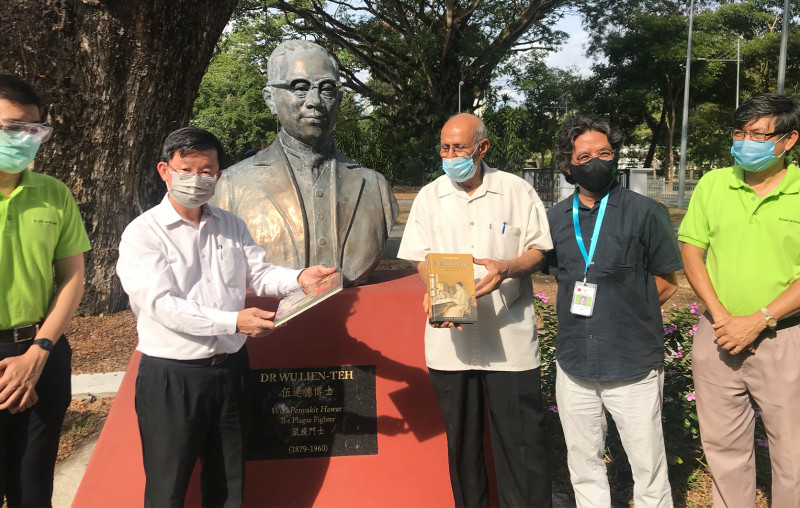
GEORGE TOWN – A resource centre and a herb garden will be set up in Penang to commemorate renowned physician Dr Wu Lien-Teh in his home state.
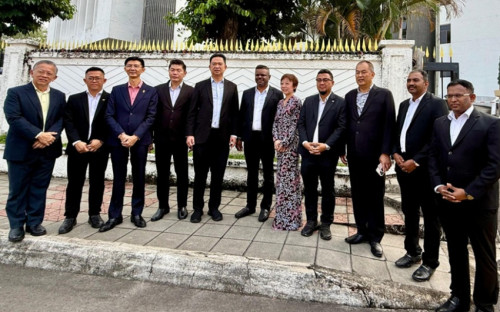
The Dr Wu Lien-Teh Herb Garden at Penang Institute was unveiled yesterday – in time for what would be his 142nd birthday – and serves as a home to the traditional medicinal shrub Senna alata, also known as “emperor’s candlestick”.
It was donated by Dr Wu Lien-Teh Society founder Khoo Salma Nasution and president Datuk Seri Anwar Fazal.
The resource centre, which is in the same location, will memorialise Dr Wu’s work and contributions, to inspire the next generation of doctors.
Once completed and opened to the public, visitors will be greeted by a bronze bask donated by China’s Hospital of Harbin Medical University to the people of Penang in 2013.
At the launch, Anwar highlighted Dr Wu’s life, saying he was the best student at Cambridge University, but subjected to racism.
“Because of the institutionalised racism, he could not be a full-fledged doctor, and was told he was only fit as a medical officer.
“He was later invited to China to tackle an unknown epidemic, and that was when he created the world’s first face mask.”
When Dr Wu returned to Malaya, he opened a small family clinic in Ipoh, distributing free medicine during the Japanese Occupation, and later, he returned to Penang, where stayed until his death in 1960, said Anwar.
“He is a great role model for all of us in Penang and Malaysia.
“If the younger generation is looking for a role model, he is the one.
“He was well known for his insights on Chinese medicinal herbs. And, we want to highlight this through the herb garden.”
In 1910, Dr Wu was appointed by the Chinese government to investigate an unknown outbreak in the country’s northwest.
He later identified it as the highly contagious pneumonic plague, which spread from human to human through respiratory transmission.
To combat the disease, he designed and produced a surgical mask with cotton and gauze, adding several layers of cloth as a filter.
He advised people to wear the mask, and worked with government officials to establish quarantine stations and hospitals, restrict travel, and apply progressive sterilisation techniques.
Dr Wu’s methods contributed greatly to the end of the Manchurian plague by April 1911 – four months after he was tasked with controlling its spread.
He was also Malaysia’s first Nobel Prize nominee, and an advocate of medical advancement.
In 1935, he was the first Malaysian, and the first person of Chinese descent, to be nominated for the Nobel Prize in Physiology or Medicine, for his work to control the plague.
His autobiography, Plague Fighter: The Autobiography of a Modern Chinese Physician, which took six years to complete, was published a year before his death.
Its second edition, published this year, was commissioned and funded by the Dr Wu Lien-Teh Society. – The Vibes, March 11, 2021



.jpeg)