
KOTA KINABALU – The Sabah Forestry Department assured that its carbon trading collaboration between the state and a private Singaporean company will never put Sabah’s Total Protected Areas (TPAs) in danger due to commercial exploitation or deforestation.
In a statement today, Sabah chief conservator of forests Datuk Frederick Kugan denied allegations made in an article by Mongabay recently that the TPAs involved in the trade would be placed under threat of mining, logging or industrial agriculture following an agreement made between the Sabah government and Hoch Standard Pte Ltd, a private Singaporean company.
“TPAs are areas already locked in for conservation and protection under various state laws and international treaties. As such, these areas were not, are not and will never be in danger of commercial exploitation or deforestation,” he said in a statement today.
He was responding to a news article published by a conservation website Mongabay on November 9 titled: “Bornean communities locked into 2-million-hectare carbon deal they don’t know about”.
It was reported that leaders in Sabah have signed a nature conservation agreement on October 30 which calls for the marketing of carbon and other ecosystem services to companies looking, for example, to buy credits to offset Sabah’s emissions.
The report also claimed that the deal would grant 30% of the profits to Australian and Singaporean companies, and that the agreement involving more than 2 million hectares (4.9 million acres) of forest was signed without participation from the indigenous communities.
Kugan said the agreement named the Nature Conservation Agreement (NCA) is neither complete nor binding.
“The state government has agreed to a provisional framework agreement with Hoch Standard Pte Ltd (HS), a private Singapore company. In exchange, HS has made several representations to the state government that it has access to financial networks which are capable of funding and realising the objectives of the NCA,” he said.
He explained that NCA’s main objective is to conserve and protect tropical rainforests through the monetisation of carbon stored in standing trees, in addition to natural capital benefits in the natural forest environment.
Among the issues under the NCA which have yet to be resolved:
- Designated area – the size and locality, of which is yet to be determined and approved by the state government.
- Addendum to the framework agreement which specifies that an initial area of 600,000 ha is to be identified as a pilot scheme first. Only upon the success of that pilot scheme will the state government consider approving such further areas as it deems appropriate (up to a potential total area of 2 million ha).
- Nature Conservation Management Plan – a plan that is acceptable to the state government over the pilot scheme area must be approved first before any carbon trading or sale of natural assets under the NCA can take place.
- Native customary rights and ownership – pre-existing native customary rights of ownership have previously been attached to certain TPAs. As these rights belong to native communities and not the state, consent from each respective native community is required before these rights are ‘signed away’ through the NCA.
- Carbon pricing and price discovery mechanisms agreeable to the state
- Independent oversight of the implementation of the NCA and, together with this, an objective performance assessment on the meeting of the intended goals – in particular those related to meeting the 17 United Nations Sustainable Development Goals.
- Safeguards to mitigate / avoid negative impact on current key economic sectors of the state.
- Safeguards to ensure that revenue gained from natural capital benefits are maximally leveraged for the long-term benefit of the people of Sabah.
- A satisfactory due diligence report on and confirmation of the truth and reliability of HS’s representations and capability.
Kugan said the NCA will be placed under the purview of the Sabah Climate Change Committee, a unit envisaged to be set up in the near future as announced by the chief minister of Sabah recently, to oversee all climate change-related projects, since natural capital requires cross-sectoral, multi-stakeholder coordination.
By virtue of being a frontrunner, the state government acknowledges that there is always an element of risk. However, the state government envisions great benefits from being a frontrunner in an era where the world is rushing towards a low carbon future.
“The state government will try its utmost to mitigate the risks but will not let the people down by shying away from being a front runner.
“The state government invites all stakeholders to engage and evaluate the government’s performance in relation to the implementation of the NCA. An appropriate mechanism for doing so will be developed,” Kugan said.
Jeffrey admits to having witnessed NCA signing
Earlier today, The Malay Mail reported that Deputy Chief Minister Datuk Jeffrey Kitingan said that the controversial carbon-trading deal involving two million ha of Sabah’s forests had gone through the state cabinet and was approved.
It was reported that Jeffrey, who was witness to the signing of the deal with third-party Hoch Standard on October 30, admitted it was not publicised, but that the NCA was supposed to be announced in January by the state government, and hence the low-key signing.
He was quoted saying: “There’s nothing to hide. It is not a tangible asset, so I think people don’t understand.”
Environmental and civil groups demanding details
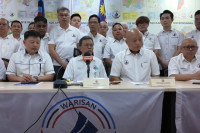
Earlier today, several Sabah environmental and social civil society organisations have called for an explanation from the Sabah government regarding the deal.
The group included the Bornean Sun Bear Conservation Centre, Borneo Rhino Alliance, Danau Girang Field Centre, Future Alam Borneo, Land Empowerment Animals People, Pacos Trust, Sabah Environmental Trust, Seratu Aatai, South East Asia Rainforest Research Partnership and WWF Malaysia.
“Approval of agreements at this scale cannot be done without technical review of the terms and a transparent process.
“There must be rigorous open tendering and evaluation processes that scrutinise candidates and options for partnerships to ensure they best align with interests of Sabah and Sabahans present and future,” they said.
They also argued that Sabah has the in-house capacity to manage and market its own carbon to the world without the need to share profits with external brokers.
“Signing such a deal will have implications for existing conservation, carbon and ecosystem service agreements that have been initiated by Sabah’s own institutions and longstanding partners.
“Many in the civil service, civil society and private sector have worked hard over the decades to build Sabah’s good work and reputation in conservation, and reputation underpins carbon prices and credibility.
“Regional or international entities doing due diligence to invest under this deal in Sabah will investigate these matters as part of verification under independent international standards such as Verified Carbon Standard.
“Any such agreement involving major public assets of state heritage, which the government holds in trust, must be entered into with the prior knowledge of its society and stakeholders. Decisions today will impact many generations,” the statement read. – The Vibes, November 12, 2021.